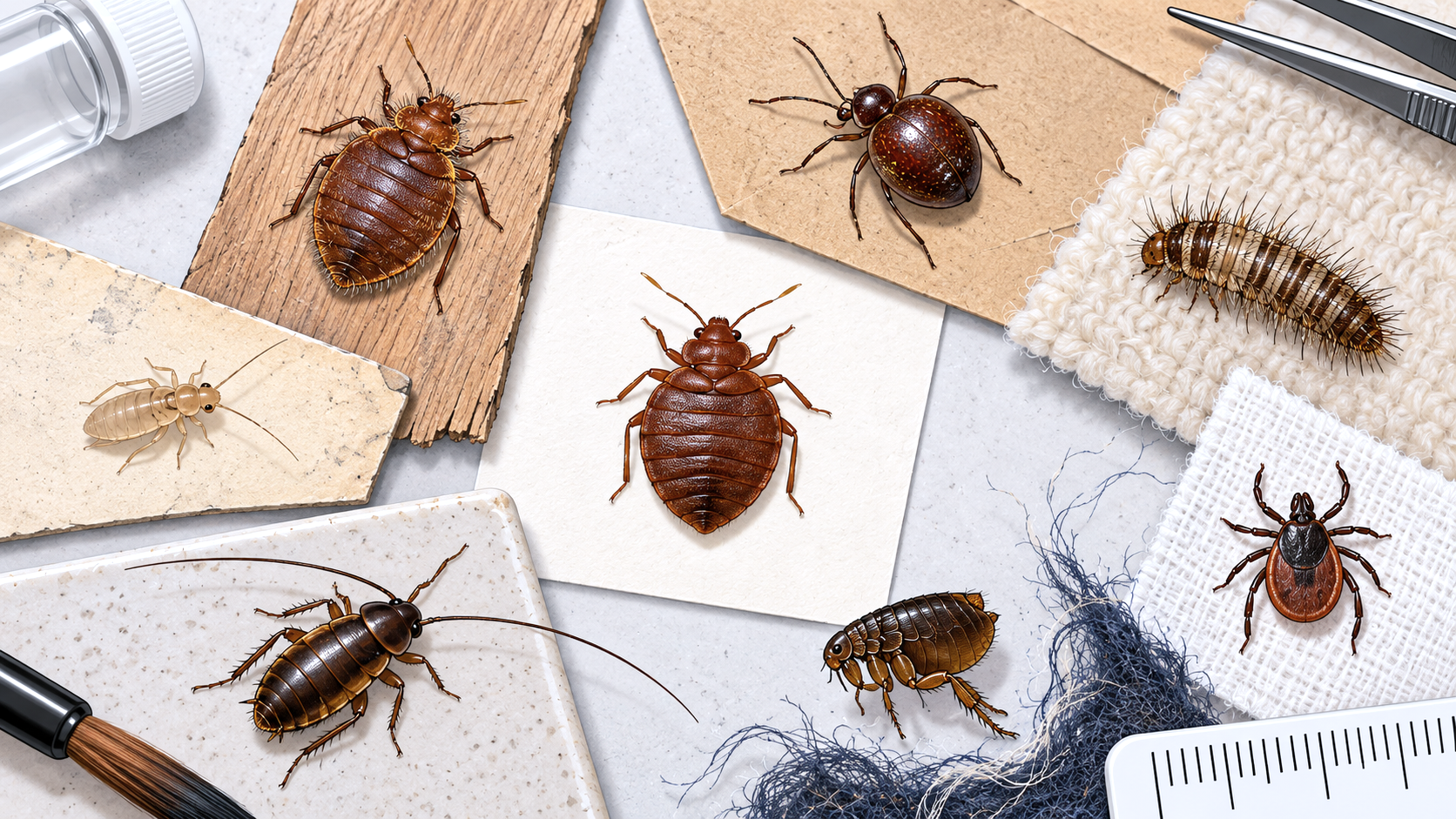
Finding a small brown bug near your bed does not automatically mean you have bed bugs. Beetles, cockroach nymphs, and even close relatives of bed bugs can be mistaken for them, but the right physical feature can often narrow the identification quickly.
Common bugs mistaken for bed bugs include bat bugs, carpet beetles and their larvae, drugstore beetles, spider beetles, and cockroach nymphs. Bat bugs are the difficult exception because they are extremely similar to bed bugs and can bite people. The others differ noticeably in body shape, hairs, wing covers, antennae, or legs once viewed clearly.
Before treating a room, identify the insect. The wrong identification can mean treating a bed when the real source is an attic, pantry, carpet, or another part of the home.
Bat Bugs Are Almost Identical to Bed Bugs
Bat bugs belong to the same insect family as bed bugs and are the look-alike most likely to require expert identification. The distinguishing feature is tiny. Bed bugs have hairs along the sides of the pronotum that are shorter than the width of the eye, while the corresponding hairs on bat bugs are as long as or longer than the eye is wide.
That difference is difficult to evaluate with the naked eye. Iowa State describes microscopic examination as necessary to confidently separate the two.
Their feeding behavior also makes this comparison different from the beetles on this list. Bat bugs normally feed on bats, but they can bite people and other warm-blooded animals when they leave a bat roost.
Location provides another clue. Bat bugs are associated with buildings containing bats, particularly areas such as attics and eaves. Finding a bed-bug-like insect alongside evidence of bats makes professional identification especially worthwhile because controlling the wrong host problem can waste substantial time and money.
Our bat bugs vs bed bugs comparison covers those identification differences in greater depth.
Carpet Beetle Larvae Are Hairy, Not Flat and Smooth
Carpet beetles can turn up in bedrooms, but their appearance and diet are completely different from those of bed bugs.
Adult carpet beetles vary considerably by species. Utah State University describes them as approximately 1/16 to 1/4 inch long, with coloration ranging from black to multicolored. Adults are frequently noticed around windowsills.
The larvae are even easier to separate from bed bugs once you get a close look. They are hairy, often tan to dark brown, and some appear banded or striped. Bed bug nymphs have the same general flattened bed bug body plan as adults and are not covered in the conspicuous bristles characteristic of carpet beetle larvae.
Those hairs matter for another reason. Some dermestid larvae have specialized hairs capable of causing irritation or allergy-related symptoms after contact. That can create an itchy skin problem without the insect actually biting or feeding on the person.
Carpet beetle larvae instead feed on susceptible materials such as wool, fur, feathers, hair, dead insects, and other animal-derived material, depending on the species.
If the insect is beetle-shaped, carpet beetles vs bed bugs is the more specific comparison.
Drugstore Beetles Have Hard, Grooved Wing Covers
A drugstore beetle, Stegobium paniceum, is small enough and brown enough to create confusion when seen without magnification.
Its shape gives it away. Penn State describes adult drugstore beetles as about one-tenth of an inch long, cylindrical, light to reddish brown, and humpbacked. Their hardened wing covers have distinct longitudinal grooves, and their antennae end in three enlarged segments.
Bed bugs do not have beetle-like hardened wing covers. Adults are broadly oval and flattened when unfed, with no functional wings.
The location of repeated sightings can provide another clue. Drugstore beetles infest stored foods, seeds, spices, pet food, and numerous other dried organic materials. Finding several of these small beetles should therefore trigger an inspection of stored products rather than an immediate mattress treatment.
A bedroom sighting is still possible because adult pantry beetles can wander away from their food source.
The exact identification differences are covered in drugstore beetles vs bed bugs.
Spider Beetles Have Long Legs and a Rounded Body
Spider beetles look unusual enough that their name is fairly descriptive.
University of Minnesota describes spider beetles as reddish-brown beetles with long legs and a spider-like appearance. Their rounded bodies and relatively long legs create a very different silhouette from the broad, flattened outline of an unfed bed bug.
They are stored-product pests rather than blood feeders. Different spider beetles can infest dried plant products and other stored materials, so repeated sightings point toward a food or organic-material source rather than a human host.
A clear view from above is particularly useful here. The long-legged, rounded beetle shape is difficult to reconcile with a true bed bug once both insects are viewed closely.
Our spider beetles vs bed bugs comparison focuses on those differences.
Cockroach Nymphs Have Longer Antennae and a Different Body Shape
Young cockroaches can be surprisingly small, and they lack the developed wings people often associate with adult roaches.
That can make a quick bedroom sighting confusing.
Cockroach nymphs generally have elongated antennae that extend conspicuously from the head. Their body proportions also differ from the broad, strongly flattened, oval form of an unfed adult bed bug.
Species matters because cockroach nymphs do not all have the same markings. For example, brown-banded cockroach nymphs can range from approximately 1/16 to 1/2 inch as they develop. (umn.edu)
A cockroach identification also changes what you inspect next. Roaches can establish persistent indoor populations but have different food, moisture, harborage, and control requirements from bed bugs.
If your specimen looks more roach-like, cockroaches vs bed bugs provides the closer comparison.
Don’t Diagnose Bed Bugs From One Trait
There is no single visual trick that reliably identifies every small brown insect found in a bedroom.
Instead, look at several features together: body shape, size, antennae, hairs, presence of hardened wing covers, and where the specimen was found.
Then inspect the surrounding area for independent evidence.
A genuine bed bug infestation can leave live bugs, pale eggs, shed skins, and dark fecal spotting around harborages. Checking the places bed bugs actually hide gives you much stronger evidence than assuming every brown insect found on a bed belongs to the same species.
Even professionals sometimes rely on magnification or expert identification for difficult specimens. University of Minnesota notes that many insects submitted as suspected bed bugs turn out to be something else and recommends having questionable specimens examined by an expert. (umn.edu)
That is particularly sensible for bat bugs, where the feature separating them from bed bugs may be microscopic.
Questions About Bugs That Look Like Bed Bugs
Can a bug look almost exactly like a bed bug and still bite me?
Yes. Bat bugs are extremely close relatives of bed bugs and can feed on people when their normal bat hosts are unavailable. That is one reason correct identification matters rather than assuming a near-identical specimen must be a bed bug.
Why am I finding tiny beetles around my bedroom window?
Adult carpet beetles are commonly found around windowsills and are attracted to light. Their presence there fits carpet beetles better than bed bugs, although the specimen itself should still be identified.
Can pantry beetles end up in a bedroom?
Yes. Finding one drugstore or spider beetle away from a pantry does not mean the bedroom is its breeding source. Adult stored-product pests can wander, so repeated sightings warrant checking dried foods and other susceptible materials elsewhere in the home.
Should I throw away my mattress if I find an unidentified brown bug on it?
No. A bug found on a mattress has not been identified simply because of its location. Capture the specimen if possible and confirm what it is before making treatment or disposal decisions.
12 thoughts on “Bugs That Look Like Bed Bugs: The Complete Identification Guide”