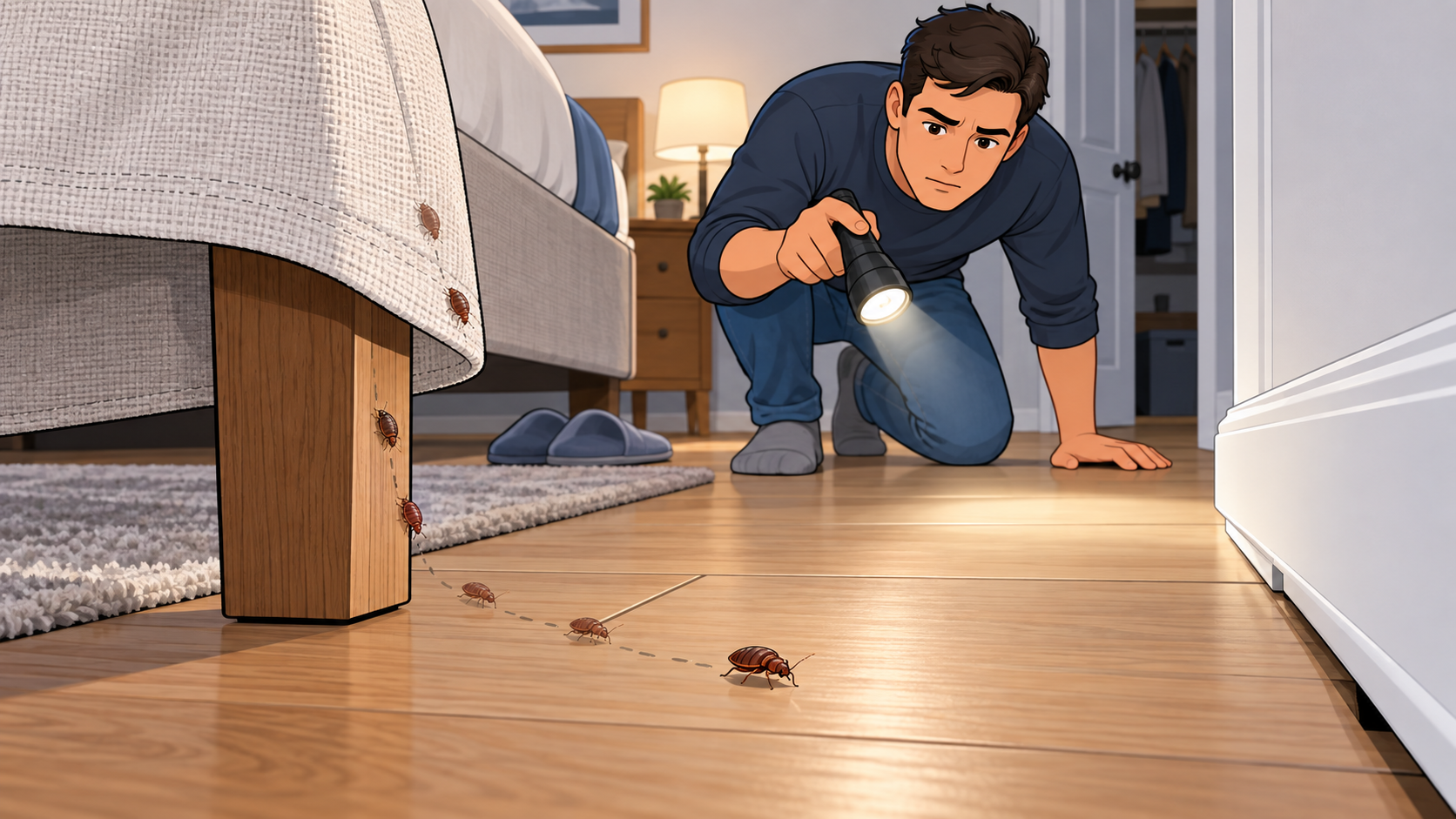
Bed bugs cannot fly or jump. They move by crawling and climbing, while longer-distance spread commonly happens when they hitchhike on luggage, clothing, furniture, bags, and other belongings. That distinction is useful when identifying an unknown bug. If you actually watched an insect jump or fly from the bed, it wasn’t a bed bug.
Why Bed Bugs Can’t Fly
Adult bed bugs are wingless. Ohio State University Extension describes them as having small, nonfunctional wing pads rather than functional wings, so they cannot take off or fly at any stage of their life cycle.
Those reduced structures don’t develop into working wings as the insect ages. A bed bug found high on a wall or ceiling therefore got there by climbing rather than flying.
Bed Bugs Can’t Jump Either
Bed bugs also lack the specialized legs that allow fleas to jump. Their six legs are adapted for walking and gripping surfaces, not launching their bodies through the air.
Fleas are very different. Their powerful hind legs allow them to jump, which is one of the quickest behavioral clues separating them from bed bugs. If a tiny insect visibly springs away when disturbed, a flea or another jumping arthropod is more plausible than a bed bug.
Bed Bugs Can Still Crawl Surprisingly Far
Being unable to fly or jump doesn’t keep bed bugs confined to a mattress. They can crawl across floors, furniture, walls, and other suitable surfaces while searching for hosts or new harborages.
Laboratory research examining bed bug movement and dispersal found considerable variation between individual bugs. Some remained near their starting position, while others traveled much farther during the observation period. Recently fed bugs were particularly likely to make longer movements in the study.
Those experimental measurements shouldn’t be converted into a fixed rule for how far every bed bug travels in a home. Temperature, feeding status, available shelter, host cues, and the surrounding environment can all affect movement. How fast bed bugs move depends on more than their maximum crawling ability.
Can Bed Bugs Climb Walls?
Yes. Bed bugs can climb many common household surfaces, including textured walls, wood, fabric, and paper. Their climbing ability depends heavily on the surface.
Research comparing common and tropical bed bugs found an important species difference. In one experiment, common bed bugs, Cimex lectularius, couldn’t escape four commercial pitfall-style traps, while tropical bed bugs, Cimex hemipterus, escaped all four. The tropical species had greater attachment ability on smooth surfaces.
This is relevant to bed bug interceptor cups, which rely on bugs crawling into a trap and being unable to climb back out. Interceptors can be useful monitoring tools, but their performance can vary with design, condition, and bed bug species.
How Bed Bugs Actually Spread
Bed bugs spread in two main ways: active crawling and passive hitchhiking.
Within a building, they can crawl away from established harborages and move through accessible gaps and openings into other areas. Research in apartment buildings has documented active dispersal between neighboring units, so a bed bug doesn’t necessarily need to be carried by a person to reach another room or apartment.
For longer distances, hitchhiking becomes especially important. Bed bugs can hide in suitcases, bags, clothing, furniture, boxes, and other movable belongings and be transported to entirely new buildings. This is how a crawling insect can travel hundreds or thousands of miles without ever flying.
Understanding how bed bugs spread from one place to another is therefore more useful than worrying about them jumping across a room.
Questions About Bed Bug Movement
Can bed bugs jump onto you?
No. They have to crawl onto you or onto something that eventually contacts you. They cannot leap through open air like fleas.
Can bed bugs fall from ceilings?
A bed bug can lose its footing and fall, but dropping from ceilings isn’t its normal method of reaching a host. Finding one on a ceiling means it climbed there.
Can bed bugs climb smooth surfaces?
Their ability depends on both the surface and species. Common bed bugs struggle with some very smooth surfaces, which is why appropriately designed pitfall interceptors can trap them.
Can bed bugs crawl between apartments?
Yes. Bed bugs can actively disperse between neighboring units where structural openings provide a route, while belongings and furniture can also transport them. Bed bug spread between apartments can therefore occur without jumping or flying.
7 thoughts on “Do Bed Bugs Fly or Jump? Here’s How They Really Get Around”