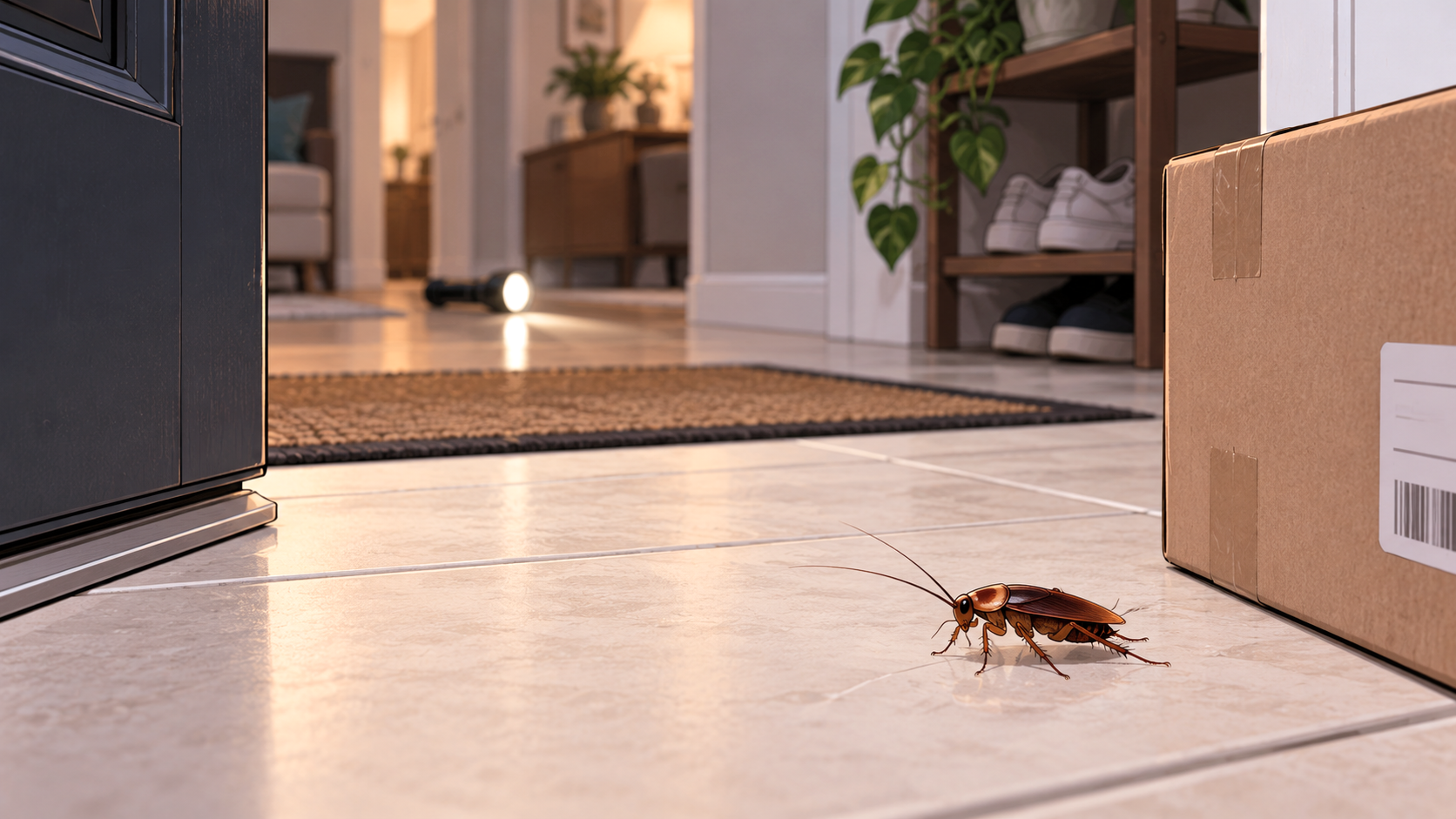
One cockroach gives you one confirmed fact: a cockroach reached that spot. It does not reveal, by itself, whether dozens more are nearby, whether the insect normally lives outdoors, or whether it arrived inside a box five minutes earlier. The useful information comes from identifying what you found and checking whether the sighting can be reproduced.
Finding one cockroach does not automatically mean you have an infestation, but it should not be ignored. A single German or brown-banded cockroach indoors is more concerning than an outdoor species that wandered inside. A nymph, egg-carrying female, repeated sightings, or additional cockroaches caught on monitors makes an established indoor population more plausible.
Start With the Cockroach, Not the Number
Species changes the meaning of a lone sighting considerably. German and brown-banded cockroaches commonly live and reproduce inside buildings, whereas several other types of cockroaches maintain outdoor populations and may enter structures temporarily. Outdoor species can invade buildings without establishing indoor populations, so counting every cockroach as equivalent produces unnecessary conclusions.
Wood cockroaches provide a particularly clear example. They can enter through doors and windows, arrive on firewood, or be attracted toward lights, yet wood cockroaches generally do not feed or reproduce indoors. One found near a doorway in a wooded setting can therefore have a very different explanation from a German cockroach collected beneath a kitchen refrigerator. If identification is uncertain, the insect’s body shape, markings, size, and wings are more useful starting points than assuming the worst from the sighting alone.
A Nymph Changes the Picture
An adult can enter a building from elsewhere. A small nymph deserves closer attention because immature cockroaches are less likely to be noticed during long-distance wandering, and species that reproduce indoors can produce several developmental stages within the same building. The appearance of baby cockroaches can also help distinguish a genuine nymph from a beetle, bed bug, or another small insect.
Location still matters. A German cockroach nymph beneath a kitchen appliance fits the normal indoor ecology of that species far better than an outdoor cockroach beside an open exterior door. Cockroaches transported in belongings can complicate the interpretation, however. Health Canada notes that cockroaches and their egg cases can be carried indoors on shipping cartons, used furniture, food items, and other objects. A recently delivered or moved item may therefore explain an isolated insect without proving that a resident population has already developed.
Where You Found It Can Narrow the Possibilities
A cockroach beside a stove, beneath a sink, behind a refrigerator, or inside a cabinet has appeared in habitat commonly used by indoor pest species. Food, moisture, warmth, narrow crevices, and undisturbed shelter can occur close together in these areas. Cockroaches are primarily nocturnal and may remain concealed for long periods, which allows indoor populations to escape notice.
An insect beside an exterior door, garage opening, basement entrance, or recently moved package has more potential entry explanations. Plumbing openings, structural gaps, doors, windows, and transported goods can all provide routes indoors. A cockroach near a drain likewise does not establish that it emerged through the pipe because the surrounding area may also provide moisture and hiding spaces. The circumstances that bring cockroaches into a house need to fit the location before an entry route can be assigned confidently.
One Sighting Is a Good Reason to Monitor
Searching frantically for a second cockroach immediately after the first disappears is not especially reliable. Low populations can remain concealed, and visual inspections become less effective when only a few insects are present. Strategically placed sticky traps are more effective for detecting low-level German cockroach activity and can show whether the original sighting was isolated or part of continuing movement.
Place monitors flush against edges where cockroaches naturally travel, particularly behind or beside appliances, beneath sinks, inside suitable cabinets, and close to the original sighting. Traps near exterior doors can also help distinguish invading outdoor cockroaches from activity deeper inside the building. Comparing catches from several trap locations is more informative than relying on one trap in the middle of a room. Keep the insects caught on the monitors identifiable rather than crushing them immediately, since species and life stage can change what the catch means.
Daytime Does Not Give You an Infestation Count
Seeing a cockroach in daylight is sometimes treated as proof that an infestation has become severe because every hiding place is supposedly full. Daytime activity can occur in substantial infestations, but the clock cannot tell you how many cockroaches are present. Harborage disturbance, movement between locations, environmental changes, or an outdoor insect entering during daylight can also produce an exposed cockroach.
Treat the timing as one piece of context rather than a population estimate. Actual monitoring provides better evidence because sticky traps can reveal the location and relative distribution of cockroach activity. If monitoring begins producing multiple insects, the situation has moved beyond interpreting the original sighting and into evaluating the evidence of an established cockroach infestation.
Questions That Become Relevant After One Sighting
What if the cockroach was carrying an egg case?
An ootheca attached to a female adds reproductive significance to the sighting, especially with an indoor pest species. Species handle their cockroach egg cases differently, so identification affects how much can be inferred from an attached case.
What if I cannot find the cockroach again?
Losing sight of it does not confirm or rule out anything beyond the original observation. Use monitors rather than repeatedly disturbing furniture and appliances, since traps can continue sampling activity while the room is quiet.
What if I find another cockroach several days later?
A second confirmed sighting makes an accidental one-off explanation less convincing, particularly when both insects are an indoor species and appear in the same area. Record where each insect was found and use traps to determine whether activity has a consistent center.
What if I live in an apartment?
The insect may originate within your unit or move from another part of the building. Cockroaches can travel through structural openings and utility penetrations, so cockroaches appearing in an apartment cannot always be interpreted as an isolated unit-level problem.