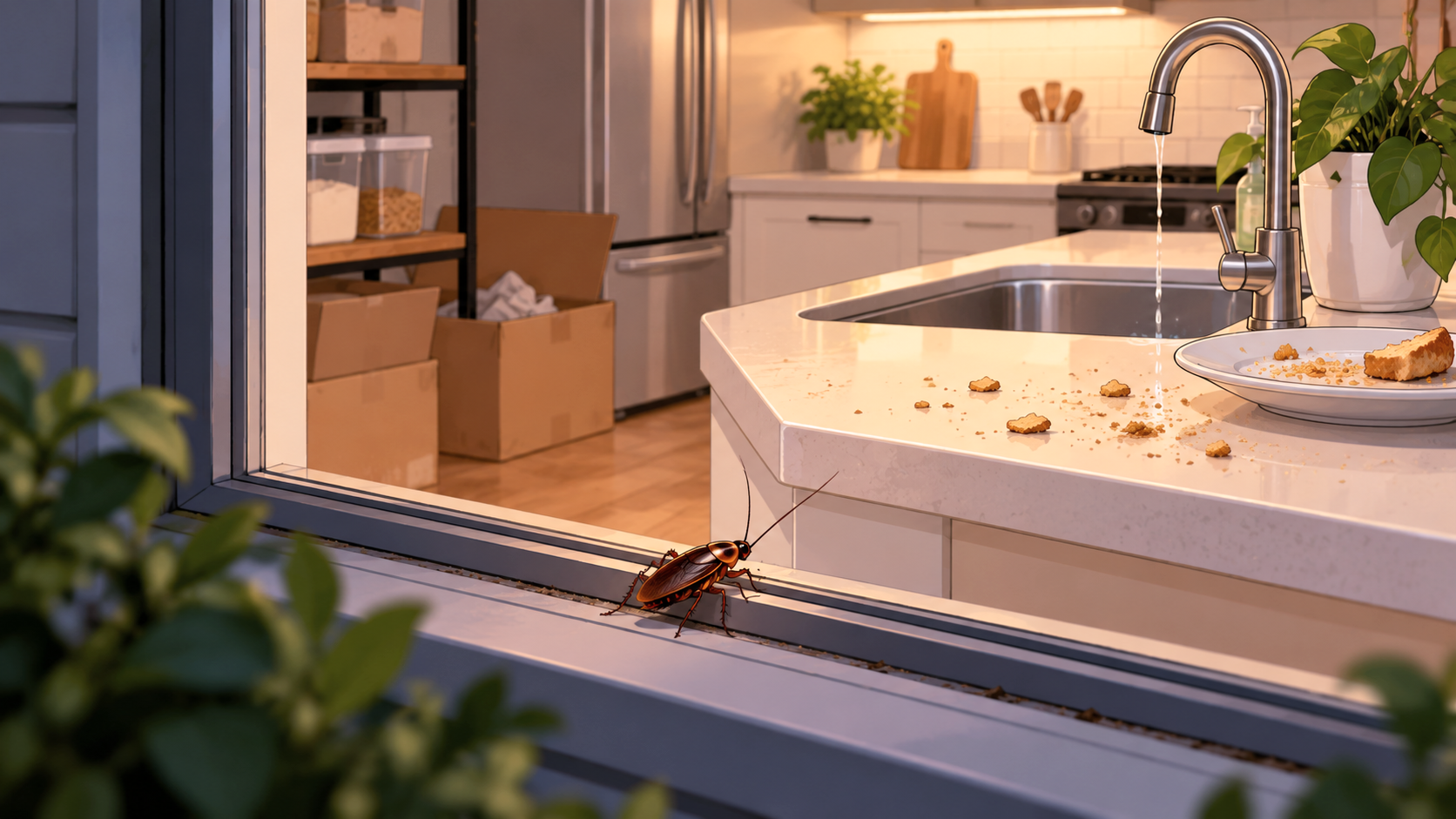
Cockroaches can appear in a spotless home, which is one reason their presence is so often misunderstood. Cleaning affects the resources available to them, but cleanliness does not control every route by which a cockroach reaches a building. Some walk in, some move between connected units, and others arrive hidden inside belongings.
Cockroaches get into houses through openings or are carried inside on items, then may remain where they can find suitable food, moisture, shelter, and warmth. Their presence does not necessarily mean a home is dirty. The species involved and the conditions inside determine whether an occasional arrival becomes an established infestation.
Arrival and Establishment Are Two Separate Events
Before cockroaches can exploit a house, they have to reach it. Cracks around doors and windows, utility penetrations, pipe openings, vents, drains, damaged screens, and other structural gaps can provide access. Sealing openings and other pest entryways reduces opportunities for insects to move indoors, but exterior entry is only part of the picture.
Cockroaches and their egg cases can also be transported. Shipping cartons, grocery items, used furniture, bottles, appliances, and other belongings can carry insects into a building. Health Canada specifically recognizes transport on household goods and packaging as a route into homes. Corrugated packaging is particularly useful as shelter because its folds and channels create concealed spaces, although the relationship between cockroaches and paper or cardboard involves more than simple attraction to boxes.
An insect arriving indoors still needs conditions that allow it to remain. A German cockroach transported into a building containing suitable resources can potentially establish there, while an outdoor species may wander inside and fail to reproduce. The ecological differences among common cockroach types make species identification an important part of explaining why one has appeared.
A Home Can Supply Food Without Having Food Lying Everywhere
Cockroaches are scavengers, and their usable food supply is much broader than an uncovered meal. Crumbs beneath appliances, grease beside a stove, residue in recycling, dirty dishes, garbage, spilled pet food, and particles caught in cabinet seams can provide feeding opportunities. Their broad omnivorous diet allows them to exploit small quantities from many sources rather than depending on one conspicuous food item.
A visibly clean countertop therefore says little about what exists behind a refrigerator or beneath a stove. Integrated pest management guidance recommends removing food residue and storing food and garbage securely because reducing accessible resources makes a building less supportive. It does not follow that finding cockroaches proves poor housekeeping. Health Canada explicitly notes that cockroach presence does not necessarily indicate unclean conditions.
A Small Moisture Source Can Be Enough to Matter
Indoor plumbing creates numerous places where moisture persists out of sight. Leaking pipe joints, condensation, appliance drip pans, wet cabinet surfaces, pet bowls, plant trays, and small plumbing leaks can provide water. Kitchens, bathrooms, basements, and plumbing areas frequently combine moisture with protected hiding spaces.
Removing these sources is a standard part of cockroach prevention. Public-health guidance recommends drying wet areas, repairing leaks, and reducing excess indoor moisture. Species differ in their tolerance of dry environments, so water availability should not be treated as a universal predictor of where every cockroach will occur. The physiological importance of water to cockroach survival also does not mean a visible puddle must be present.
The Best Hiding Places Are Easy to Overlook
A house contains thousands of narrow spaces that are irrelevant to its occupants but useful to a cockroach. Gaps along cabinets, appliance cavities, spaces around plumbing, wall penetrations, loose trim, clutter, cardboard, and cracks along baseboards can provide sheltered harborages. EPA indoor pest guidance recommends reducing clutter and closing cracks and crevices because removing shelter and access routes limits the spaces pests can use.
Cockroach anatomy suits this environment. Their flattened body profile allows them to occupy narrow crevices, and nocturnal activity can keep them out of view while people are awake. A population may consequently remain concealed long enough for the first visible cockroach to seem as though it appeared suddenly.
Apartments Add Routes That Detached Houses Do Not Have
A cockroach in an apartment may not have originated within that unit. Connected walls, utility penetrations, plumbing routes, hallways, and adjoining rooms create possible movement paths between units. Trapping research in apartment buildings documented German cockroach movement between neighboring apartments, with substantial movement occurring between adjoining kitchen areas.
This limits what cleaning inside one apartment can accomplish when insects continue arriving from elsewhere in the building. Effective multifamily control may require cooperation among residents, property management, maintenance staff, and pest professionals. EPA guidance for housing managers describes building-wide integrated pest management as a coordinated approach rather than treating each unit as completely isolated. Repeated cockroach activity in an apartment should therefore be considered in the context of the surrounding building.
The Species Can Reveal More Than the Room
Not every cockroach enters for the same reason. German cockroaches are strongly associated with human buildings and are commonly transported among them. Brown-banded cockroaches can occupy comparatively dry indoor areas. Oriental cockroaches favor cooler, damper environments, while various outdoor cockroaches may enter accidentally without becoming permanent residents.
Identification prevents the location from doing too much of the diagnostic work. An insect found near a door could be an outdoor visitor, while a German cockroach in the same position could have moved from an established indoor population. If only one insect has appeared, what a single cockroach sighting means depends heavily on species, life stage, location, and whether monitoring detects additional activity.
Questions That Help Explain How Cockroaches Got In
Can cockroaches come home with groceries?
Yes. Packaging and transported goods can conceal cockroaches or egg cases. Inspecting cartons, bags, and other items before storage can reduce the chance of bringing concealed insects farther into the home.
Can used furniture bring cockroaches into a house?
Yes. Furniture can contain seams, cavities, joints, and enclosed spaces where cockroaches or egg cases remain hidden. A careful inspection is especially worthwhile before bringing secondhand furniture indoors.
Does cold weather make cockroaches enter houses?
Some outdoor species may seek protected environments as conditions change, but major indoor pest species such as German cockroaches already depend heavily on heated buildings in colder climates. Seasonal outdoor invasion and a resident indoor population should not be treated as the same phenomenon.
Can cockroaches keep appearing after I remove their food?
Yes. They may still have access to overlooked food, moisture, shelter, neighboring units, or continuing entry routes. Once several forms of cockroach infestation evidence are present, correcting resources and access points becomes part of managing an existing population rather than simply preventing arrival.
4 thoughts on “Why Are Cockroaches in My House?”