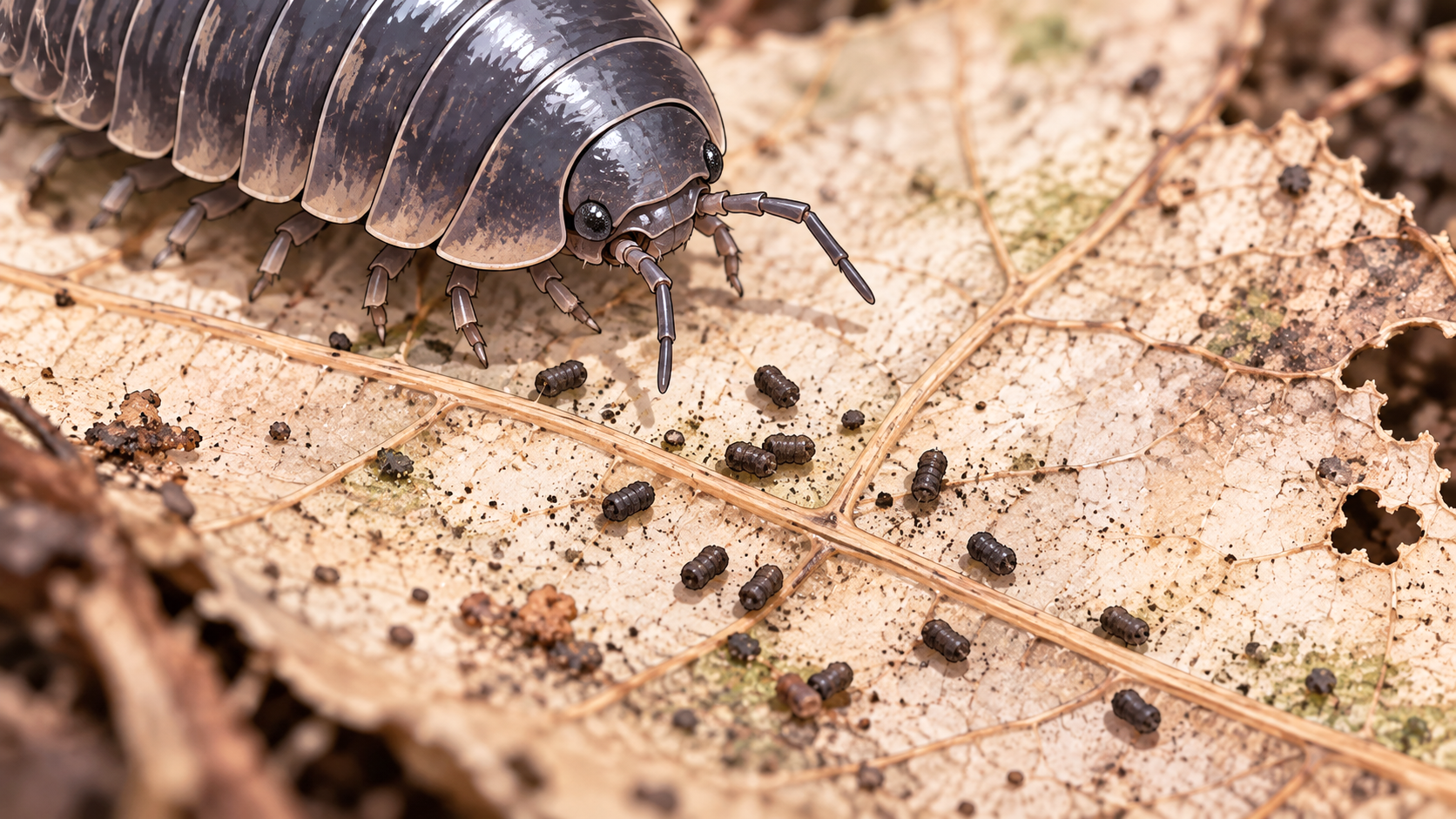
Roly-poly poop looks like tiny, dark brown or black pellets resembling miniature chocolate sprinkles. The droppings are usually short, cylindrical, or slightly rounded, with a granular appearance that makes them difficult to distinguish from soil particles. They are particularly noticeable against light-colored surfaces but often disappear visually into dark potting soil, decomposing leaves, and garden mulch.
The common roly-poly, Armadillidium vulgare, produces these pellets as it digests organic matter. Unlike the droppings of some household pests, roly-poly feces have no distinctive markings that allow reliable identification from appearance alone.
The Size, Shape, and Color of Roly-Poly Droppings
Individual fecal pellets are extremely small, commonly appearing as short, dark grains that require close inspection to recognize. Their shape resembles tiny cylinders with rounded ends, although pellets can break apart or become irregular after being disturbed. In classroom observations of live pill bugs, the droppings have been compared to miniature candy sprinkles, a useful visual comparison because of their short, compact form.
Color is influenced by the material passing through the animal’s digestive system. Roly-polies consume decomposing plant matter, including fallen leaves and softened organic debris, so their feces contain processed plant material. Brown and nearly black pellets blend particularly well with the substrates where these animals normally feed. Research examining the digestive anatomy of terrestrial isopods describes the specialized gut structures responsible for processing and eliminating this material.
There is no dependable universal pellet measurement that identifies every roly-poly species. The droppings of a small juvenile and those of a fully grown adult also differ in scale. A precise measurement should therefore be taken from an identified specimen rather than used as an independent species identification method.
Where Roly-Poly Poop Accumulates
Fecal pellets are deposited wherever roly-polies have been feeding or sheltering. Under natural conditions, this places them among decomposing leaves, damp wood fragments, and the upper layers of soil. They rarely form an obvious, isolated pile because surrounding organic debris conceals the individual pellets.
An enclosure containing several roly-polies provides a clearer opportunity to recognize their waste. Pellets gradually appear on the substrate surface, beneath pieces of bark, and around feeding areas. Researchers studying the feeding behavior of terrestrial isopods routinely separate fecal pellets from soil particles and uneaten leaves when measuring how much plant material the animals consume.
Some terrestrial isopods produce more conspicuous accumulations. Research on the desert isopod Hemilepistus reaumuri documented fecal pellets piled around burrow entrances. This behavior belongs to a burrowing desert species and should not be treated as the normal waste-deposition pattern of the common garden roly-poly.
How to Tell Roly-Poly Poop From Soil and Other Debris
The biggest identification difficulty is that roly-poly droppings resemble the material surrounding them. Dark grains of compost, crumbled leaves, and small fragments of decomposing wood can have similar shapes and colors. Some soil particles also retain a rounded appearance, especially after repeated wetting and drying.
Location alone cannot establish the source. Springtails found in potted plants frequently share damp organic substrates with isopods, while other decomposers contribute their own waste and fragmented plant material. A few dark pellets beneath a flowerpot therefore provide insufficient evidence to identify the animal responsible.
A more reliable approach is to observe a confirmed roly-poly in a clean, temporary container with a small piece of damp leaf litter. Place a light-colored surface beneath part of the container so newly deposited pellets are visible. Comparing those pellets with material found in the original habitat provides a direct reference without relying on photographs of unrelated pests. Return the animal to its original sheltered location afterward.
Does Roly-Poly Poop Need to Be Removed?
Roly-poly droppings are a normal component of decomposition. Their fecal pellets contain organic matter that microorganisms can continue processing, contributing to nutrient movement through the surrounding substrate. Research using fecal samples from terrestrial isopods also demonstrates how the material can be examined to investigate the animals’ diets.
There is usually no reason to remove individual pellets from ordinary garden soil. In a captive isopod enclosure, modest amounts can remain as part of the substrate’s organic material. Excessive accumulations of waste, spoiled food, or deteriorating substrate should be addressed through routine enclosure maintenance rather than attempting to collect every pellet.
For identification, freshly deposited droppings observed alongside a known roly-poly are much more informative than isolated dark specks. Without that association, appearance alone cannot reliably establish their origin.