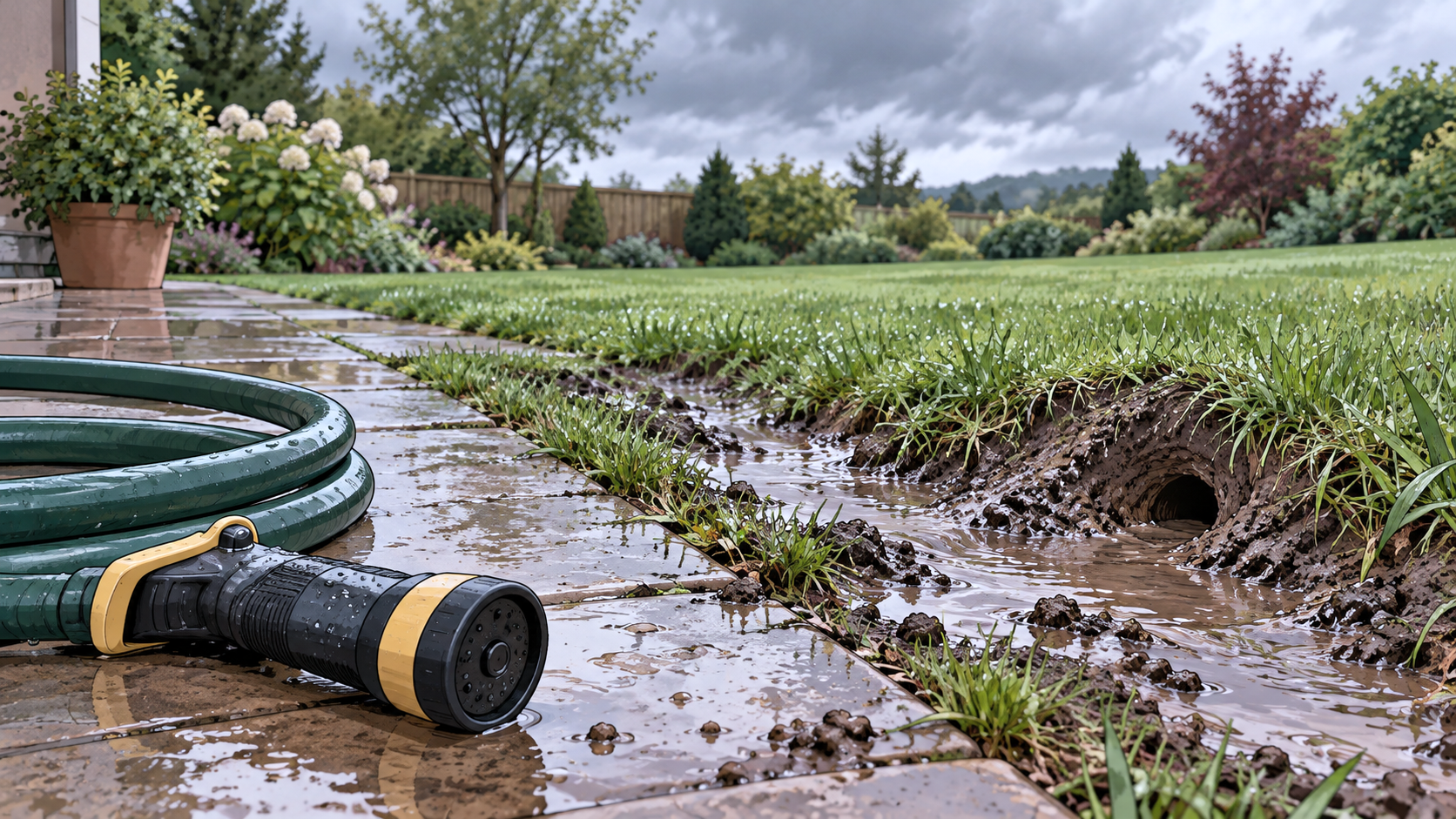
Flooding vole tunnels with a garden hose is not a reliable way to get rid of voles. Water may temporarily disturb an occupied burrow or cause an animal to leave through another opening, but it rarely reaches every passage or resting area. Much of the water can soak into the surrounding soil, and voles may continue using the location after it drains.
Flooding is particularly unreliable in landscaped yards because vole activity often involves a combination of shallow underground passages and surface routes through vegetation. Pouring water into one visible opening does not establish that the connected areas have been reached, much less that the animals have been removed.
Why Water Rarely Reaches Every Vole Tunnel
A garden hose delivers water into the ground, but the soil does not behave like a sealed pipe. Water can seep through tunnel walls, collect in low sections, or drain into the surrounding soil before reaching another occupied area.
The problem is compounded by the way voles use their surroundings. Meadow voles commonly travel along exposed or vegetation-covered surface pathways connected to shallow burrows. Woodland voles rely more extensively on underground passages. These differences in vole burrowing behavior affect where water may travel, but neither arrangement provides a dependable enclosed system that can be filled from one entrance.
A homeowner may see water disappear rapidly into a hole and assume it is spreading throughout the tunnels. The same observation could mean that the water is simply soaking into porous ground.
The openings and passageways associated with vole burrows also cannot be mapped reliably by watching where water enters. Even if it emerges from a second opening, other portions of the system may remain dry.
Flooding has been found ineffective for controlling both moles and voles. The apparent simplicity of the method does not overcome the difficulty of reaching animals distributed across multiple routes.
Can Flooding Force Voles Out of Their Holes?
Water entering an occupied space may cause a vole to move away, but forcing an animal to change location is not the same as controlling the population.
A vole that encounters rising water may retreat toward a drier passage, leave through another opening, or move into nearby vegetation. Meadow voles can also move through narrow surface runways concealed by grass, so they do not necessarily remain underground when conditions become unfavorable.
Seeing an animal emerge after flooding demonstrates only that it left the disturbed location. It does not establish whether other voles remain, whether the animal will return, or whether it has moved into another part of the yard.
Even if the original passage becomes temporarily unusable, surrounding vegetation may continue providing suitable food and shelter. Flooding landscape burrows is considered ineffective against voles, partly because their systems are shallow and contain numerous openings.
An animal may also be injured or trapped by deliberate flooding. The method should not be assumed humane simply because it uses water rather than a chemical pesticide.
Does Flooding Work Better in Clay or Sandy Soil?
Soil texture can influence what happens to the water without making flooding an effective vole treatment.
Sandy and other freely draining soils may absorb water relatively quickly, limiting how far it travels through an open passage. Heavy clay soils can drain more slowly, potentially allowing water to collect near the opening or spread across the surface.
Compacted ground, existing moisture, slope, and nearby drainage structures introduce further variation. Water may follow an unexpected route rather than travel toward the suspected nest.
The movement of water through soil depends on soil structure and pore spaces, not merely on the presence of an animal-made tunnel.
For these reasons, a water-filled entrance provides little information about how much of the surrounding ground has become saturated. Continued water flow also cannot demonstrate successful control.
Water and smoke treatments are seldom effective because they can be absorbed into the soil, making repeated flooding a poor use of water even before possible landscape damage is considered.
Can Flooding Vole Tunnels Damage Your Lawn or Garden?
Excessive watering can introduce problems unrelated to the original vole activity. Saturated soil contains less air in its pore spaces, which can interfere with root respiration. Prolonged waterlogging may weaken plants, particularly those growing in poorly drained ground.
Repeatedly directing a hose into the same opening can also wash loose soil from around roots, create muddy depressions, or encourage runoff across sloping ground. These outcomes are especially undesirable near newly planted shrubs, garden borders, and areas already weakened by underground feeding.
Poor drainage can contribute to root injury and plant decline in waterlogged soil, creating another possible cause of unhealthy vegetation.
Where a tunnel lies close to a foundation, retaining wall, paved surface, or drainage feature, adding large quantities of water may aggravate an existing moisture problem. A visible animal opening is not evidence that directing water into the ground is safe for nearby structures.
The recovery of lawns damaged by vole activity can be complicated by unnecessary saturation, especially where soil is already compacted or poorly drained.
Why Flooding Can Appear to Work at First
Flooding can produce immediate visible changes. Water may rise in a hole, a small animal may flee, or the entrance may collapse. None of those outcomes demonstrates that vole activity has stopped.
A collapsed opening may simply prevent observation of the original passage. Nearby routes can remain usable, and another opening may become visible later. Likewise, a temporary absence of sightings is not especially informative because voles frequently remain concealed within vegetation.
The uncertainty is greatest when flooding is attempted without confirming that the opening belongs to a vole. Moles and voles produce different patterns of lawn disturbance, and some small holes belong to unrelated animals.
One animal leaving a hole cannot establish how many remain nearby. Nor can an area of wet ground establish that any animal was present when the water entered.
If fresh feeding damage or newly used runways appear after the soil dries, the underlying activity clearly has not been resolved. A temporarily wet or collapsed opening should never be treated as proof of eradication.
What Works Better Than Flooding?
Where voles are causing meaningful damage, management is more effective when directed at the conditions sustaining their activity and the particular plants requiring protection.
Dense grass, weeds, spreading groundcovers, and excessive mulch can provide the concealment voles need. Reducing ground-level shelter through vegetation management can make exposed lawn areas less favorable without attempting to force water underground. The food and shelter conditions that attract voles to yards may persist long after a tunnel has dried. Consequently, flooding a burrow does not address the resources that support continued activity.
For valuable plants, properly installed hardware-cloth barriers can provide more direct protection. Where active damage justifies additional intervention, the appropriate options depend on the species, property conditions, and local wildlife and pesticide regulations.
Not every vole sighting requires population reduction. Their numbers can fluctuate naturally, and some lawn damage recovers without extensive intervention. When activity repeatedly affects the same planting area, a targeted yard-management approach is more defensible than repeatedly filling holes with water.
Should You Flood an Active Vole Hole Before Closing It?
No. There is no established benefit to deliberately saturating an occupied passage before closing its entrance. Water can disturb an animal without ensuring that it has escaped, and wet soil may collapse over an occupied section.
A hole should not be assumed abandoned merely because no animal is visible. Closing an active passage without understanding what occupies it can create unnecessary animal-welfare concerns.
If the opening is causing a lawn-maintenance problem, determine whether it remains active before deciding what restoration is appropriate. The long-term prevention of recurring vole activity depends more on surrounding conditions than on whether an individual entrance remains visible.
Flooding offers no reliable confirmation that a passage is empty. It introduces water into the soil while leaving the underlying questions of occupancy and continued activity unresolved.