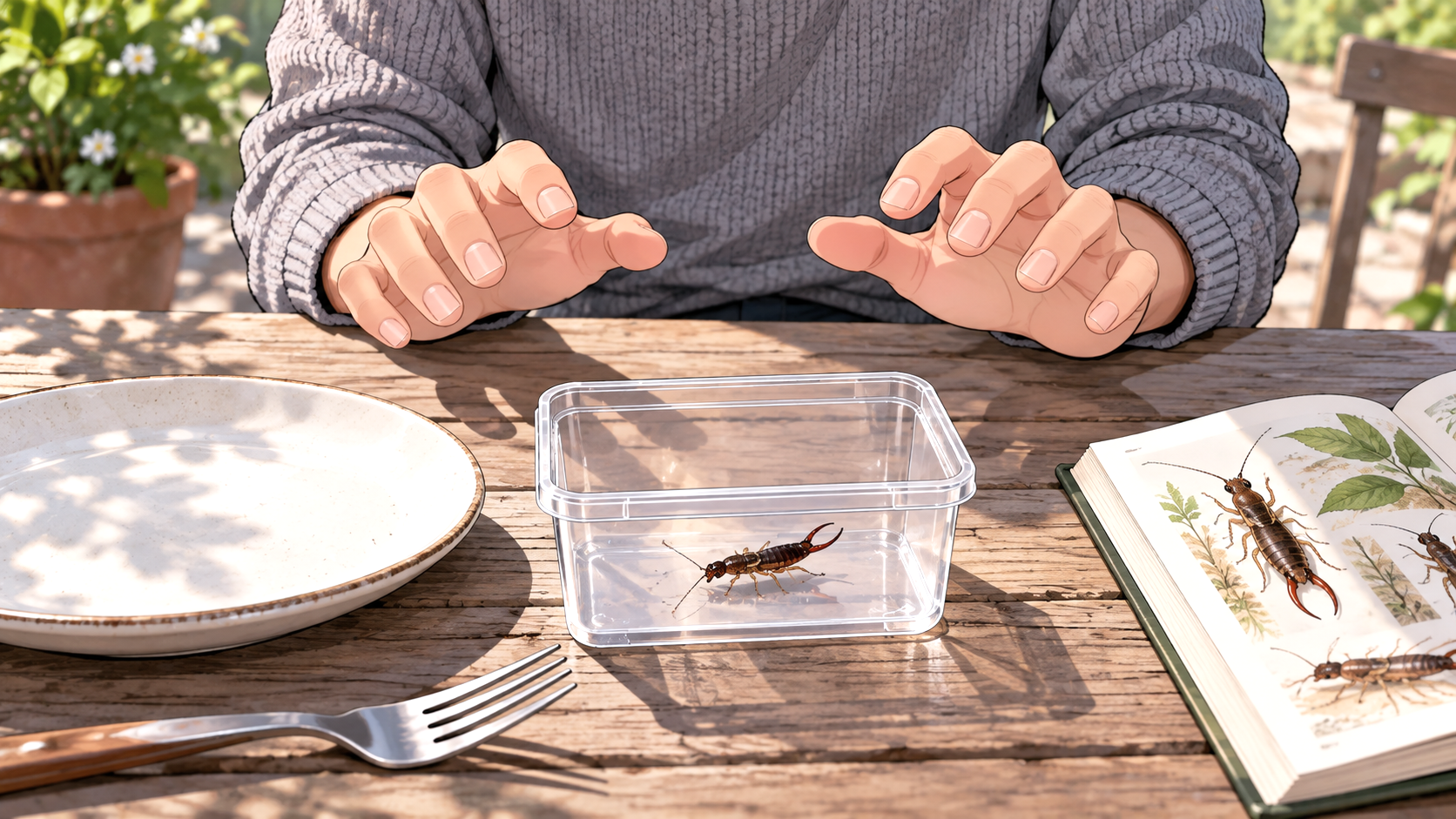
Earwigs are not generally considered poisonous insects, and there is limited documentation of humans consuming them. However, a wild earwig found in a garden, kitchen, or household crevice should not be considered safe to eat. It may carry microorganisms, pesticide residues, or other contaminants acquired from its surroundings. There is also insufficient earwig-specific research to establish reliable food-safety standards, nutritional values, or preparation requirements.
Eating insects is an established practice in many cultures, but that does not make every insect suitable for consumption. The safety of an edible insect depends on its species, how it was raised or collected, what it encountered, and how it was processed. Earwigs found around homes do not meet the controlled conditions associated with insects raised for human food.
Have People Actually Eaten Earwigs?
There is some published evidence of earwigs being consumed, although they are exceptionally uncommon in documented human diets.
A 2024 study published in Scientific Reports, The Global Atlas of Edible Insects, compiled records of 2,205 insect species consumed across 128 countries. It identified just one species belonging to Dermaptera, the order containing earwigs, within the family Forficulidae.
The study did not establish that the familiar European earwig (Forficula auricularia) is commonly eaten, nor did its main findings provide earwig-specific preparation practices or safety assessments.
This contrasts with better-documented food insects such as crickets, grasshoppers, certain beetle larvae, and caterpillars. The Food and Agriculture Organization’s work on edible insects describes established insect-consumption traditions, particularly in parts of Africa, Asia, and Latin America.
The limited number of documented earwig food uses should not be interpreted as evidence that all earwigs are toxic. It indicates that their use as human food is poorly characterized compared with insects that have established culinary histories.
Nor does one recorded edible species establish the suitability of the more than 2,000 recognized earwig species. Their diets, habitats, and chemical exposures vary, and species-specific food-safety information cannot be generalized across the entire order.
Are Earwigs Poisonous if Swallowed?
Earwigs are not known to contain a characteristic poison that makes accidental ingestion inherently toxic to humans. Their abdominal pincers are physical appendages rather than venom-injecting structures, and the familiar European earwig is not classified as a medically important venomous insect.
Health Canada describes earwigs as not directly harmful to people, although that assessment concerns ordinary encounters rather than intentional consumption.
An absence of known venom does not establish that an insect is food-safe. Toxicity can arise from substances acquired through the environment, including insecticides applied to gardens, contaminated surfaces, or other hazardous materials.
An earwig discovered in a location treated with household pesticide is particularly unsuitable for consumption. Its exposure history cannot be determined by inspecting its appearance, and an insect that remains alive after contacting a chemical may still carry residues.
Likewise, an earwig does not become safe merely because it looks clean, has no odor, or shows no sign of disease.
The practical concern is therefore less about a known earwig-specific poison and more about the absence of controlled food production and testing.
Why Wild Earwigs Are Not Food-Grade Insects
Food-grade insects are produced or collected under conditions intended to control hazards associated with their diet, surroundings, processing, and storage. A wild earwig offers none of those assurances.
Earwigs frequently occupy soil, decaying vegetation, damp crevices, and other environments where microorganisms and environmental contaminants may be present. Their usual hiding places beneath debris and outdoor objects create opportunities for contact with materials that would not be acceptable in controlled food production.
The FAO’s review of wild-harvested and reared edible insects identifies significant differences in food-safety hazards according to collection, rearing, and processing methods.
Several concerns are especially relevant to earwigs collected around homes.
Microbial Contamination
Insects can carry microorganisms on their external surfaces or within their digestive systems. Some of these organisms are harmless, but environmental exposure can introduce bacteria or fungi of food-safety concern.
A review of microbiological and chemical hazards associated with insect foods found that contamination depends partly on the substrates insects encounter and the conditions under which they are processed.
An earwig crawling over a dirty floor, compost pile, or decaying material could acquire microorganisms from those environments. Its presence on a food-preparation surface should therefore be treated as a possible contamination event rather than an indication that it is suitable for eating.
The particular pathogens present on an individual earwig cannot be determined without testing. It would be inaccurate to claim that every wild earwig carries a dangerous infection, but equally inaccurate to assume that none do.
Pesticide and Chemical Residues
Garden and household pesticides create a separate hazard because earwigs may contact treated plants, soil, or structural surfaces.
An insect collected from a pesticide-treated area cannot be considered safe simply because the pesticide application occurred several days earlier. Chemical persistence differs among ingredients and environmental conditions.
The scientific review of contaminants in insects intended for food and feed identifies pesticide residues and environmental pollutants as potential concerns.
Normal appearance does not reveal whether a wild insect has accumulated or contacted a hazardous substance. Washing may remove some surface material, but it cannot reliably eliminate absorbed chemicals.
Unknown Feeding History
Wild earwigs eat a wide variety of organic material, including plants, other arthropods, and decomposing matter.
Their opportunistic feeding does not automatically make them dangerous, but it introduces uncertainty about what they have consumed. Food-insect production systems control feed partly because contaminants or allergens originating in the diet may affect the final product.
An individual earwig’s feeding behavior around indoor organic material offers little basis for determining its suitability as human food. Knowing that an insect eats plant matter or smaller insects does not establish that its body is free from contamination.
Can Cooking Make an Earwig Safe to Eat?
Cooking can reduce many microbial hazards, but there is no validated household cooking method that establishes the safety of wild earwigs.
Research on edible insects generally supports the value of suitable heat processing. A review published in Food Control found that boiling, frying, and roasting can substantially improve the microbiological safety of insects intended for food.
However, those results concern the species and procedures evaluated in the literature. They do not establish a recommended cooking temperature, preparation time, or validated food-safety process for earwigs.
Heat also has limitations. It does not reliably eliminate pesticide residues, heavy metals, or every possible environmental contaminant.
A second concern is allergic proteins. Cooking may alter their structure, but heat treatment does not consistently remove the potential for an allergic reaction.
The European Food Safety Authority’s evaluation of insect-derived foods emphasizes that safety assessments consider microbiology, composition, processing, and allergens together.
A wild earwig should therefore not be regarded as safe after washing, boiling, roasting, or frying. The absence of a validated preparation standard makes such experimentation unnecessary.
Could Eating an Earwig Cause an Allergic Reaction?
Potentially, although earwig-specific food-allergy evidence is limited.
Some insects contain proteins capable of triggering allergic reactions, particularly in people sensitized to certain other arthropods. Research involving commercially studied edible insects has identified cross-reactivity with crustaceans and house dust mites.
For example, the European Food Safety Authority’s assessment of yellow mealworms found that mealworm proteins could trigger allergic reactions in susceptible individuals, including some people with crustacean allergies.
A separate systematic review of edible-insect allergy risks identified tropomyosin and arginine kinase among proteins involved in potential cross-reactivity.
These findings justify caution, but they should not be presented as proof that earwigs have the same documented allergenicity as mealworms or crickets. The necessary earwig-specific testing has not been established.
People with shellfish or dust-mite allergies have particular reason to avoid experimenting with unfamiliar insects as food. An allergic reaction can also occur in someone without a previously recognized insect-food allergy.
Cooking does not guarantee that an allergenic insect protein becomes harmless. The FDA’s food-allergy guidance identifies breathing difficulties, throat swelling, and other severe symptoms as potential signs of anaphylaxis requiring emergency treatment.
Are Earwigs Nutritious?
Earwigs contain animal tissues that include protein, fat, and other biological components, but their exact nutritional composition has not been adequately established for routine human dietary use.
It would be inappropriate to assign European earwigs a specific protein percentage or calorie value based on data from crickets, mealworms, or grasshoppers.
Different insect species vary considerably in nutrient composition, and measurements can change according to development, feeding conditions, and laboratory methods.
The FAO recognizes edible insects as potential sources of protein and other nutrients, but those broader nutritional benefits do not establish that earwigs are a worthwhile or safe source of human nutrition.
Even if an earwig contained a useful concentration of protein, its small body size would make the practical nutritional contribution of an individual insect negligible.
A nutritional claim would require species-specific chemical analysis and an assessment of the safety of the material being consumed. Without those measurements, describing earwigs as a high-protein food would be speculative.
What if You Accidentally Swallow an Earwig?
Accidentally swallowing a single earwig does not automatically mean serious illness will follow. Earwigs are not known for injecting venom during ingestion, and an isolated accidental exposure is different from deliberately eating insects collected from unknown environments.
However, the circumstances of exposure matter. An insect contaminated with pesticide or another hazardous substance may create a different risk from one accidentally swallowed outdoors.
If the incident has already occurred, remove any remaining insect material from the mouth and rinse with water. Do not induce vomiting. Observe for symptoms such as persistent vomiting, unusual abdominal pain, or signs of an allergic reaction.
If pesticide contamination is possible, contact a poison control service for advice. In the United States, Poison Control can provide guidance based on the suspected substance and circumstances.
Difficulty breathing, throat swelling, faintness, or other symptoms of a severe allergic reaction require emergency medical attention.
The situation is also different when an insect is discovered in prepared food before anyone has eaten it. The sensible response is to remove the contaminated food rather than intentionally consume the insect or assume the surrounding food is unaffected.
The presence of earwigs around human food and kitchen storage does not establish that the insects are edible themselves.
Is There a Reason to Eat Earwigs Instead of Other Edible Insects?
There is little practical reason to choose wild earwigs as food when better-studied edible insect species are available through legitimate food suppliers.
Crickets, mealworms, and certain locusts have substantially more research concerning human consumption, composition, processing, and allergy risks. Their status as food products still depends on the species, producer, and applicable regulations, but their safety profiles are much better documented than those of earwigs.
The FAO’s work on controlled insect rearing emphasizes the role of production conditions in developing insect foods. Controlled rearing cannot eliminate every hazard, but it allows much greater oversight than collecting insects from gardens or houses.
Earwigs also perform ecological functions in outdoor environments. Many consume aphids and other small invertebrates, and the Royal Horticultural Society recognizes their beneficial predatory activity.
Their role in gardens provides no evidence that they should be harvested for consumption. Similarly, the variety of earwig species found worldwide makes it inappropriate to generalize from limited documentation of one consumed species to every earwig.
For a person interested in eating insects, food-grade products from appropriately controlled and legally compliant suppliers offer a better-supported option than wild-collected earwigs. The limited evidence of historical consumption does not justify treating an insect found beneath a flowerpot or inside a house as a safe snack.