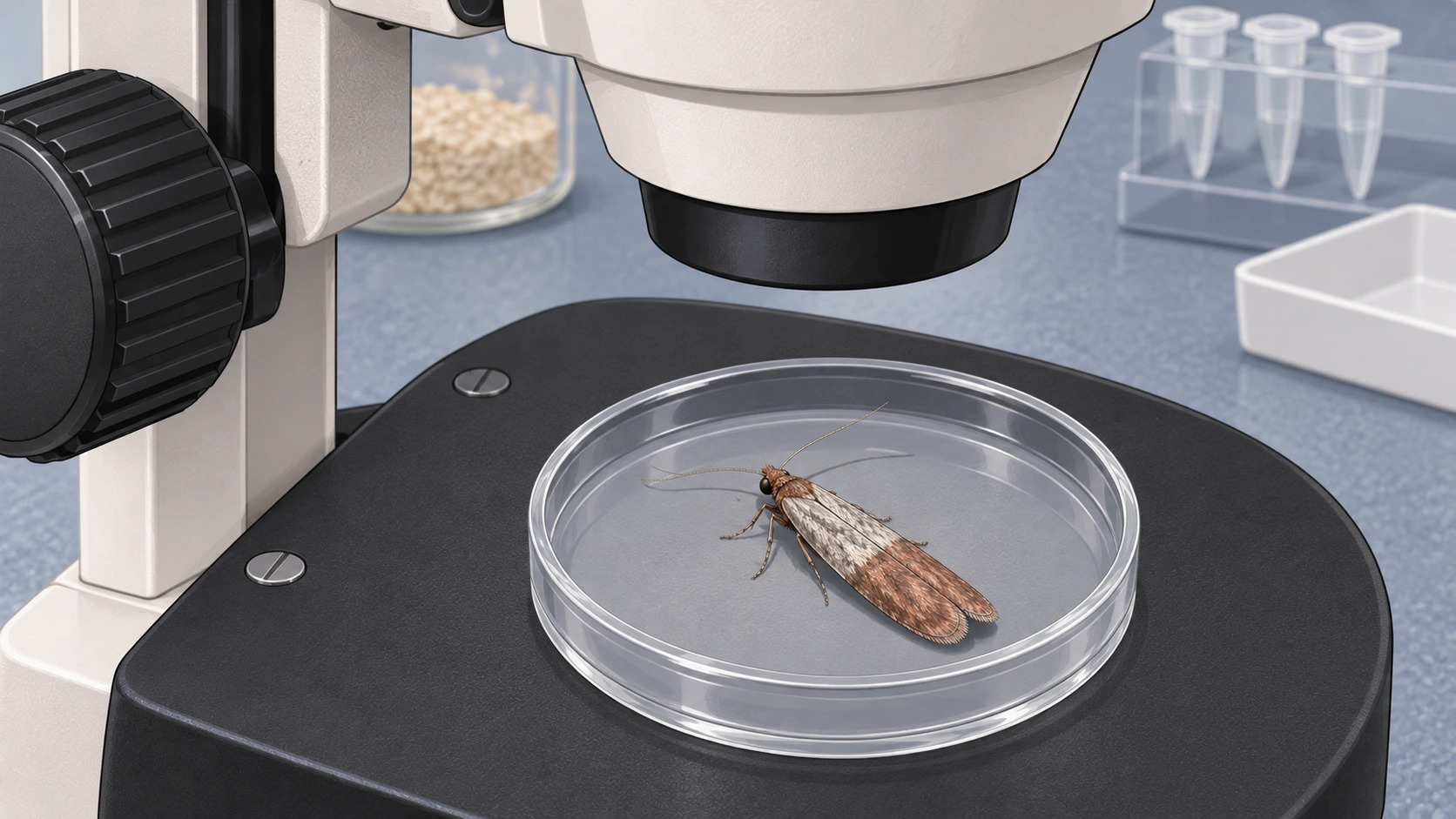
The scientific name of the Indian meal moth is Plodia interpunctella. Its full scientific citation is Plodia interpunctella (Hübner, 1813), recognizing Jacob Hübner, the entomologist who originally described the species. The name identifies the same stored-food moth commonly found in household pantries, regardless of variations in how its everyday name is written.
The two words Plodia interpunctella form the species’ scientific name. The author and year in parentheses provide historical information about the original description. They are not additional words in the species name.
Older publications sometimes use other scientific names for this moth. Those names can be legitimate historical synonyms rather than references to different insects. Understanding the original name and the correct formatting makes it easier to recognize the species across modern identification resources and older pest literature.
What Does Plodia interpunctella Mean?
Plodia interpunctella is a two-part scientific name, also called a binomial.
Plodia is the genus name. It begins with a capital letter and identifies the genus in which the Indian meal moth is currently classified.
interpunctella is the specific epithet. It is written in lowercase and, together with the genus name, identifies the species.
The two words must be read together. Plodia alone is a genus designation rather than the full name of the Indian meal moth. Likewise, interpunctella by itself does not supply the complete scientific name.
This distinction matters when searching scientific records. Entering the complete binomial is usually the most direct way to find information about the exact insect.
The accepted name is recorded as Plodia interpunctella in the Catalogue of Life taxonomy presented by GBIF. That record also connects the accepted name with historical combinations and synonyms.
Scientific names do not depend on the language used by a homeowner or the country where an insect is found. A reference using “Indianmeal moth,” another using “Indian meal moth,” and a scientific paper using Plodia interpunctella can all be describing the same species.
The broader identification and significance of the Indian meal moth are separate from the rules governing its scientific name.
How Do You Write the Indian Meal Moth’s Scientific Name Correctly?
The standard form is:
Plodia interpunctella
The genus begins with a capital P, while the species epithet starts with a lowercase i. Both words are conventionally italicized.
If the author’s name and year are included, the correct presentation is:
Plodia interpunctella (Hübner, 1813)
Only the genus and species epithet are italicized. The author, comma, year and surrounding parentheses remain in ordinary type.
These are established conventions for writing zoological scientific names, which help readers distinguish taxonomic names from surrounding text.
When italics are unavailable, as in some plain-text databases or labels, the name may appear as Plodia interpunctella. That is still recognizable, although italics are preferred in formatted scientific and educational writing.
After the full name has been introduced, it can be shortened to P. interpunctella when the genus is unambiguous.
The shortened form is particularly useful in technical writing that mentions the species repeatedly. In a homeowner guide, however, writing “Indian meal moth” is often more readable than repeating the abbreviation.
Common Formatting Mistakes
Some variations are merely presentation differences, while others are spelling errors.
| Written form | Is it correct? | Explanation |
|---|---|---|
| Plodia interpunctella | Yes | Accepted two-part scientific name |
| Plodia interpunctella (Hübner, 1813) | Yes | Full name with author and year |
| P. interpunctella | Yes, after context establishes the genus | Accepted abbreviation |
| plodia interpunctella | Incorrect capitalization | The genus should begin with a capital letter |
| Plodia Interpunctella | Incorrect capitalization | The species epithet should be lowercase |
| Plodia interpunctata | Incorrect spelling for this species | A known misspelling, not the accepted epithet |
| Plodia interpuntella | Incorrect spelling | The spelling omits a letter from interpunctella |
The practical value of correct spelling is straightforward. Search databases and research tools may recognize some misspellings, but using the accepted form reduces the chance of retrieving incomplete or unrelated results.
Who First Named the Indian Meal Moth?
The name is attributed to Jacob Hübner, a German entomologist whose work on moths and butterflies included the original description of this species.
The standard authorship citation is (Hübner, 1813).
That information is retained in modern taxonomic references, including the Natural History Museum’s species record.
The year identifies the date conventionally associated with the species’ original scientific description. It is not the year the moth first appeared in the world, nor does it establish when people first encountered it in stored food.
Some specialist catalogs display the date as [1813], while others provide a publication interval such as [1810–1813]. These differences concern the dating of Hübner’s original work rather than the identity of the insect.
For ordinary educational writing, Plodia interpunctella (Hübner, 1813) is a clear and accepted form.
Why Is Hübner’s Name in Parentheses?
The parentheses indicate that the species was originally described under a different genus.
Hübner did not originally publish the combination Plodia interpunctella. The original combination was Tinea interpunctella.
The species was subsequently placed in the genus Plodia. Under zoological naming conventions, the original author’s name and date are enclosed in parentheses when a species is combined with a genus different from the one used in its original description.
The International Commission on Zoological Nomenclature explains this authorship rule as a way to show that the genus assignment has changed.
The parentheses therefore do not express doubt about Hübner’s authorship. They preserve information about the history of the scientific name.
It is also important to distinguish the species author from the person who established its current genus. The genus Plodia is attributed to Guenée, 1845, while the species epithet interpunctella retains Hübner’s original authorship.
That is why the full species citation uses Hübner’s name rather than replacing it with the author of the genus.
What Was the Original Scientific Name?
The Indian meal moth was originally described as Tinea interpunctella Hübner, 1813.
This is known as the original combination, or basionym in some taxonomic databases.
The species epithet interpunctella was retained when the insect was placed in Plodia. What changed was the genus used with that epithet.
The historical name is preserved in the Natural History Museum’s Global Lepidoptera Names Index, which records Tinea as the original genus and Plodia as the current genus.
This is a useful distinction when reading older books or digitized scientific papers. A historical document using Tinea interpunctella is not necessarily describing a different moth from a modern document using Plodia interpunctella.
It also explains why the current genus and the original species author can have different dates attached to their taxonomic histories.
What Other Scientific Names Have Been Used?
Several historical names are associated with the Indian meal moth. Some arose when the species was placed in different genera. Others were names later treated as referring to the same species.
The following examples appear in established taxonomic synonymy records.
| Historical scientific name | Authorship commonly recorded | Relationship to the accepted name |
|---|---|---|
| Tinea interpunctella | Hübner, 1813 | Original combination |
| Phycis interpunctella | (Hübner, 1813) | Later genus combination |
| Ephestia interpunctella | (Hübner, 1813) | Later genus combination |
| Tinea zeae | Fitch, 1856 | Historical synonym |
| Plodia castaneella | Reutti, 1898 | Historical synonym |
| Unadilla latercula | Hampson, 1901 | Historical synonym |
| Ephestia glycinivora | Matsumura, 1917 | Historical synonym |
| Plodia americana | Piutti, 1920 | Historical synonym |
These entries are supported by the synonym list associated with the accepted species in the Catalogue of Life data accessible through GBIF. The list is selective rather than a complete account of every published spelling, recombination or taxonomic treatment.
A synonym is not automatically an error. In taxonomy, it can be a previously published scientific name that is no longer the accepted name for the species.
The distinction is especially important for older pest-control literature. You might find a historical experiment, species description or stored-product insect record under a name that does not appear in a modern household identification guide.
The current scientific name is still Plodia interpunctella.
Are Historical Synonyms Different Species?
Not when the names are being used as synonyms for Plodia interpunctella in the relevant taxonomic treatment.
For example, Tinea zeae Fitch, 1856 is listed as a synonym of the Indian meal moth. A reference using that historical name can therefore concern the species now called Plodia interpunctella.
However, the fact that two scientific names appear in the same historical discussion does not prove they are synonyms. Scientific identification depends on the actual names and the accepted taxonomic treatment.
It would be incorrect to assume that every species once placed in Tinea, Ephestia or Plodia is an Indian meal moth. Those genus names have been applied to many different taxa.
We recommend checking an unfamiliar historical binomial against a modern taxonomic database rather than relying on a shared genus or a similar common name.
Is Plodia interpunctella Still the Accepted Scientific Name?
Yes. Plodia interpunctella remains the accepted scientific name in major taxonomic and identification references.
The current NCBI taxonomy record identifies the species under that name and records Tinea interpunctella as its original name.
The same accepted binomial is used by the Entomological Society of America and the Canadian Grain Commission, among other entomological references.
The existence of synonyms does not mean the accepted scientific name is unsettled. It reflects the historical development of how the insect was described and classified.
Different databases may display a slightly different selection of synonym names or dating conventions. That does not create a reason to abandon the accepted two-word name.
For general identification and contemporary research searches, Plodia interpunctella is the appropriate starting point.
Does the Scientific Name Help Avoid Confusion With Other Moths?
Yes. Its main benefit is precision.
Several moths associated with stored products have similar everyday names, and common labels may be used loosely. The binomial Plodia interpunctella identifies one species without depending on those informal distinctions.
For example, an article about whether pantry moths and Indian meal moths mean the same thing needs to distinguish a broad household term from a species-specific name. The scientific binomial provides that distinction.
The alternative name “mealworm moth” can also refer to the Indian meal moth, but that does not change its scientific identity.
Scientific names are especially useful when matching a specimen with an identification reference, reading a research paper or verifying whether a product’s pest list includes the insect you have found.
They do not, by themselves, confirm that a moth photographed in your home belongs to the named species. The insect still has to be identified from appropriate evidence. A name is precise only when it is applied to the correct specimen.
That is why adult Indian meal moth identification features remain relevant even when you know the scientific name.
What Is the Difference Between the Scientific Name and Its Classification?
Plodia interpunctella is the species-level name. Its broader classification places the species within other taxonomic groups, such as a genus, family and order.
Knowing the scientific name is not the same as understanding every level of that classification.
For this question, the important distinction is that Plodia is the genus and interpunctella is the species epithet. Together they form the accepted binomial.
The order and family classification of the Indian meal moth provides the broader taxonomic context without changing how the species name should be written.
Likewise, the historical origin of the common name “Indian meal moth” is a different naming question. Its everyday name and scientific binomial have separate histories.
The Correct Name to Use
For a species label, research reference or educational article, use Plodia interpunctella.
When full taxonomic authorship is relevant, write Plodia interpunctella (Hübner, 1813). Italicize the genus and species epithet, capitalize only the genus, and keep the author’s name and year in ordinary type.
Historical names such as Tinea interpunctella and Tinea zeae may appear in older sources, but they do not replace the accepted modern name.
For most homeowners, remembering the two words Plodia interpunctella is sufficient. They provide an exact scientific reference for the Indian meal moth and help separate a confirmed species identification from the less precise names used in everyday conversation.