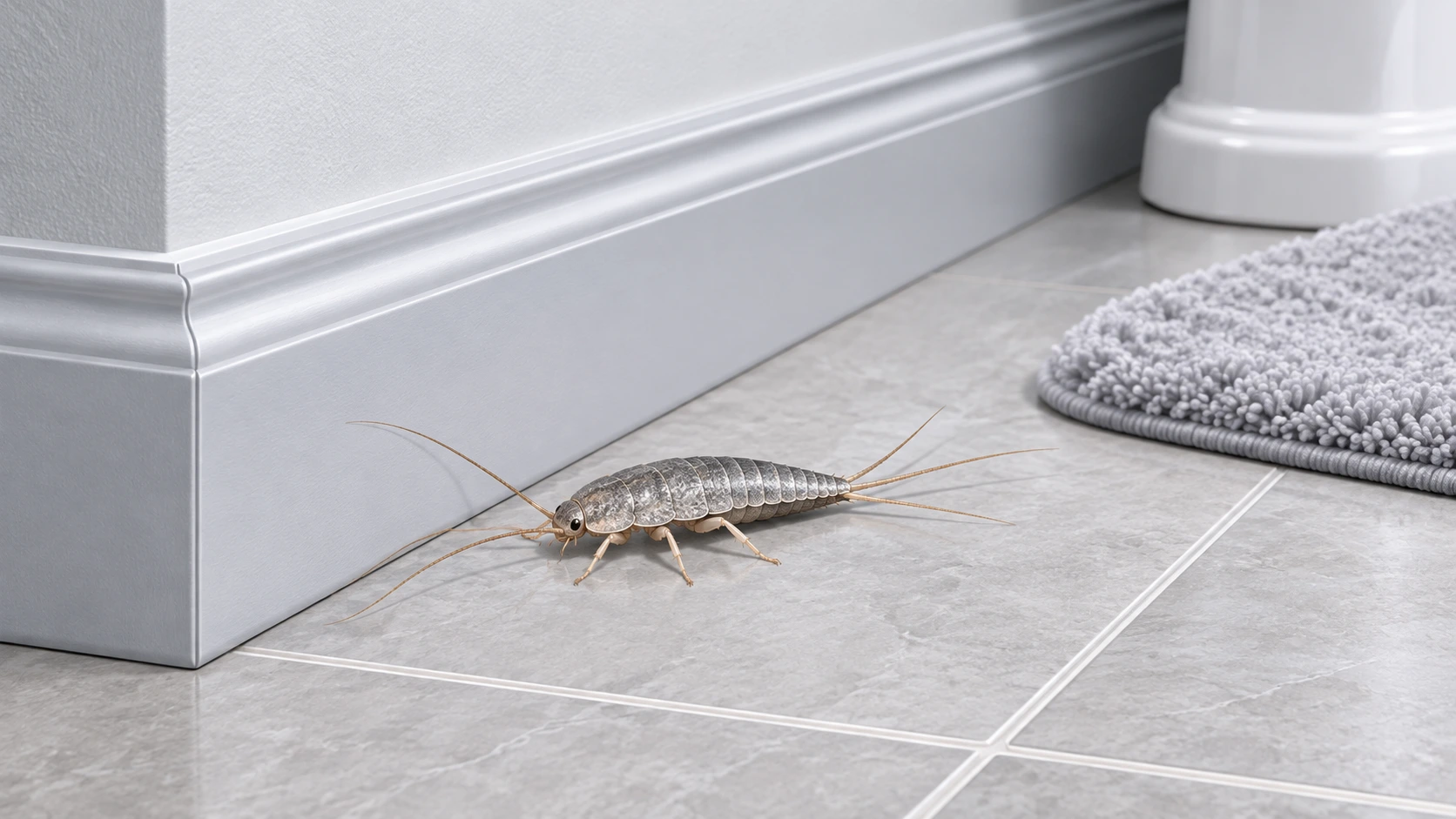
Silverfish are not recognized as established vectors of human diseases. Although bacteria can be associated with the bodies and internal structures of some silverfish, there is no documented evidence establishing that these insects transmit human infections inside homes. Finding one crawling across a countertop, bathroom floor, or bookshelf is therefore not evidence that you have been exposed to a disease.
There is a biological qualification worth understanding though. Research discussing the long-tailed silverfish (Ctenolepisma longicaudatum) describes the isolation of several bacterial genera from collected specimens. However, the findings included in that publication came from previously unpublished research, and direct transmission from silverfish to a human host had not been recorded.
Do Silverfish Carry Bacteria on Their Bodies?
Silverfish can encounter microorganisms while moving through household environments. Their bodies may come into contact with dust, organic debris, food residues, and other material containing bacteria.
The potential for microbial carriage has received some scientific attention, particularly regarding the long-tailed silverfish. A published study examining the increasing occurrence of this species in European buildings discussed bacterial associations involving specimens collected for investigation.
The paper identified reports of Staphylococcus, Acinetobacter, Bacillus, and Kocuria bacteria associated with the exoskeleton and internal structures of Ctenolepisma longicaudatum. However, the bacterial isolation results cited in that discussion were unpublished data from another researcher at the time of publication.
The 2021 research on long-tailed silverfish in European buildings raised the possibility of mechanical bacterial dispersal but did not establish human infections caused by silverfish.
This finding should not be extended to every silverfish species. The common silverfish (Lepisma saccharinum), long-tailed silverfish, and other members of the group should not automatically be assigned identical microbial associations.
Which bacteria have been associated with silverfish?
The bacterial genera mentioned in the research have different characteristics and environmental distributions.
| Bacterial genus | General characteristics | What the silverfish evidence establishes |
|---|---|---|
| Staphylococcus | Includes species commonly found on human and animal skin, as well as some opportunistic pathogens | Reported isolation from examined long-tailed silverfish specimens |
| Acinetobacter | Includes environmental bacteria and opportunistic human pathogens | Reported association with examined specimens |
| Bacillus | Includes widespread soil and environmental bacteria, with some species having medical significance | Reported association with examined specimens |
| Kocuria | Includes bacteria commonly encountered in environmental and skin-associated settings | Reported association with examined specimens |
The presence of a bacterial genus is not enough to determine whether the organism is harmful. Individual species and strains can differ substantially in their ability to cause disease.
For example, finding a bacterium belonging to Staphylococcus does not establish that it is Staphylococcus aureus. Similarly, the identification of Acinetobacter does not establish that a disease-causing strain is present.
Without species-level identification and evidence of a relevant exposure, the health significance of a bacterial association cannot be established.
Can Silverfish Spread Diseases to Humans?
Silverfish are not established human disease vectors. Their presence in homes is primarily associated with nuisance activity and damage to susceptible household materials.
A biological vector carries an infectious agent and contributes to its transmission between hosts. In some cases, the microorganism must develop or multiply inside the insect. Other insects can spread microorganisms mechanically when contaminated material is transferred from their bodies to food or surfaces.
The CDC’s explanation of biological and mechanical disease transmission describes these different routes and explains why microbial carriage alone is insufficient to establish vector status.
Silverfish have not been established as transmitters of recognized human infectious diseases through either mechanism.
This does not require assuming that their bodies are always sterile. It means that the available evidence does not establish an actual silverfish-to-human disease transmission pathway.
Could silverfish mechanically spread bacteria?
Mechanical transmission is biologically possible for some insects. A microorganism may adhere to an insect’s external structures or be transferred through contaminated material.
However, the presence of bacteria on an insect is only an initial part of that process. Establishing meaningful transmission would require evidence that the microorganism moves from the insect to another surface or person under relevant conditions and remains capable of causing infection.
The long-tailed silverfish research discussed this possibility but did not document direct human transmission.
Consequently, describing silverfish as proven mechanical vectors would overstate the findings. The research supports a question about potential microbial carriage, not a demonstrated household disease risk.
Do silverfish spread Salmonella or E. coli?
There is no established evidence identifying ordinary household silverfish as important vectors of Salmonella or pathogenic Escherichia coli.
These bacteria have recognized transmission routes involving contaminated food, water, infected animals, and other exposure circumstances.
Finding a silverfish near a kitchen surface does not establish that either organism is present. Its appearance also cannot identify whether food has been contaminated with a particular microorganism.
We should avoid transferring disease-transmission claims from better-studied pests, such as certain flies and cockroaches, to silverfish without species-specific evidence.
Can Silverfish Contaminate Food?
Silverfish are scavengers that consume starch-containing materials, crumbs, dead insects, and other organic substances. They may enter food-storage areas while searching for accessible nourishment.
Their presence in an exposed food container makes the affected food unsuitable for consumption, particularly when the insect or its debris has contacted the contents.
The food concern is based on unwanted insect contamination, not an established silverfish-transmitted disease.
Health Canada’s silverfish and firebrat information describes their scavenging habits and ability to enter homes through stored materials and food-related products.
What if a silverfish crawls across a kitchen counter?
A silverfish crossing a countertop does not establish that it deposited a dangerous pathogen.
The surface should be cleaned using a suitable household cleaning product, particularly before preparing food. Remove any visible insect debris and keep exposed food covered.
If an insect is found inside an open food package, inspect the contents rather than assuming they remain suitable for consumption. Discard food that has been contaminated by insects or their debris.
Can silverfish contaminate stored food with their droppings?
Silverfish produce fecal material that can accumulate in areas where they shelter or feed. If these insects occupy a food container, their remains and waste can contribute to physical contamination.
However, finding suspected silverfish droppings near packaged food does not identify a particular bacterium or establish an infectious hazard.
The appearance of silverfish fecal deposits can help identify possible insect activity, but their presence should not be treated as a laboratory test for contamination.
Food-contact surfaces should be cleaned, and visibly contaminated food should not be consumed. Those precautions address the actual contamination rather than assuming an unsupported disease transmission risk.
Are Silverfish More Dangerous in Kitchens and Food-Storage Areas?
A kitchen sighting deserves attention because silverfish can access food materials and stored products. Their presence can result in unwanted contamination even when no disease transmission has been established.
An individual insect crawling across an empty shelf is different from several insects occupying an exposed food container. The circumstances determine which household materials need inspection.
Silverfish may also feed on food-related packaging, starch-based adhesives, and organic debris around storage areas. Their ability to use these materials makes food cupboards potential locations for activity.
The feeding behavior of silverfish helps explain why they sometimes appear around dry goods and paper-based packaging.
A pest-control assessment should therefore consider both the location of the insects and the condition of stored products. Finding silverfish in a kitchen is not, by itself, evidence that the home’s food supply contains disease-causing bacteria.
Are Certain People at Greater Risk From Silverfish-Associated Bacteria?
A person’s health circumstances can affect how they respond to particular microorganisms. People with significantly weakened immune systems may be more vulnerable to opportunistic infections from organisms that cause little or no illness in healthy individuals.
However, this general medical principle cannot be converted into a claim that silverfish pose a demonstrated bacterial infection risk to immunocompromised householders.
The long-tailed silverfish study raised a theoretical concern about opportunistic bacteria and more vulnerable people. Its discussion did not establish infection rates, household transmission events, or a measurable level of risk.
Someone receiving immune-suppressing treatment or living with a serious immune deficiency should follow their healthcare team’s advice about infection prevention. There is no basis for treating an ordinary silverfish sighting as an infectious exposure requiring medical testing.
How Does Silverfish Bacterial Carriage Compare With Other Household Pests?
Different household insects have different relationships with microorganisms. Some have been investigated as mechanical carriers because they regularly visit waste, food, animal material, and other contaminated environments.
Houseflies and certain cockroach species have received substantially more attention in microbial contamination research than silverfish.
The CDC’s description of insect-mediated transmission explains how mechanical vectors can transfer microorganisms without serving as a biological host.
The comparison below shows why disease-vector claims should remain species-specific.
| Household insect | Microbial or disease significance | Evidence relevant to humans |
|---|---|---|
| Common silverfish | Not an established human disease vector | No established disease transmission |
| Long-tailed silverfish | Reports of bacterial associations, with direct human transmission unrecorded in the cited study | Potential carriage has been discussed, but transmission remains unproven |
| Houseflies | Can mechanically transfer disease-causing microorganisms | Recognized mechanical transmission pathways |
| Some cockroach species | Can carry microorganisms on their bodies and in their digestive systems | Contamination potential is documented, although carriage and disease transmission remain separate questions |
This comparison is not a ranking of household danger. It shows why the presence of microorganisms on an insect should not automatically give every pest the same public-health classification.
Does Finding Silverfish Droppings or Shed Skins Mean There Are Bacteria in Your Home?
Finding insect remains means that silverfish have occupied or passed through an area. It does not establish which microorganisms are present or whether anyone has been exposed to a pathogen.
Droppings, scales, and shed skins are physical evidence of insect activity. Their discovery can justify cleaning the affected area, particularly where food or personal belongings are stored.
The broader signs of silverfish infestation can help determine whether insects have been active repeatedly. These signs cannot identify bacteria or establish an infectious exposure.
An environmental microbiology test would be needed to identify particular microorganisms in a sample. Even a positive surface test would not automatically prove that a person had been infected by the insect.
For ordinary household situations, identifying the pest and removing visible contamination are more appropriate than ordering medical or bacterial testing after a routine sighting.
What Should You Do if You Find Silverfish Around Food or Household Surfaces?
Use ordinary household hygiene rather than treating the discovery as a disease emergency.
Remove the insect and any visible remains. Clean exposed food-preparation surfaces before using them again. Inspect open food packages and discard products showing insect contamination.
Wash your hands after handling dead insects or cleaning debris. Keep food covered and store susceptible products in suitable closed containers.
These precautions are sensible for general household cleanliness. They do not require assuming that the silverfish carried an infectious pathogen.
For repeated activity, investigate the conditions supporting the insects and identify where they are entering or sheltering. A continuing problem warrants attention even when there is no established disease-transmission concern.
What the Evidence Actually Says About Silverfish and Disease
The evidence supports a limited but important conclusion.
Silverfish can be associated with microorganisms, and research has discussed bacterial carriage in the long-tailed silverfish. However, the relevant bacterial isolation findings cited in that research were unpublished at the time, and direct transmission from silverfish to people had not been recorded.
Ordinary household silverfish are not recognized as established vectors of human disease. Their presence can still result in unwanted food contamination and damage to susceptible materials, so basic cleaning and pest identification remain appropriate.
The most accurate assessment is to distinguish microbial presence, possible mechanical carriage, demonstrated transmission, and actual human infection. These are separate findings, and evidence for one does not automatically establish the next.