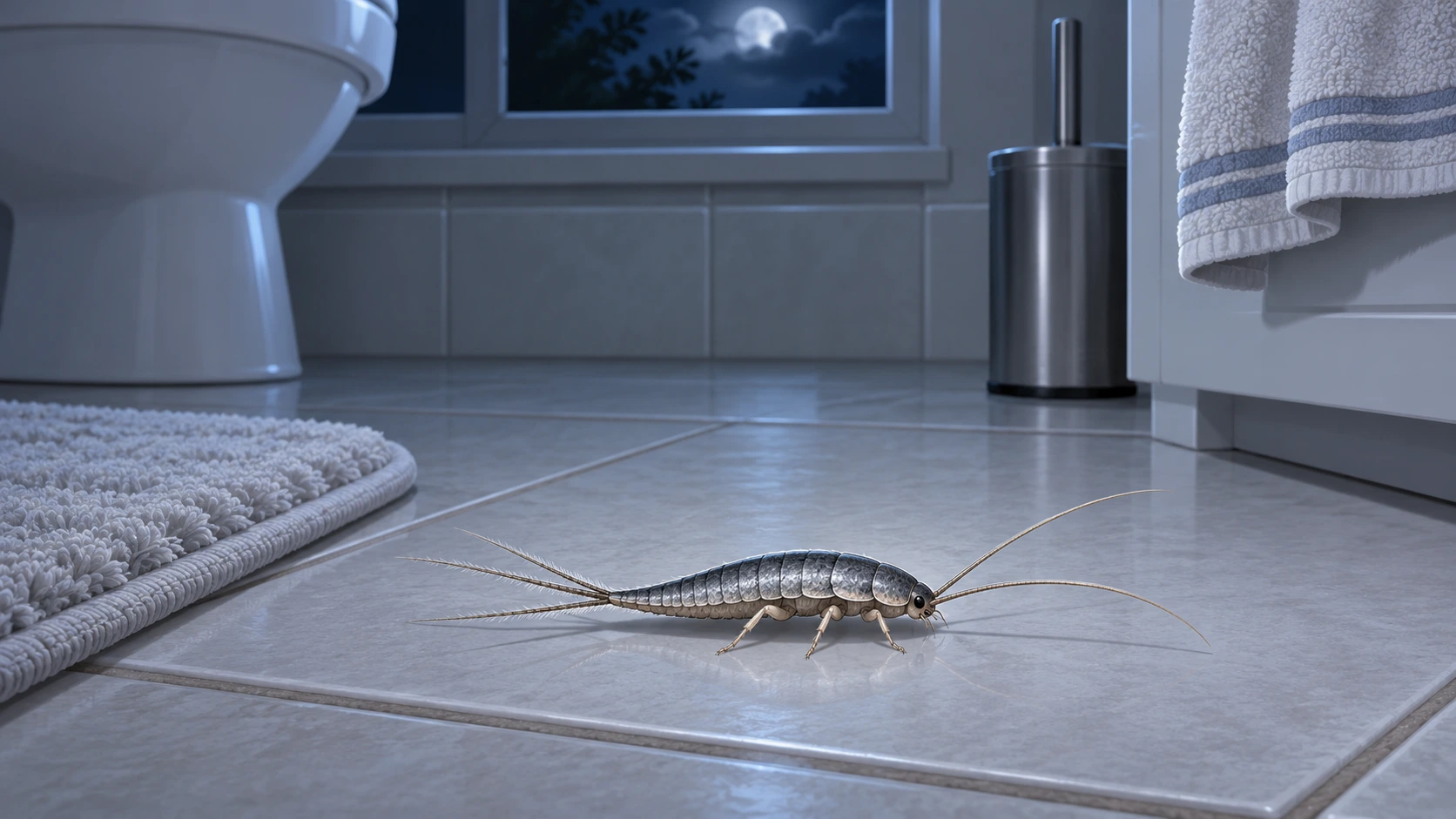
Silverfish are primarily nocturnal insects, meaning they are most active at night and spend much of the daylight hours concealed in sheltered places. They emerge to search for food and water, then retreat when disturbed or exposed. Finding one during the day is possible, but the sighting alone does not establish that a home has a serious infestation. Their nighttime habits explain why homeowners may go weeks without seeing one, even when silverfish are present. An insect that darts across the bathroom floor after dark may have been sheltering nearby throughout the day.
Are Silverfish Active at Night?
Silverfish are active mainly during nighttime hours. Their usual pattern involves remaining concealed during the day and becoming more active after dark, when they search for accessible food and water.
The common household silverfish, Lepisma saccharina, follows this pattern. It spends much of the daylight period in sheltered spaces and moves around more freely when its surroundings are darker.
The University of Florida’s silverfish biology description identifies the common silverfish as nocturnal and notes that daytime encounters are uncommon unless an insect has been disturbed from its resting place.
Nighttime activity does not follow an exact clock schedule. Silverfish do not need to emerge at a particular hour, and their movements depend on the conditions around their shelter and available resources.
A silverfish might become active shortly after a room darkens or remain concealed for longer if its surroundings are disturbed. The general pattern is more useful than trying to predict the precise hour when one will appear.
What Do Silverfish Do During the Day?
During daylight, silverfish generally remain in sheltered locations rather than spending extended periods moving around exposed floors and walls.
They can rest in narrow spaces where they are less likely to be disturbed. Their flattened bodies allow them to occupy small cracks and crevices, including gaps around building materials and stored belongings.
Silverfish also tend to gather in protected resting areas. These locations can provide relatively stable conditions while the insects remain inactive.
The University of California’s silverfish and firebrat guidance describes how these insects hide during the day and dart toward another secluded location when the object covering them is moved.
This explains a familiar household encounter. Someone moves a storage box, lifts a rarely used object, or opens a concealed space and suddenly sees a silverfish running away. The insect was already there. The disturbance simply exposed it.
Daytime inactivity should therefore not be confused with absence. A room can appear completely free of silverfish while individuals remain concealed in nearby shelter.
Why Do Silverfish Prefer Coming Out at Night?
Nighttime activity is part of the silverfish’s normal behavior. These insects are adapted to spend much of their time concealed and search for resources during darker periods.
Food and water are among the reasons they leave their resting places. A silverfish may travel between sheltered spaces and accessible materials while searching for suitable nourishment.
Its surroundings also matter. Silverfish prefer protected conditions, and exposed movement across an open floor leaves them more vulnerable to disturbance.
Nighttime activity can reduce encounters with people and other sources of disturbance. It also allows silverfish to move through quiet household spaces that receive little attention during the evening.
The moisture and shelter conditions available inside a property can influence how suitable an area remains for these insects. Their household attractants and preferred environmental conditions help explain why certain concealed areas continue supporting activity after dark.
Do Silverfish Come Out During the Day?
Daytime sightings occur, although they are less typical than nighttime encounters.
A silverfish may emerge during daylight when something disturbs its shelter. Moving furniture, opening storage containers, lifting books, or disturbing objects near a baseboard can expose an insect that would otherwise remain hidden.
A change in its immediate surroundings may also cause it to relocate. Once exposed, it usually runs quickly toward another sheltered location.
The North Carolina State Extension description of silverfish behavior confirms that silverfish and firebrats are active at night but hide in cracks and crevices during the day. A daytime encounter is therefore compatible with normal silverfish behavior. The insect does not have to be unusually active or displaced permanently to appear in the middle of the day.
There is also no requirement that every individual follow an identical schedule. An insect’s immediate surroundings can influence when it becomes visible.
What Does It Mean When You See a Silverfish in the Daytime?
A daytime sighting tells you that a silverfish was exposed during daylight. It does not, by itself, reveal the size of the population or establish how long the insect has occupied the building.
The circumstances surrounding the encounter are more informative than the time alone.
| What happened | What it may indicate |
|---|---|
| A silverfish runs away after you move a box | Its daytime shelter may have been disturbed. |
| One appears on an open floor without an obvious disturbance | It may have emerged from nearby shelter or be relocating. |
| Silverfish are repeatedly encountered when stored objects are moved | Those areas may contain recurring sheltered activity. |
| Several are seen during different daytime encounters | More than one insect may be using the surrounding area, but the population size remains unknown. |
| Silverfish are seen both day and night | Activity is occurring at different times, although the sightings do not establish severity. |
The distinction prevents two common misinterpretations. A single daytime sighting does not automatically prove a severe infestation, and seeing an insect only at night does not prove that its numbers are low.
The location, repetition of encounters, and other physical evidence provide a better basis for assessing the situation. When only one insect has been found, the circumstances surrounding a single silverfish sighting should be considered separately from the evidence of an established population.
Are Silverfish More Common in Certain Rooms at Night?
Silverfish may become noticeable in rooms where suitable shelter, food, and moisture are available. Bathrooms, basements, laundry rooms, and storage areas are common places to encounter them.
A bathroom sighting at night may involve an insect emerging from a nearby gap or sheltered space. It does not necessarily mean the insect lives inside the sink or drain. The circumstances behind silverfish appearing in bathrooms are influenced by the surrounding conditions.
Basements and storage areas can also provide relatively undisturbed environments. Silverfish may remain concealed around stored belongings or within building spaces, including walls, attics, and insulation.
The room where you see an insect is not always the place where it spends most of its time. It may simply be part of a route between its daytime shelter and an accessible food source.
Does Seeing Silverfish During the Day Mean the Infestation Is Worse?
Daytime sightings do not provide a reliable measure of infestation severity.
A silverfish appearing in daylight may have been disturbed, displaced, or caught in an exposed area. Seeing several during daylight can justify investigating their surroundings, but it does not establish an exact population count or prove that their behavior has changed.
Look for supporting evidence instead. Repeated sightings, young silverfish, discarded skins, droppings, and feeding damage provide more useful information about continued activity than the hour of discovery.
These observations form part of the signs of a silverfish infestation, particularly when several types of evidence occur together.
We would not classify a property as heavily infested simply because someone found a silverfish in the afternoon. The insect’s location and the evidence left behind deserve more attention than the clock.
How Can You Observe Silverfish Activity at Night?
A silverfish’s nocturnal habits can make ordinary daytime inspections less informative. Monitoring should account for the fact that the insects remain concealed during much of the day.
A practical observation approach involves keeping track of when and where encounters occur. Record the room, approximate time, whether something was disturbed immediately beforehand, and whether the insect was moving across an exposed surface or emerging from a gap.
Sticky monitoring traps can also help identify areas of recurring activity. Their placement should be based on suspected travel routes and accessible shelter rather than assuming every room has equal activity. Traps can indicate where insects are being encountered, although they do not provide a complete count of the population.
Avoid interpreting an empty trap as proof that silverfish are absent. A trap only records insects that encounter it during the monitoring period.
The most useful record combines the time of sightings with their location and any physical evidence nearby. That gives a more dependable picture of household activity than simply counting how many silverfish appear after dark.
What Their Nighttime Habits Mean for Your Home
Silverfish are primarily nocturnal, hiding during daylight and becoming more active when their surroundings are dark and undisturbed. They emerge to search for food and water, then retreat when exposed or disturbed.
Daytime sightings are possible and often occur when someone moves an object covering a resting insect. Nighttime sightings are consistent with normal activity, but neither observation establishes the severity of an infestation on its own.
When evaluating silverfish activity, consider the timing alongside repeated encounters, physical evidence, and the conditions around the places where insects appear. That approach avoids mistaking an ordinary daytime disturbance for proof of a major infestation.
One thought on “Are Silverfish Nocturnal?”