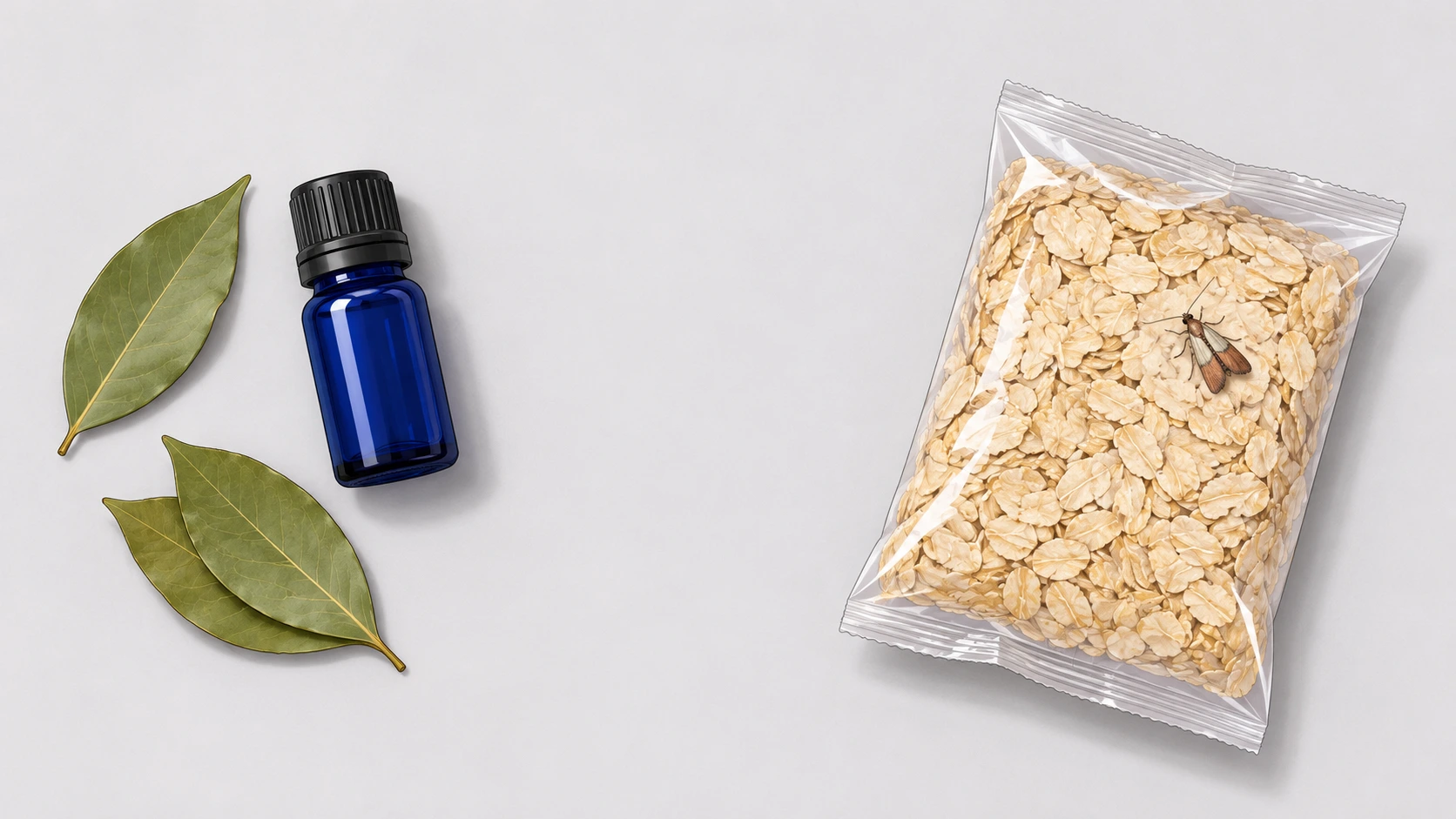
Bay leaves tucked between cereal boxes, peppermint oil on cotton balls, and homemade herbal sachets are popular suggestions for keeping Indian meal moths away. Some smell pleasant, and certain plant oils affect insects under laboratory conditions. But that does not mean they can protect an open bag of flour or eliminate larvae already feeding inside it.
The most reliable natural methods for Indian meal moths are removing infested food, vacuuming accessible insects and food debris, and storing unaffected dry products in tightly sealed containers. Bay leaves, peppermint oil, cloves, cedar, and other scented remedies have not been demonstrated to provide dependable household control of these pests.
Indian meal moths (Plodia interpunctella) reproduce in stored dry foods, where their larvae feed and leave silk, shed skins, and waste. Adults may fly around the kitchen, while the source of the infestation remains concealed in a package of grain, cereal, nuts, dried fruit, or another suitable product.
We recommend evaluating home remedies by the evidence for the particular insect, the stage they affect, and whether they can reach the insects. A scent that influences moths in a laboratory chamber is not necessarily useful in a cupboard containing several food packages.
Which Natural Remedies Actually Work Against Indian Meal Moths?
The strongest nonchemical options remove insects, deprive them of accessible breeding material, or prevent them from reaching new food. Most scented remedies have a weaker evidence base.
| Remedy or method | Evidence and likely effect | Our practical verdict |
|---|---|---|
| Bay leaves in cupboards | No reliable evidence that ordinary dried leaves prevent stored-food infestations | Do not rely on them |
| Peppermint essential oil | Laboratory activity against Indian meal moths has been reported, but household repellency is unproven | Not recommended for spraying or diffusing around food |
| Lavender oil or dried lavender | Some experimental insecticidal activity for concentrated oil; little dependable evidence for household sachets | Fragrance, not a proven control |
| Cedar blocks or chips | Pantry moth protection has not been established by ordinary cedar placement | Unreliable |
| Cloves, cinnamon, and rosemary | Some plant extracts have insect-related research, but household spice use lacks demonstrated control | Do not substitute for secure storage |
| Eucalyptus and other concentrated oils | Laboratory insecticidal effects reported for certain formulations | Not a validated DIY pantry treatment |
| Vinegar | Can clean suitable surfaces; not established as a reliable Indian meal moth killer or repellent | Cleaning aid only |
| Vacuuming | Physically collects exposed moths, larvae, cocoons, and food debris | Useful |
| Removing infested food | Removes the material supporting feeding larvae and other developing stages | Most important source-control measure |
| Tight-fitting containers | Block access to suitable foods and contain insects already inside | Strong protective measure |
| Pheromone monitoring traps | Attract and capture primarily adult males | Useful for monitoring, not complete elimination |
These verdicts describe ordinary household use. They do not mean every plant compound is biologically inactive. They distinguish a controlled scientific exposure from placing a household remedy on a shelf and expecting it to work.
That distinction is particularly clear with bay leaves. There is no established evidence that placing dried bay leaves or spearmint gum in cupboards prevents stored-food pests.
Do Bay Leaves Keep Indian Meal Moths Away?
We would not rely on bay leaves to protect stored food from Indian meal moths.
The usual recommendation involves putting several dried culinary bay leaves inside a cupboard, near a flour container, or among packages of dry food. The assumption is that the leaves release an odor strong enough to make the storage area unattractive to moths.
The problem is that the concentration and distribution of those odors are uncontrolled. A few dried leaves do not create a dependable barrier around bags and boxes, and there is no validated household placement method that guarantees protection.
A moth can still reach exposed food, and larvae already present inside a package are unlikely to be eliminated by nearby bay leaves.
What About Research on Bay Laurel Oil?
Bay laurel essential oil is not the same as a dried bay leaf.
A 2026 laboratory study examined concentrated oil from Laurus nobilis against Indian meal moth larvae. Under controlled experimental conditions, the oil showed contact toxicity and reduced feeding activity.
Those findings support further investigation of bay laurel essential oil as a potential botanical insecticide. They do not establish that putting culinary bay leaves in a cereal box will kill larvae or prevent moths from laying eggs.
The experimental treatment involved controlled concentrations and direct exposure. Ordinary dried leaves release much smaller and more variable amounts of volatile compounds.
It would also be inappropriate to respond by pouring concentrated bay oil into food containers. An experimental insecticidal effect does not establish that an oil is safe for direct treatment of groceries.
Should You Put Bay Leaves Inside Flour or Rice?
We do not recommend using loose bay leaves as a pest-control additive in stored flour, rice, or cereal.
They can make food inspection more difficult, and there is no dependable evidence that they protect the product from Indian meal moths. Their presence may also create false reassurance, allowing a developing infestation to go unnoticed.
A clean container with a reliable lid offers meaningful physical protection without adding foreign material to the food.
Does Peppermint Oil Repel Indian Meal Moths?
Peppermint oil contains volatile compounds that can affect insect behavior and physiology. Laboratory work has found insecticidal activity against adult Indian meal moths, including effects from contact with treated surfaces and exposure to concentrated vapors.
However, those experiments do not demonstrate that a few drops of peppermint oil placed on cotton balls will repel Indian meal moths throughout a household pantry.
The dose, exposure time, air circulation, formulation, and insect life stage all matter. A laboratory chamber can maintain conditions that are difficult to reproduce in a cabinet repeatedly opened for normal household use.
Research evaluating peppermint, lavender, eucalyptus, and other essential oils against adult Indian meal moths reported varying insecticidal effects under experimental conditions. The authors identified potential for developing botanical insecticides, while noting that further formulation research was needed.
That is promising research, but it is not evidence for a particular homemade peppermint spray recipe.
Do Peppermint-Oil Cotton Balls Work?
There is no reliable household treatment standard specifying how many cotton balls to use, how much oil to apply, or how frequently to replace them to prevent Indian meal moth infestations.
Essential oil gradually evaporates, and its concentration changes over time. The amount released by a cotton ball may vary with temperature, airflow, the product formulation, and the size of the cupboard.
Even if an adult moth avoids a strongly scented spot, the same effect cannot be assumed for eggs, feeding larvae, or protected pupae.
We would not use peppermint-soaked cotton balls as the main protection for dry food. They introduce concentrated fragrance near groceries without a demonstrated advantage over sealed containers.
Is Peppermint Oil Safe Around Pets?
Concentrated peppermint oil deserves particular caution in households with cats. It is identified as toxic to cats, and exposure can occur through ingestion, skin contact, and other routes.
Other concentrated oils, including tea tree, eucalyptus, and certain citrus oils, may also create pet safety concerns.
The veterinary toxicology guidance on peppermint oil and other household substances is a strong reason not to spray concentrated oils in pet feeding areas or place accessible oil-soaked materials near animals.
Diffusers can also expose pets to airborne droplets or residues, depending on their design. Avoid treating essential-oil products as harmless merely because they are plant-derived.
If a pet appears unwell after essential-oil exposure, contact a veterinarian or animal poison service promptly. Do not attempt to treat suspected poisoning with another household remedy.
Do Lavender, Cedar, Cloves, or Cinnamon Repel Pantry Moths?
These materials are frequently grouped together under the label “natural moth repellents,” but the phrase can hide an important species difference.
Traditional sachets and cedar blocks are often marketed for clothes storage. Indian meal moths are stored-food pests, and evidence about clothes moth behavior does not automatically apply to them.
Lavender
Concentrated lavender essential oil has shown biological activity against Indian meal moths in laboratory experiments. Ordinary dried lavender sachets, however, have not been demonstrated to stop pantry infestations when placed among groceries.
A sachet may provide fragrance, but it cannot reach larvae feeding inside a package of cereal.
We would not interpret the survival of stored food beside a lavender sachet as proof that the sachet worked. The food may simply have been uninfested or adequately protected by its packaging.
Cedar
Cedar blocks, chips, and scented rings are especially associated with clothing and linen storage. Their reputation does not establish reliable Indian meal moth control.
Cedar’s odor may decline over time, and the concentration of volatile compounds released into an open cupboard is variable. There is no dependable household application rate for using ordinary cedar blocks to prevent this species from reproducing in food.
Do not scatter wood chips among uncovered groceries or mix cedar oils into food-storage containers.
Cloves and Cinnamon
Cloves and cinnamon contain aromatic compounds, and extracts from various spices have been investigated for insect-related effects.
Still, there is insufficient evidence that scattering whole cloves or placing cinnamon sticks on pantry shelves reliably excludes Indian meal moths.
Aromatic spices may also be susceptible stored products themselves, depending on the material and storage conditions. Using them loosely throughout a cupboard can introduce more debris without addressing the actual infestation source.
Rosemary and Herbal Sachets
Rosemary, thyme, and mixed herbal sachets face the same practical limitation. Their scent does not reliably penetrate sealed packaging or destroy developing insects in stored food.
There is no validated number of sachets per shelf, replacement interval, or expected success rate for protecting a household pantry from Indian meal moths.
A homemade herbal sachet should therefore be regarded as an optional fragrance item, not an insect-proofing system.
Why Can Essential Oils Work in Studies but Fail in a Pantry?
An insect exposed to a measured concentration of essential oil in a laboratory is in a different environment from one flying through a kitchen.
Researchers may apply an oil directly to an insect or treated surface, or expose insects to a controlled concentration of vapor. They can then record mortality, movement, feeding, or reproduction under those conditions.
A household oil diffuser or cotton ball does not reproduce that exposure reliably. Air moves through rooms, cupboard doors open, and volatile compounds disperse or settle onto nearby materials.
There is also a difference between repellency, toxicity, and prevention. A chemical that kills an adult insect after direct contact has not necessarily been shown to deter egg laying. A compound that reduces larval feeding in an experimental dish has not necessarily been shown to protect a large bag of rice.
Likewise, a substance may affect one life stage but have little effect on another.
These uncertainties do not invalidate botanical insecticide research. They explain why a promising study cannot justify claiming that a homemade mixture will eliminate a pantry moth infestation.
Are Natural Insecticides Safer Than Conventional Products?
Not automatically. Essential oils contain biologically active chemicals, and concentrated formulations can irritate skin, eyes, or airways. Some also pose significant risks to pets.
A product’s safety depends on its ingredients, concentration, application method, exposure, and intended use. Its plant origin is not sufficient evidence that it is harmless.
Do not apply a homemade essential-oil spray directly to stored food or food-contact surfaces. If a commercial product claims to control Indian meal moths, follow its current label and confirm that the intended application site is authorized.
A labeled botanical pesticide should be evaluated as a pesticide, not as an ordinary kitchen fragrance.
Does Vinegar Help With Indian Meal Moths?
Vinegar may be used to clean certain household surfaces, but there is no dependable evidence that ordinary vinegar wiping kills all Indian meal moth stages or prevents another infestation.
The cleaning action comes mainly from physically wiping away residue. A cloth can remove crumbs and accessible insect material whether the suitable cleaning solution contains vinegar or ordinary dish soap.
Vinegar does not reach larvae concealed inside packages. Nor does placing an open dish of vinegar in a cupboard establish an effective moth-catching or repellent method.
For its specific claims, limitations, and common misconceptions, see does vinegar kill Indian meal moths?.
We prefer ordinary soap-and-water cleaning for suitable pantry surfaces, followed by thorough drying. Never mix vinegar with bleach or other household cleaners, because incompatible chemicals can release hazardous gases.
Nonchemical Methods That Have a Stronger Practical Basis
There are effective ways to manage Indian meal moths without relying on scented substances.
Remove Products That Contain Larvae or Webbing
Indian meal moth larvae develop inside susceptible food and leave silk and other contamination. When a product contains live larvae or obvious webbing, sealing and discarding it removes a developing source from the home.
This is the most useful nonchemical action because it addresses the insects that ordinary fragrance treatments cannot reach.
Do not attempt to make visibly contaminated food usable again by adding herbs, essential oils, or other supposed repellents.
Vacuum Exposed Insects and Food Debris
Vacuuming can physically collect exposed adults, wandering larvae, accessible cocoons, and spilled dry food. Empty the collected material promptly into a securely closed outdoor trash bag.
A crevice attachment is useful for reachable cupboard joints and shelf corners. These places can retain food residues and sheltered insect material even after the main package has been discarded.
Practical pantry moth control without insecticide sprays emphasizes source removal, vacuuming, sanitation, and protected storage.
Keep Unaffected Food in Secure Containers
Glass, metal, and sturdy food-grade plastic containers with tight-fitting lids offer a physical barrier that scented leaves cannot provide.
Inspect food before transferring it. A tightly sealed container can confine insects already present in the product, but it does not make that food uninfested.
Replace damaged lids or gaskets, and avoid refilling containers on top of old residues.
The detailed storage strategy, including purchasing and stock rotation, belongs in our guide to preventing Indian meal moths from returning.
Use Traps for Monitoring, Not as a Scented Repellent
Commercial Indian meal moth pheromone traps use a specific chemical signal that attracts adult males. That signal is different from the general fragrances produced by lavender, mint, or cedar.
Traps can help detect continued adult activity, but they cannot remove all eggs, larvae, pupae, or females. A full trap does not mean the source has been eliminated.
Our comparison of Indian meal moth pheromone and sticky traps explains their proper monitoring role.
Should You Freeze Food Instead of Using Natural Repellents?
Appropriate cold treatment can kill stored-food insects when the necessary conditions are reached throughout the material. This is a much better-supported biological effect than relying on dried herbs to deter moths.
However, temperature treatment is not suitable for every product or situation, and killing insects does not remove contamination from visibly infested food.
The correct time and temperature depend on the method and material being treated. We cover those requirements separately in what temperature kills Indian meal moths.
Do not attempt to reproduce thermal treatments with improvised room heating, open flames, or uncontrolled temperatures. These approaches can create property damage or fire risks without ensuring the insects receive a lethal exposure.
How to Decide Whether a Home Remedy Is Worth Using
Before putting a remedy in your food-storage area, consider what you expect it to accomplish.
If your goal is to remove larvae inside a contaminated bag of flour, a scented sachet cannot do that. If your goal is to prevent moths from reaching clean cereal, a dependable lid offers a direct physical barrier. If you want to know whether adult moths are still present, a correctly selected monitoring trap provides more relevant information than a bowl of aromatic liquid.
Use this decision guide when evaluating a remedy claim:
| Claim on a website or product | What evidence would be needed |
|---|---|
| “Repels Indian meal moths” | Species-specific avoidance results at realistic household exposure levels |
| “Kills moth eggs” | Evidence of egg mortality under the proposed concentration and exposure time |
| “Prevents pantry infestations” | Demonstrated protection of susceptible stored products under relevant conditions |
| “Safe because it is natural” | Exposure and safety information for people, pets, and food-contact areas |
| “Works for all moths” | Evidence covering the relevant species, not only clothes moths or outdoor moths |
| “Keeps working for months” | Verified persistence under realistic storage conditions |
This does not require homeowners to read scientific papers before buying a container or cleaning a cupboard. It provides a way to recognize when a simple-sounding claim offers no explanation of how the treatment reaches Indian meal moths.
For a broader comparison of which measures actually kill exposed insects or developing stages, see what kills Indian meal moths?.
Food-Storage Precautions With Natural Remedies
Do not allow essential oils, concentrated herbal extracts, scented waxes, or homemade sprays to contact dry food or food-preparation equipment unless the specific product is intended and authorized for that use.
Avoid spraying aromatic oils into cupboards containing unpackaged ingredients. Even when the intention is to repel insects, volatile residues may contaminate food or settle onto utensils.
Keep oil bottles, treated cotton balls, sachets containing loose herbs, and other small objects away from children and pets. Be particularly cautious around cats, which can be sensitive to several commonly recommended essential oils.
Do not burn herbs, incense, or candles in cupboards or use heating devices to disperse botanical vapors. Introducing heat or an open flame near paper packaging and stored products creates an unnecessary hazard.
For the food-storage space itself, ordinary cleaning and secure containers offer a safer, more predictable route than distributing concentrated plant chemicals.
Frequently Asked Questions
Do Bay Leaves Really Repel Indian Meal Moths?
There is no reliable evidence that ordinary dried bay leaves placed in cupboards prevent or eliminate Indian meal moth infestations. Concentrated bay laurel oil has shown effects on larvae in laboratory studies, but that does not validate the use of culinary leaves as a pantry repellent.
Will Peppermint Oil Keep Pantry Moths Away?
Peppermint essential oil has demonstrated insecticidal activity against Indian meal moths under controlled experimental conditions. That does not establish that cotton balls, homemade sprays, or diffusers provide dependable household protection. Concentrated peppermint oil also presents safety concerns, particularly around cats.
Does Lavender Stop Indian Meal Moths From Laying Eggs?
There is insufficient household evidence that dried lavender sachets or ordinary lavender fragrance reliably prevent Indian meal moth egg laying. Laboratory findings involving concentrated lavender oil should not be interpreted as proof that a sachet will protect stored groceries.
Can Cedar Wood Keep Indian Meal Moths Out of Food?
Ordinary cedar blocks or chips are not a dependable barrier against Indian meal moths. The insect is a stored-food pest, and traditional cedar use in clothing storage does not establish effectiveness against larvae developing in food.
Can Cloves or Cinnamon Kill Pantry Moth Larvae?
There is no validated household method for killing Indian meal moth larvae by scattering whole cloves or cinnamon sticks near food. Extracts and individual plant compounds may have biological activity under experimental conditions, but that does not justify using loose spices as a larval treatment.
What Is the Best Natural Way to Get Rid of Indian Meal Moths?
Removing confirmed infested food, physically collecting accessible insects, cleaning food residues, and protecting unaffected products in secure containers have the strongest practical basis. These measures address the developing population without requiring scented repellents.
Do Essential Oils Work Better Than Pheromone Traps?
They serve different proposed purposes, and the evidence is not equivalent. Appropriately formulated pheromone traps have an established role in attracting and monitoring adult male Indian meal moths. Household essential-oil repellents lack comparable evidence for reliable pantry protection. Neither approach substitutes for dealing with infested food.
Choose Proven Nonchemical Control Over Unverified Repellents
Bay leaves, lavender sachets, cedar chips, cloves, and peppermint oil are appealing partly because they are familiar household materials. Yet familiarity and fragrance do not establish pest-control performance.
Concentrated plant oils have shown real biological activity against Indian meal moths in laboratory settings. That research deserves to be distinguished from unsupported claims about ordinary pantry remedies. A measured experimental treatment cannot be reproduced simply by adding a few drops of oil to a cotton ball.
For homeowners, the sounder choice is to remove infested products, vacuum accessible insects and residues, keep clean food protected, and monitor for new activity.
Use natural methods that physically remove or exclude Indian meal moths. Do not rely on scent alone to protect food or declare an infestation eliminated.