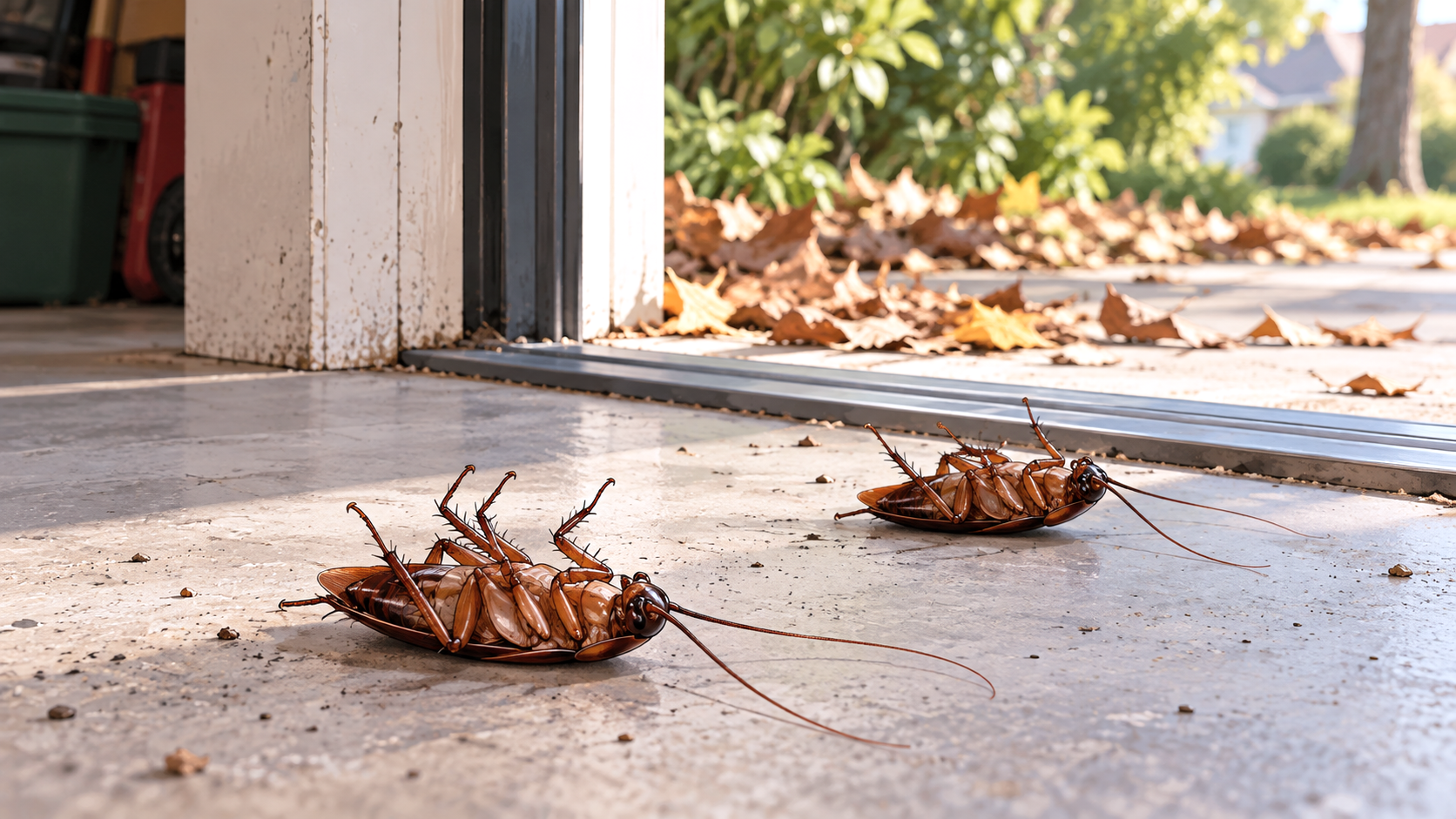
A dead cockroach beside the refrigerator may be the result of an insecticide treatment, an outdoor insect that wandered inside, or a cockroach that died naturally. Finding several bodies in the same area raises different questions, particularly when nobody has recently applied pest-control products.
Dead cockroaches indicate that insects have been present, but their bodies alone cannot reveal what killed them or whether others are still alive. The most useful clues are the species involved, where the bodies appear, whether pest treatment has occurred, and whether fresh signs of activity continue to develop.
Dead Cockroaches After Applying Spray or Bait
Finding dead cockroaches after an insecticide application is consistent with the treatment killing exposed insects. Sprays and baits work differently, however, so the location and timing of the bodies may vary.
A contact insecticide can kill cockroaches exposed during application or subsequently encountering a treated surface. Baits generally require the insect to consume the formulation, and death may occur after it has moved away from the bait placement. The University of Florida’s assessment-based cockroach management guidance explains that some modern baits act relatively quickly, while others produce delayed mortality.
Consequently, a cockroach found dead in the middle of a kitchen floor may have been exposed elsewhere. Its final position does not establish where it encountered the insecticide or where the surrounding population lives.
A sudden increase in dead insects can indicate that treatment is affecting the population, but it should not be interpreted as a count of all cockroaches killed. Many insects die inside inaccessible gaps, while survivors may continue developing away from treated surfaces. Visible mortality is only one part of evaluating a treatment’s effect.
The conditions that make cockroach populations difficult to eliminate also mean that discovering several dead adults does not establish whether immature insects or egg cases remain.
Why Cockroaches May Die Without Any Recent Treatment
An insecticide is not required for a cockroach to die indoors. Cockroaches experience natural mortality from age, dehydration, unfavorable temperatures, injury, and other environmental stresses.
Water availability is particularly relevant. A cockroach entering a dry, heated room may have difficulty obtaining enough moisture, especially if it normally occupies damp outdoor or utility environments. The EPA identifies eliminating standing water and repairing leaks as ways to make buildings less suitable for cockroaches.
Different species tolerate environmental conditions differently. An Oriental cockroach accidentally entering a warm, dry living area faces different conditions from a German cockroach established near indoor food and moisture. Their survival without access to water is not identical across species or environmental conditions.
Old age is another possibility, although the appearance of a dead adult rarely reveals its exact age. An isolated carcass cannot establish whether the insect died naturally, encountered an old pesticide residue, or was affected by an environmental condition.
The normal lifespan of cockroaches varies considerably, making it inappropriate to assign a single expected age to every insect found dead.
What the Location of Dead Cockroaches Can Reveal
Bodies found repeatedly in one area deserve more attention than a single insect discovered in an otherwise unused corner. Their distribution may help identify where cockroaches have been moving, although a dying insect can travel before coming to rest.
| Where you find them | Possible explanation |
|---|---|
| Near exterior doors or windows | Outdoor cockroaches entering and failing to survive indoors |
| Beside refrigerators or stoves | Nearby cockroach activity, potentially affected by pesticide treatment |
| Around basement drains or utility areas | Moisture-associated species moving through lower building spaces |
| Inside cabinets or beneath sinks | Activity near concealed resting locations |
| Across several rooms | More extensive movement, multiple sources, or treatment-related mortality |
| In a recently opened storage box | Old remains transported with stored belongings |
These are investigative clues rather than diagnoses. A carcass beneath a sink does not prove that plumbing contains a breeding population, and several insects near a door may have entered separately.
The Illinois Department of Public Health’s cockroach guidance recommends examining insect evidence in relation to likely shelters, food sources, and moisture. Its guidance also supports using monitoring traps to locate activity that visual inspection cannot fully explain.
The different distances cockroaches can travel further limit what can be inferred from a final resting place. A dead insect may have originated beyond the immediate room.
One Dead Cockroach Versus Several Dead Cockroaches
One dead cockroach has limited diagnostic value. It may represent an isolated visitor, a previously unnoticed insect, or the remains of an earlier infestation.
Several bodies of similar appearance appearing repeatedly in the same room make continuing cockroach activity more plausible, particularly when other evidence is present. Multiple sizes may warrant closer investigation because the presence of adults and immature cockroaches can indicate more than one developmental stage.
Species identification changes the interpretation. A large outdoor-associated cockroach near an exterior entrance may have entered accidentally. Repeated discoveries of small German cockroaches inside kitchen cabinets deserve greater attention because this species commonly establishes indoor populations. The University of California’s cockroach management guidance distinguishes these patterns and recommends identification before choosing control measures.
The range of cockroach sizes also means that a small specimen is not necessarily a young member of a larger species. A naturally small adult and an immature cockroach may require different interpretations.
Bodies alone cannot provide a reliable population estimate. Two visible carcasses could come from a minor introduction or a much larger, mostly concealed population.
Dead Cockroaches Near Doors, Windows, and Garages
Discovering dead cockroaches around entrances may indicate that outdoor insects are entering a building but failing to survive in the indoor environment.
Turkestan cockroaches are a useful example. They generally reproduce outdoors and are associated with landscaping, utility boxes, and other sheltered exterior locations. The University of California’s account of Turkestan cockroaches specifically notes that they may be found dead inside garages and near entrances because they cannot establish thriving indoor populations under typical conditions.
This pattern differs from repeatedly finding German cockroaches beneath a kitchen appliance. The species involved can substantially change whether the most likely source lies inside or outside the building.
If dead insects appear close to one doorway, examine the door sweep, threshold, weather stripping, and adjacent openings. Outdoor lighting and surrounding vegetation may also influence insect activity near entrances, although neither establishes how an individual cockroach entered.
A recurring concentration near an exterior opening is more informative than finding isolated bodies scattered throughout unrelated rooms.
How to Investigate When You Keep Finding Dead Cockroaches
Begin by recording the location, date, approximate size, and number of cockroaches discovered. Remove the bodies so subsequent findings can be distinguished from old remains. A photograph or securely contained specimen can help establish whether repeated sightings involve the same species.
Next, examine accessible areas near the discoveries for living insects, egg cases, shed skins, or cockroach droppings. The absence of those signs does not rule out activity, but their presence can justify investigating nearby concealed spaces.
Sticky monitors provide a more dependable way to assess what is happening. The EPA’s school integrated pest management manual recommends placing traps along cockroach movement routes and comparing catches between locations.
Put dated monitors against walls near the areas where bodies were found, keeping them inaccessible to children and pets. Check them after several days and record the number and type of insects caught. The Extension Foundation’s outdoor cockroach monitoring guidance recommends recording trap locations and inspection dates so that results can be compared meaningfully.
If a trap remains empty while dead cockroaches continue appearing elsewhere, reposition it toward the observed activity. An empty trap is not proof that no cockroaches are present.
The pattern developing over successive inspections is more useful than assigning a cause to each individual carcass.
Should You Remove Dead Cockroaches Immediately?
Remove accessible carcasses rather than allowing them to accumulate. Dead cockroach bodies can contribute allergenic material to household dust, especially when they deteriorate or are disturbed.
A clinical practice parameter published in the Journal of Allergy and Clinical Immunology identifies dead cockroach bodies among potential indoor allergen reservoirs. Its recommendations for reducing cockroach allergen exposure emphasize removing contaminated material as well as controlling living insects.
Pick up individual bodies using a disposable towel or gloves, place them in a sealed bag, and dispose of them in household trash. Clean the contacted surface as appropriate and wash your hands afterward. Avoid crushing dried remains or vigorously brushing accumulated material into the air, particularly when someone in the household has cockroach allergies or asthma.
Before disposal, photograph specimens if their identity or location may help explain repeated sightings. A clean, dated record of newly discovered bodies is more valuable for investigating the source than leaving carcasses scattered around the house.
When Do Dead Cockroaches Justify Professional Inspection?
Professional assessment becomes reasonable when dead cockroaches continue appearing in substantial numbers, several developmental stages are present, or monitoring reveals live insects in multiple areas.
These findings warrant more attention when they occur without any known recent treatment, particularly if they suggest concealed activity behind appliances, cabinets, or structural openings.
The EPA’s guidance for housing managers emphasizes documenting pest activity, inspecting affected areas, and addressing building maintenance conditions alongside pest management.
In a shared building, repeated discoveries near plumbing shafts or service penetrations may also justify involving building management, because the source may not be confined to the room where bodies are found.
Do not repeatedly apply insecticide merely because another dead cockroach appears. The health and exposure risks associated with cockroach sprays make unnecessary applications undesirable, while additional spraying may complicate the interpretation of subsequent deaths.
A dead cockroach is evidence of a past presence and a useful starting point for investigation. Its importance becomes clearer when the species, location, treatment history, and monitoring results are considered together, rather than relying on the number of bodies alone.