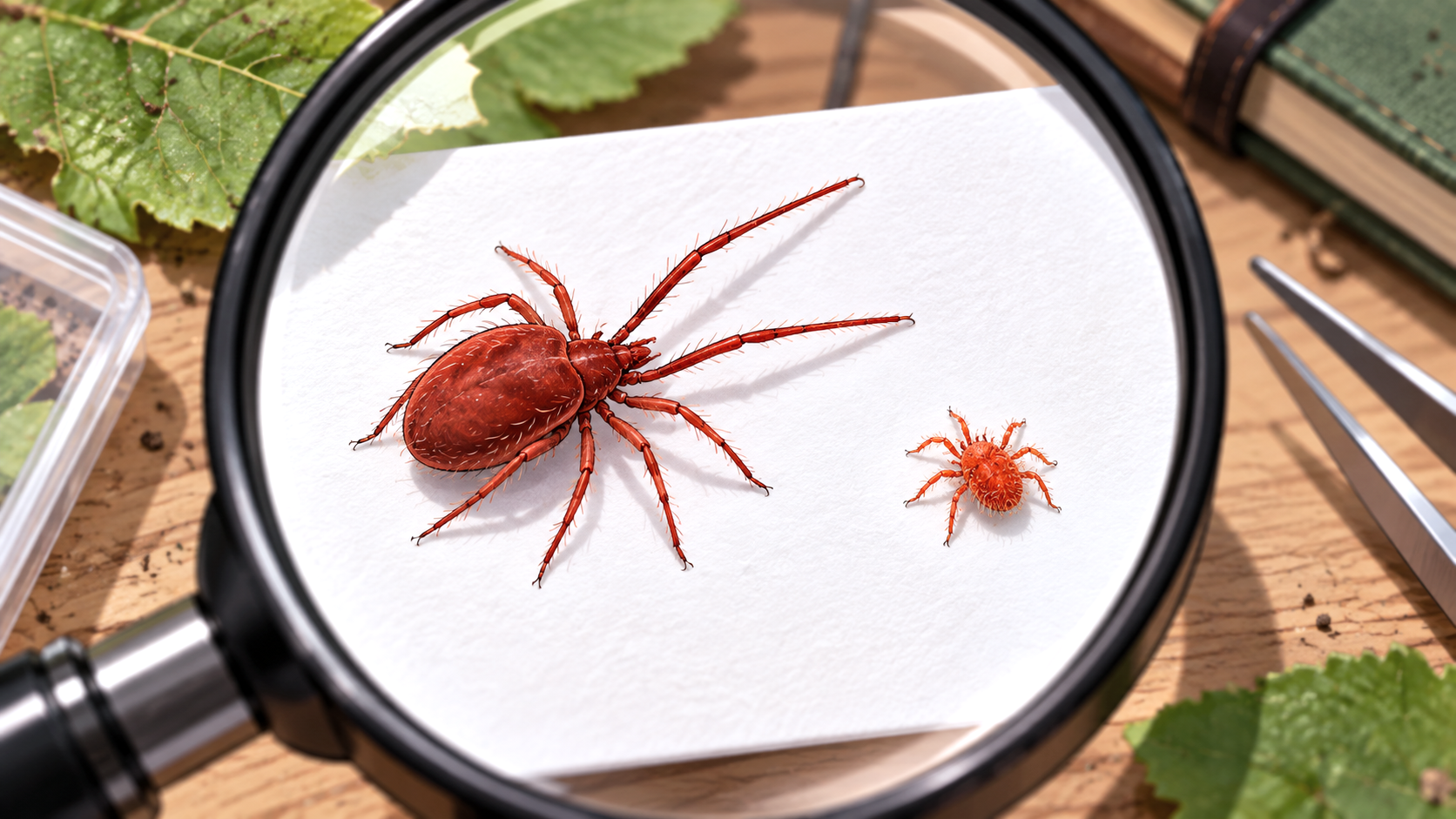
Clover mites and chiggers are both tiny arachnids that can look reddish, but confusing them can turn a harmless household sighting into an unnecessary skin concern, or cause a genuine chigger exposure to be dismissed as clover mites. Clover mites are plant feeders that do not bite people. Chiggers are the six-legged larval stage of certain trombiculid mites, and species that feed on humans can produce intensely itchy skin lesions. Where you found the mite and what happened afterward can therefore be more informative than its color alone.
The Clearest Differences Between Clover Mites and Chiggers
Adult clover mites have eight legs, an oval body, and a remarkably long first pair of legs that can resemble antennae. At roughly 1/64 inch long, they are tiny but may still be noticed crawling across a surface, particularly when many appear together. Their rusty brown to dark red coloration overlaps enough with chiggers that “tiny red mite” is not a reliable identification. The very long front legs of a clover mite are far more useful.
A chigger that feeds on people is a larva, not an adult mite. These larvae have six legs and are extraordinarily small, commonly around 0.15 to 0.3 mm long, with orange to bright-red coloration. After feeding, they develop into eight-legged nymphs and later adults, but only the larval stage feeds on humans. The adults are therefore not simply larger versions of the biting chigger encountered on skin.
| Feature | Clover mite | Chigger |
|---|---|---|
| Human-feeding stage | None | Larva |
| Legs on the form most relevant here | 8 | 6 |
| Useful visual clue | Extremely long front pair of legs | Minute larva without the exaggerated front legs of a clover mite |
| Common color | Rusty brown to dark red | Red, orange, or yellow |
| Food | Plant material | Larvae feed on animal tissue fluids and skin cells |
| Human skin effect | Does not bite | Can cause intensely itchy lesions |
| Typical setting | Lawns, vegetation, building exteriors, windows and indoor surfaces | Grass, scrub, leaf litter and other outdoor vegetation |
A Clover Mite on a Wall and a Chigger on Your Skin Tell Very Different Stories
Clover mites frequently become conspicuous because they leave vegetation and crawl onto buildings. They are commonly found around sunny walls and windows and may enter through small openings, which explains why clover mites appear on window sills or turn up in large numbers indoors. Their normal diet consists of sap from grasses, clover and other plants, so a house is not providing them with human or animal hosts.
Chiggers are associated more strongly with outdoor vegetation and ground-level habitats, including grassy or scrubby areas, shaded vegetation, leaf litter, rotten logs and stumps. A person can encounter larvae while moving or sitting in infested habitat. The larvae attach to skin and release digestive enzymes that allow them to consume liquefied skin cells; they do not burrow beneath the skin. That last point is worth preserving because the widespread idea that chiggers tunnel into people is itself incorrect, just as clover mites cannot burrow into human skin.
Itchy Welts Point Away From Clover Mites
A cluster of intensely itchy lesions after exposure to suitable outdoor habitat fits chigger feeding far better than a clover mite encounter. Chigger larvae can produce red papules, vesicles and substantial itching through the host’s reaction to their feeding. Clover mites, by comparison, do not bite humans. A red smear left after crushing one is also not evidence of a bite because clover mites contain red body pigment that can stain skin, walls, curtains and other surfaces.
Skin lesions alone still cannot identify the responsible arthropod with certainty. Numerous insects, mites and non-pest conditions can produce itching or redness, while a mite collected from the environment may have nothing to do with the skin symptoms. Persistent, severe or otherwise concerning symptoms warrant medical assessment rather than treatment based solely on the assumption that a tiny red arthropod was a chigger.
Chiggers Have a Disease Risk That Clover Mites Do Not Share
Some chigger species in parts of the world can transmit Orientia tsutsugamushi, the bacterium responsible for scrub typhus. The disease is transmitted through bites from infected larval trombiculid mites and occurs primarily within parts of the Asia-Pacific region. This should not be interpreted to mean that every chigger carries scrub typhus or that seeing a red mite creates an immediate disease risk. The geographic distribution and vector species involved in scrub typhus are specific. Clover mites have no comparable role as human-feeding disease vectors. Their relationship with human health is primarily that of a nuisance mite rather than a parasite.
Questions That Help Separate Clover Mites From Chiggers
Can both be found in grass?
Yes, but for different reasons. Clover mites use grasses and other plants as food, while chigger larvae occupy vegetation and ground-level habitats where suitable animal hosts may pass. Finding a mite in grass therefore does not identify it by itself.
Will both leave red marks when crushed?
Clover mites are notorious for producing a red stain when crushed. Color left on a surface should not be confused with the inflamed skin lesion that can develop after chigger feeding.
Can you identify either one just because it looks bright red?
No. Clover mite colors range beyond bright red, and chigger larvae may appear red, orange, or yellow. Body structure and context provide better evidence than color.
Are chiggers baby clover mites?
No. They belong to different mite groups. A chigger is the parasitic larval stage of a trombiculid mite, whereas young clover mites develop through their own separate life cycle.