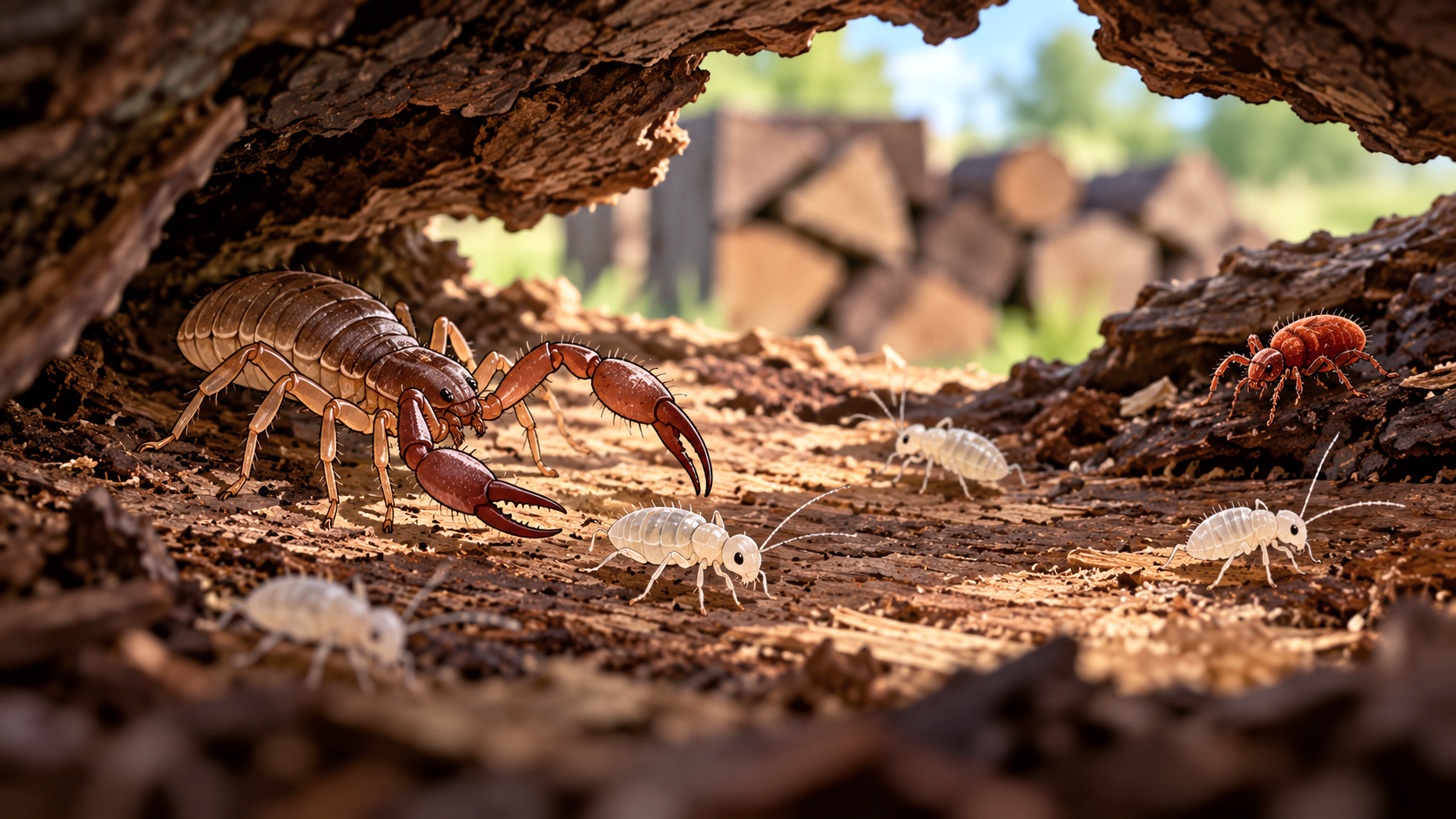
Booklice may be tiny, but they are not ignored by predators. Their small size makes them suitable prey for other minute arthropods capable of hunting in the same cracks, leaf litter, bark, stored materials, and damp spaces where psocids occur. Pseudoscorpions are confirmed natural predators of booklice and other psocids. Certain predatory mites also prey on booklice, including species studied as potential biological controls in stored products. Outdoors, booklice form part of a much broader community of small arthropods, although the exact predators vary with the booklouse species and habitat.
Inside a home, however, natural predators are not a practical substitute for moisture control. If enough booklice are present to attract your attention, the more useful question is what environmental condition is allowing them to multiply.
Pseudoscorpions Eat Booklice
One of the clearest answers to what eats booklice is the pseudoscorpion.
Pseudoscorpions are tiny arachnids that resemble miniature scorpions without tails. They have eight legs and a conspicuous pair of pincer-like pedipalps at the front of the body. Despite their intimidating appearance under magnification, they are harmless to people and pets.
These little predators hunt a range of small arthropods. Their documented prey includes booklice, springtails, mites, thrips, small beetle larvae, flies, and ants.
A pseudoscorpion detects nearby prey with sensory hairs on its pincers. When a suitable small arthropod contacts those hairs, the predator grabs it. Venom glands associated with the pincers help immobilize the prey before the pseudoscorpion feeds.
For something only a few millimeters long, a booklouse is an appropriately sized meal.
House Pseudoscorpions Can Hunt Booklice Indoors
This predator-prey relationship is not limited to forests or laboratory experiments.
The house pseudoscorpion, Chelifer cancroides, can occur inside buildings. Adults measure approximately 3 to 4 millimeters long, making them considerably larger than the common 1-to-2-millimeter booklice they can prey upon.
Booklice are specifically included among the small arthropods eaten by pseudoscorpions. That means finding a pseudoscorpion near a booklice population can have a perfectly ordinary ecological explanation. Predator and prey may simply be occupying the same environment.
Both also favor protected habitats. Pseudoscorpions occur in places such as leaf litter, beneath bark and stones, animal nests, and damp areas of buildings. Booklice likewise thrive in protected locations when humidity and fungal food are available.
A pseudoscorpion in a bathroom or basement therefore does not necessarily represent a second pest problem. It may be there because tiny prey is available.
Predatory Mites Can Eat Booklice Too
Booklice can also become prey for other animals nearly as small as they are.
Certain predatory mites have been experimentally shown to feed on Liposcelis booklice. For example, the predatory mite Blattisocius dentriticus has been studied feeding on the booklouse Liposcelis entomophila. Researchers were able to rear the mite on booklice, supporting its role as a natural predator.
Another predatory mite, Blattisocius tarsalis, has been reported preying on first-instar Liposcelis bostrychophila as well as eggs or immature stages of several stored-product pests.
This is a useful reminder that “mite” does not describe one feeding strategy. Some mites consume fungi or stored products, while others are predators.
It also means a mite found beside booklice should not automatically be assumed to be a mold mite. Reliable mite identification can require much stronger magnification than booklice identification.
Booklice Are Small Enough for Other Tiny Predators
The confirmed examples tell us something important about the ecological position of booklice.
Common household booklice are soft-bodied insects with no sting, powerful jaws, or other obvious defenses against larger arthropod predators. Their small bodies and relatively delicate structure make them potential prey for predators capable of finding and capturing animals at that scale.
However, we would not turn that observation into a long speculative list of spiders, beetles, ants, centipedes, and other predators without evidence for the particular relationship. “Could physically eat a booklouse” is not the same as being a documented or meaningful natural predator of booklice.
Pseudoscorpions and particular predatory mites give us much firmer examples because booklice or psocids have been specifically documented among their prey.
Outdoor Psocids Have a Larger Food Web Around Them
Booklice belong to the broader psocid group, most members of which live outdoors.
Outdoor psocids, often called barklice, occur on tree bark, leaves, shrubs, stones, and similar habitats. They consume fungi, lichens, pollen, decaying vegetation, and other organic material. Unlike the wingless Liposcelis species commonly found indoors, many outdoor psocids have wings.
These environments contain far more predators than the inside of a cupboard. Small predatory arthropods occupy bark crevices, leaf litter, nests, and vegetation alongside psocids, so predation forms a normal part of their ecology.
That does not mean every predator of an outdoor barklouse is necessarily an important predator of household booklice. The broader scientific classification of booklice includes multiple species with different habitats, and predator relationships can change accordingly.
When discussing natural enemies, species and habitat matter.
Do Spiders Eat Booklice?
It would be reasonable for a sufficiently small spider to capture tiny arthropods, but we would not describe ordinary household spiders as a primary booklice control based on that possibility alone.
Booklice are exceptionally small. Common indoor species are around 1 to 2 millimeters long and frequently occupy cracks, cardboard, stored products, wall voids, and other narrow spaces that do not necessarily overlap with the hunting strategy of a particular spider.
Pseudoscorpions provide a much stronger example because authoritative entomology sources specifically identify booklice among their prey.
This is a useful standard whenever discussing pest predators. An animal being capable of eating another animal does not establish an important predator-prey relationship.
Do Ants Eat Booklice?
Ants are opportunistic predators and scavengers as a group, but their diets vary enormously among species. We would not recommend identifying ants as a major natural enemy of household booklice without knowing the ant species and having evidence of that feeding relationship.
Interestingly, the better-documented interaction can run in another direction. Pseudoscorpions eat both ants and booklice, along with numerous other tiny arthropods.
If ants and booklice occur in the same damp area, the shared location alone does not demonstrate that the ants are controlling the booklice.
The same caution applies to other generalist predators. Natural food webs are complicated, and a plausible meal is not automatically a significant source of mortality.
Do Booklice Eat Each Other?
Booklice are primarily associated with fungi, molds, grains, insect fragments, and other suitable organic materials rather than hunting other booklice.
Indoor booklice commonly feed on molds and fungi growing in damp environments. Some also occur in stored products, where they may consume fungal material and suitable food residues.
That diet is fundamentally different from the predatory behavior of a pseudoscorpion.
Understanding what booklice eat also explains why moisture control has such a large effect on infestations. A damp environment can provide both favorable humidity and an expanding fungal food supply.
Natural Predators Will Not Control a Household Infestation Reliably
Finding a pseudoscorpion among booklice is interesting, but it is not a pest-management plan.
A single predator can consume individual booklice without eliminating the environmental conditions allowing hundreds or thousands more to develop. Booklice can reproduce quickly when temperature and humidity are favorable, and the booklice life cycle can progress from egg to adult in less than a month under warm conditions.
Predators also cannot repair a leaking pipe, dry wet drywall, lower excessive indoor humidity, or remove moldy stored food.
For household infestations, the University of Minnesota recommends reducing moisture as the most effective management method. Indoor psocids cannot persist when relative humidity remains below approximately 45 to 50 percent.
Natural enemies may consume some individuals, but environmental control attacks the reason the population exists.
Should You Kill a Pseudoscorpion You Find Indoors?
Usually, there is no pest-control reason to kill one.
Pseudoscorpions are harmless to people and pets. They do not damage food, clothing, or property, and their prey includes several arthropods people commonly regard as pests.
If you do not want one indoors, it can simply be physically removed and released outside. Insecticide treatment is unnecessary for an occasional pseudoscorpion.
Its presence can also tell an interesting ecological story. A predator appearing indoors may have wandered in independently, but it may also have encountered enough tiny arthropod prey to remain there.
If booklice are present nearby, concentrate on why the booklice population exists rather than treating the pseudoscorpion as the greater problem.
Moisture Can Support Both the Prey and Its Predator
A damp environment can create more than a single-pest problem.
Booklice flourish where humidity is high and microscopic fungi provide food. Pseudoscorpions are also frequently associated with humid microhabitats and hunt small arthropods living there.
Consequently, the same basement, bathroom, wall void, or damp storage area can potentially provide prey for a small predator.
The solution is still not to manipulate the food chain. Booklice have such a strong dependence on moisture that changing the environment is far more predictable.
Keeping relative humidity below the range favorable to booklice, fixing leaks, drying wet materials, improving ventilation where appropriate, and removing contaminated stored products can interrupt the conditions supporting the infestation. The importance of humidity to booklice survival is one reason this approach works so well.
Other Questions About Booklice Predators
What is the best-known predator of booklice?
Pseudoscorpions are one of the clearest documented examples. Multiple authoritative sources specifically list booklice or psocids among the small arthropods they eat.
Are pseudoscorpions dangerous to people?
No. Pseudoscorpions are harmless to people and pets. Their pincers are used to capture tiny prey, and they are not considered dangerous household pests.
Do predatory mites kill booklice?
Some do. Particular Blattisocius species have been experimentally documented preying on Liposcelis booklice. That does not mean every mite found near booklice is predatory.
Should I introduce predators to get rid of booklice?
No. Introducing predators is unnecessary for an ordinary household infestation. Correct the moisture conditions supporting the booklice instead.
Why do I have booklice if they have natural predators?
Predators rarely eliminate an entire prey species. When humidity, fungal food, and shelter remain favorable, booklice can reproduce despite some individuals being eaten.
Predators Are Interesting, but Moisture Decides the Household Problem
Booklice have natural enemies, and pseudoscorpions provide one of the best-documented examples. Certain predatory mites can also consume Liposcelis species, showing that booklice occupy the prey side of a much larger community of tiny arthropods.
That does not give us a practical reason to encourage predators throughout an infested house. A booklice population persists because the environment provides what it needs.
If booklice are multiplying indoors, look for condensation, leaks, damp cardboard, wet building materials, mold, or excessive humidity. Correcting those conditions is central to preventing booklice and is far more dependable than waiting for something else to eat them.