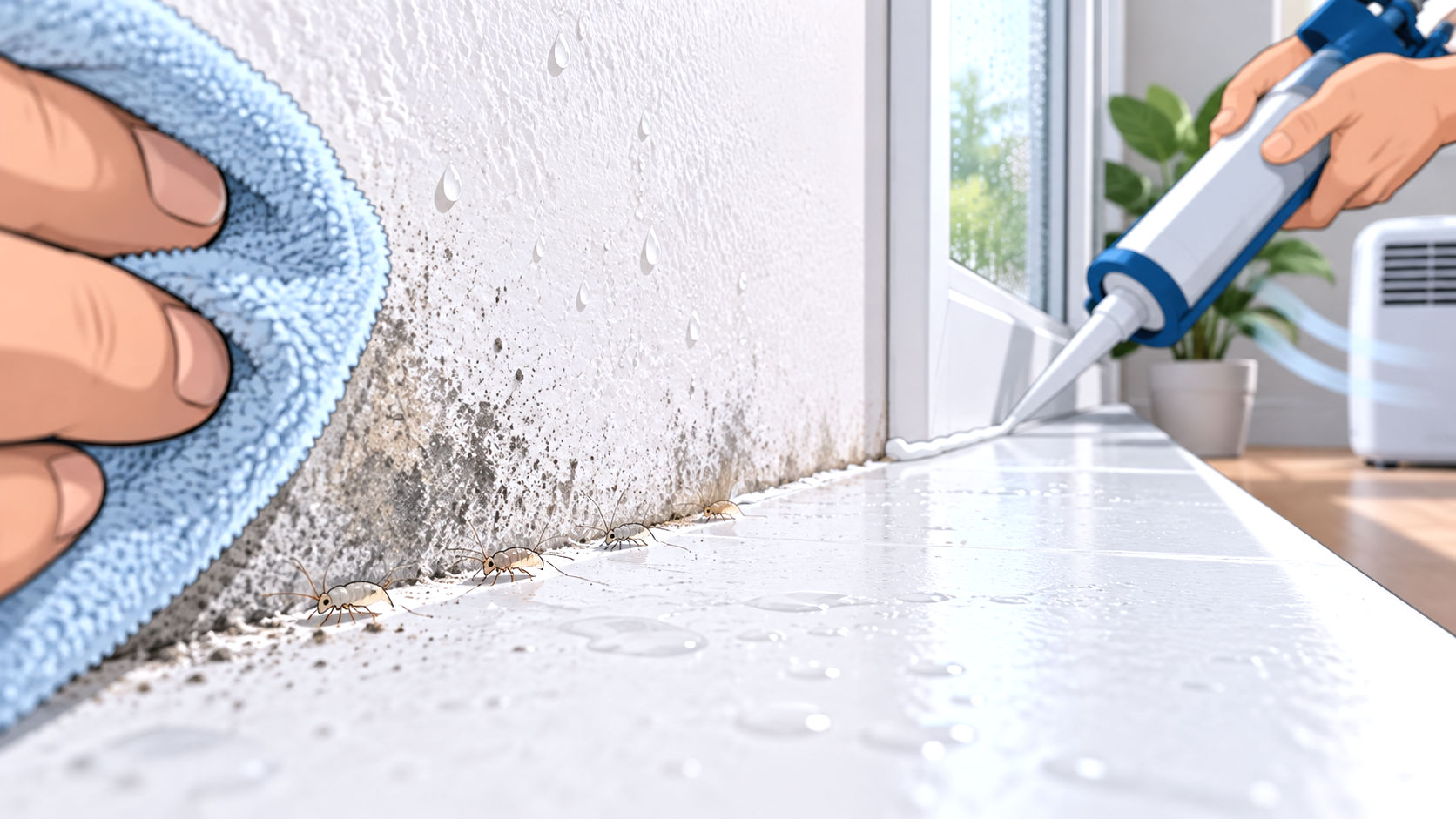
Booklice crawling across a wall or gathering along a windowsill can make it look as though the insects are living in the paint or coming through the glass. Usually, the surface is only where you happen to notice them. The more important clue is moisture, particularly when booklice repeatedly appear around windows, exterior walls, bathrooms, basements, or recently finished walls.
To get rid of booklice on walls and windowsills, vacuum or wipe away visible insects, keep relative humidity below about 50%, dry condensation, repair leaks, improve airflow, and investigate damp areas around the affected surface. Pesticides are usually unnecessary. If booklice keep returning, moisture may be trapped behind the wall, trim, or window area. Cleaning the insects from the surface gives you immediate relief. Finding and correcting the damp conditions nearby is what keeps them from returning.
Why Are Booklice Crawling on Your Walls?
Booklice are strongly associated with warm, humid environments where fungi and mold can grow. They primarily feed on microscopic fungal material rather than wall paint, drywall, or plaster itself.
This makes a wall a useful clue rather than necessarily the source. A booklouse may wander across a completely dry painted surface after developing behind baseboards, around damp wallpaper, inside a wall void, or among nearby cardboard and other moisture-retaining materials. Booklice can also become numerous in newly constructed buildings when building materials retain enough moisture to support fungal growth.
Check whether the insects match the typical appearance of booklice before assuming moisture alone explains the problem. Several other tiny household arthropods can appear on walls, and the treatment changes considerably if the insects have been misidentified.
Why Booklice Gather Around Windowsills
Windows create several conditions that can favor booklice in a very small area. Condensation can repeatedly wet the sill, frame, nearby paint, caulk, wood, or wall surface. The surrounding room may seem reasonably dry while the immediate window area remains damp enough to support fungal growth.
Look for water droplets on the glass, damp corners, discoloration, peeling paint, deteriorated caulk, or persistent moisture where the frame meets the wall. Wipe away condensation when it develops, but also determine why it keeps forming. Improving ventilation, lowering indoor humidity, and correcting window or building-envelope problems can prevent the surface from becoming wet again.
Potted plants deserve attention too. Moist soil and drainage water can create a humid pocket directly beside a window. Household booklice recommendations specifically note that leaving an air space beneath potted plants on windowsills can reduce humidity and mold growth.
Remove the Booklice You Can See
Start by physically removing visible insects from the wall and sill.
A vacuum is useful when numerous booklice are present, particularly around baseboards, window tracks, trim, cracks, and corners. Physical removal is a recognized pest-management technique, and vacuuming generally removes insects more effectively than sweeping or mopping.
For a small number of booklice on a washable surface, ordinary cleaning can remove the insects and surface debris. Use a cleaning method appropriate for the paint, wood, wallpaper, or other material involved, and avoid saturating the wall with water.
Vacuuming is not the cure by itself. If you remove 30 insects today while the damp breeding area remains untouched, more can eventually wander onto the same wall. Persistent sightings are among the more useful signs that booklice are established nearby.
Keep the Humidity Below About 50%
Humidity control is the most important step when booklice repeatedly appear on walls and windows.
Indoor booklice struggle to persist under sufficiently dry conditions. Keeping relative humidity around 45% to 50% or lower is widely recommended for household control. Lower humidity also suppresses the molds and fungi that provide much of their food.
A hygrometer is inexpensive and more useful than guessing whether the room feels damp. Measure humidity near the affected wall rather than relying entirely on a reading from another floor or room. Basements, bathrooms, laundry rooms, closets, and rooms with frequent window condensation can behave very differently from the rest of the house.
A dehumidifier or improved ventilation can help when the entire room is humid. Booklice are sufficiently dependent on moisture that reducing humidity is considered the most effective household control. The relationship between booklice and high humidity also explains why surface treatments tend to disappoint when the room remains damp.
Stop Condensation From Repeatedly Wetting the Windowsill
Wiping a wet windowsill each morning addresses the water you can see, but not necessarily the reason it is appearing.
Condensation develops when sufficiently moist air meets a cold surface. In a home with high indoor humidity, cold window glass and frames can therefore become recurring wet spots. Lowering indoor humidity can reduce the amount of condensation, while appropriate ventilation can remove moisture generated by showers, cooking, drying clothes, and other household activities.
Inspect the sill after drying it. If moisture appears to be entering around the window rather than condensing on its surface, the problem may involve failed caulking, flashing, drainage, or another building defect. That calls for repair rather than additional pest treatment.
Do not ignore persistent water damage simply because the booklice themselves are mostly nuisance pests. Dampness can support mold and damage building materials independently of the insects. Booklice are often useful precisely because they make an otherwise overlooked moisture problem visible.
Check Behind Trim, Baseboards, and Wallpaper
Booklice do not have to be breeding on the exposed portion of the wall.
Their tiny bodies allow them to occupy protected cracks and voids. They can occur around leaking or sweating pipes, damp construction materials, cardboard, and other locations capable of supporting mold. If insects repeatedly emerge from one edge of a wall, inspect what is accessible around that area instead of continually wiping the center of the wall.
Wallpaper can also create favorable conditions when moisture becomes trapped beneath or behind it. Because booklice feed primarily on mold and other fungi, microscopic fungal growth associated with damp material can support them without obvious feeding damage to the wall itself.
Avoid tearing open a finished wall merely because you saw several insects. First measure humidity, inspect for leaks and condensation, and watch where the insects are concentrated. Structural investigation becomes more reasonable when there are independent signs of moisture or when large numbers continually emerge from the same inaccessible location.
Booklice Coming From a Wall Void Need a Different Approach
A hidden wall void can explain an infestation that refuses to respond to ordinary room drying.
Moisture sometimes becomes trapped inside walls, particularly after a leak, flooding, or construction before materials have dried adequately. In those circumstances, the air in the room can become relatively dry while the concealed material remains damp.
Booklice control recommendations specifically recognize this possibility. When moisture is trapped inside a wall void, opening the wall may sometimes be necessary so the concealed space can dry properly.
That is not a reason to start cutting drywall at the first sight of booklice. Look for supporting evidence such as staining, swelling, musty odors, a known leak, persistent dampness, or large numbers of insects emerging from the same location. A plumber, contractor, building inspector, or moisture-remediation professional may be more useful than additional insecticide when water inside the structure is the real problem.
Do Booklice Eat Paint, Drywall, or Plaster?
Booklice crawling across these materials does not mean they are consuming them.
Their association with walls comes primarily from dampness and fungal food. They can graze microscopic molds growing on suitable surfaces, while some psocids also consume starches and other organic materials. They are not structural pests that tunnel through drywall or consume a building the way termites can damage wood.
Household references describe booklice as nuisance pests that do not directly damage ordinary non-food materials. Conservation literature adds some nuance by documenting surface grazing where micro-molds occur, but this is very different from boring holes or destroying a wall.
If the wall itself is deteriorating, investigate water damage, mold, construction defects, termites, wood-boring insects, or another appropriate cause rather than assuming tiny booklice produced the damage.
Check for Mold Without Assuming You Will See It
A booklice problem does not require a dramatic patch of black or green mold.
Fungi can grow microscopically on damp materials, providing food before the homeowner notices obvious visible growth. Booklice are therefore considered indicators of moisture problems because they often occur under the same humid conditions that favor mold.
This is particularly relevant around window frames, wallpaper, damp drywall, and wooden sills. Persistent insects can justify a closer inspection for moisture even when the surface looks clean.
The connection between mold and booklice should not be reversed, however. Booklice do not create a mold infestation simply by appearing on a wall. Moisture supports fungal growth, and that fungal food can help support the insects.
Move Damp Cardboard and Clutter Away From the Wall
Sometimes the wall is not the breeding area at all.
A cardboard box sitting against a basement wall can absorb moisture and provide an undisturbed environment where booklice thrive. Papers, books, storage containers, and other materials packed tightly against a damp surface can create similar protected pockets.
Move susceptible belongings away from damp walls and floors, discard ordinary cardboard that has become moldy or badly water damaged, and improve airflow around stored items. Booklice are commonly associated with wet cardboard and other damp stored materials.
Reducing clutter also makes the source easier to find. A bare wall that continues producing booklice after nearby materials have been removed tells you something different from a wall hidden behind stacks of damp boxes.
Should You Spray Booklice on Walls?
Usually not.
A household insecticide may kill insects that receive an effective exposure, but it does not dry a damp wall or eliminate fungal food. That makes spraying a poor first response to a moisture-supported booklice population.
Authoritative household guidance states that pesticides are normally unnecessary for booklice, with correction of the underlying water problem providing more effective control. Insecticides are also unlikely to solve the infestation while moisture remains favorable.
Do not repeatedly spray walls, windowsills, or window tracks simply because new insects appear. Persistent return after cleaning is evidence that you should search more carefully for the source.
If professional pesticide treatment is eventually considered, the pest should first be positively identified and the moisture problem corrected. Any pesticide must be labeled for the intended site and used exactly according to its current label.
Should You Use Vinegar, Bleach, or Rubbing Alcohol?
There is little reason to turn a booklice problem on a wall into a chemistry experiment.
A household liquid may affect an insect you directly soak, but killing exposed individuals is not the difficult part of controlling booklice. Hidden insects and eggs can remain elsewhere while the damp environment continues supporting the population.
These substances can also discolor paint, damage wallpaper, affect finishes, or create unnecessary fumes and residues. Bleach should not be treated as a general-purpose insecticide, and different wall materials require different cleaning methods.
The same principle applies when getting rid of booklice naturally. Vacuuming, drying, cleaning appropriately, increasing airflow, and correcting the moisture source provide a more useful non-pesticide strategy than repeatedly wetting the wall with homemade mixtures.
What if Booklice Are Only on One Windowsill?
A highly localized population makes the immediate environment especially important.
Inspect the window for recurring condensation, water penetration, deteriorated caulk, damp wood, nearby plants, and mold. Then examine curtains, blinds, cardboard, books, or other materials touching the area. Dry the sill thoroughly and monitor whether the insects return.
If the rest of the home is dry and booklice occur almost exclusively at that window, a localized moisture problem is more plausible than a whole-house infestation. Correcting that small wet area may be enough to stop the population.
The opposite pattern also tells you something. Booklice appearing on several windows, walls, cupboards, and stored belongings suggests that broader indoor humidity or another widespread moisture issue deserves attention.
How Long Until Booklice Disappear From Walls?
Do not expect every booklouse to vanish immediately after the wall dries.
Liposcelis species can tolerate dry conditions temporarily. Conservation research summarized by the Canadian Conservation Institute found that these insects can survive in dry atmospheres for a period before prolonged dryness becomes fatal. This makes sustained moisture control more important than a brief reduction in humidity.
Vacuum or remove the remaining insects while keeping the affected area dry. You should be looking for a downward trend rather than expecting an instant disappearance.
If numbers remain high or continue increasing, something is still supporting them. Recheck humidity, window condensation, plumbing, wall cavities, damp belongings, and your original identification. The broader process for eliminating booklice from a home applies when the problem extends beyond a single wall or window.
Questions About Booklice on Walls and Windowsills
Why do booklice keep appearing on my white walls?
Booklice are easier to notice against a plain light surface, so the wall may simply make them visible. Repeated activity can also indicate nearby moisture or a hidden breeding area. Check humidity and inspect cracks, trim, wallpaper, nearby storage, and the opposite side of the wall where possible.
Why are there booklice around my bedroom window?
Condensation is a common reason a window area becomes more favorable than the rest of a room. Check whether the glass, frame, or sill becomes wet overnight and whether curtains or blinds restrict airflow around the window.
Can booklice come through windows?
Outdoor psocids can enter buildings, and small insects can pass through gaps around windows. However, repeatedly finding indoor booklice around a damp window can also reflect a local population supported by moisture. Entry and establishment are separate issues.
Will wiping the walls every day eventually get rid of booklice?
Wiping removes exposed insects but does not reliably eliminate a population living in a damp crack, wall void, or nearby material. Combine physical removal with sustained humidity reduction and correction of the moisture source.
Do I need pest control if booklice are coming out of my walls?
Not automatically. First confirm the insects are booklice and investigate moisture. If large numbers continue emerging after the area has been properly dried, professional inspection can help locate a concealed moisture or pest problem. The person needed may ultimately be a pest professional, plumber, contractor, or moisture specialist depending on what the inspection reveals.