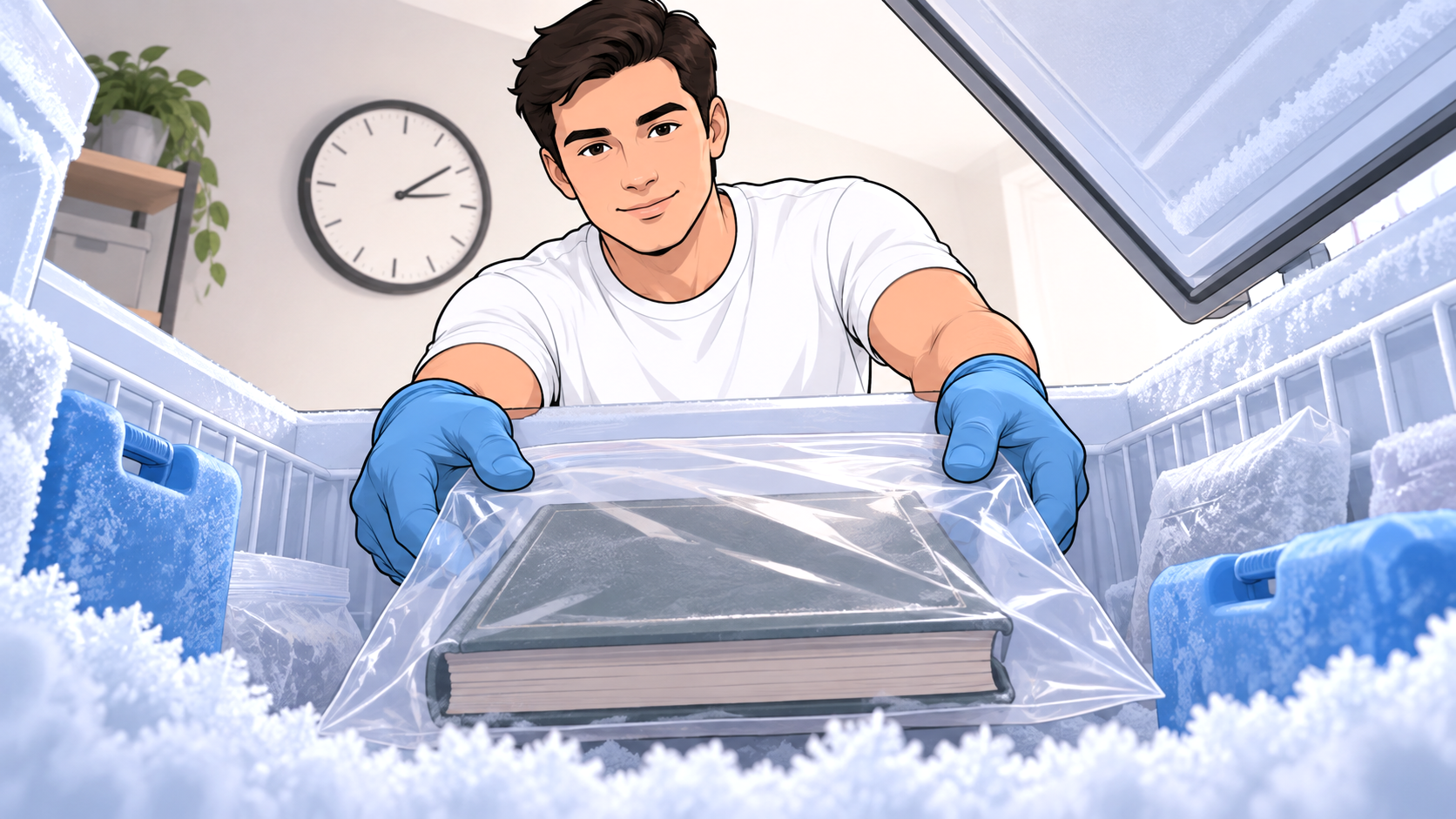
Freezing can kill booklice hiding in books, but putting an infested book in the freezer overnight is not a reliable treatment. Temperature, exposure time, the thickness of the book, and the cold tolerance of different booklouse life stages all matter. Eggs are particularly important because research has found them more resistant to cold than adults.
For ordinary books that are safe to freeze, seal the dry book in a plastic bag and keep it in a freezer at 0°F (-18°C) or colder for seven days. Let the sealed book return completely to room temperature before opening the bag. The seven-day period is a conservative household treatment that provides more margin than shorter institutional freezing schedules.
Freezing should still be selective rather than automatic. A damp book first needs appropriate drying, while rare, antique, fragile, or unusually constructed books may need professional conservation advice before they are frozen.
Does Freezing Actually Kill Booklice?
Yes. Controlled freezing is an established non-chemical method for killing booklice and other insect pests in books, archives, museum objects, and similar collections.
The Smithsonian Institution Archives identifies controlled freezing as an effective non-chemical treatment for collection pests including booklice. Cornell’s library preservation guidance likewise includes controlled freezing among the non-toxic methods used when insects have become established in library materials.
Booklice are not instantly killed simply because the temperature falls below freezing, however. Cold tolerance changes with temperature, exposure duration, species, and life stage. That distinction becomes particularly important when the goal is to kill every life stage hidden inside a book rather than simply immobilize the adults you can see.
How Long Should You Freeze Books for Booklice?
For a household treatment, seven days at 0°F (-18°C) or colder is a practical conservative target for ordinary books that can safely be frozen.
There are shorter published protocols. Cornell’s preservation guidance recommends exposing infested books to a freezer at or below -20°C (-4°F) for three to four days. Colorado State University gives a treatment of four days at -18°C (0°F) for articles that can tolerate freezing. Virginia Tech similarly recommends four days at 0°F for infested stored products.
Other institutional protocols deliberately use longer exposures. The University of Florida Herbarium keeps dry materials at -20°C (-4°F) for at least 7 to 14 days, allowing additional time when a large quantity of material takes longer to cool. That range illustrates why quoting one universal number without the temperature and object size can be misleading.
For someone treating a few ordinary books in a typical home freezer, seven days provides a sensible margin rather than trying to reproduce the shortest possible laboratory or institutional schedule.
Why One Night in the Freezer Is Not Enough
A booklouse becoming motionless in a freezer does not prove that the infestation has been eliminated.
Research on Liposcelis bostrychophila, a common stored-product booklouse, demonstrates how much cold tolerance can vary among life stages. A USDA Agricultural Research Service study of low-temperature exposure found that adults reached complete mortality after one day at -15°C (5°F). Eggs were considerably harder to kill, with survival still recorded after three days at -15°C.
That result is particularly relevant to books because the eggs of booklice are tiny and can be concealed. Killing the adults while viable eggs remain would leave the treatment incomplete.
The study also found adults surviving seven days at -10°C (14°F), showing why “below freezing” is not a useful treatment specification by itself. A freezer needs to be sufficiently cold, and the exposure needs to last sufficiently long.
Use a Freezer at 0°F (-18°C) or Colder
A freezer compartment that merely keeps food cold is not automatically suitable.
Check that the freezer maintains approximately 0°F (-18°C) or colder. A freezer thermometer is useful when you do not know its actual temperature. Do not substitute a refrigerator freezer compartment that cannot reliably maintain the treatment temperature.
The difference between 0°F and temperatures only slightly below the freezing point of water is substantial for insect control. L. bostrychophila has demonstrated considerable survival at some subzero temperatures, so simply seeing frost inside the compartment tells you very little about whether the treatment is adequate.
Collection protocols commonly use approximately -18°C to -20°C. Cornell specifies at or below -20°C for freezing infested books, while Colorado State recommends four days at -18°C for freeze-tolerant articles.
If your freezer cannot reliably reach about 0°F, drying the books and controlling humidity may be a better household strategy than attempting an uncertain cold treatment.
Make Sure the Book Is Dry Before You Freeze It
Do not take a wet book and immediately seal it for a week in the freezer as a DIY booklice treatment.
Booklice often occur around damp books because high humidity supports their survival and the fungi they commonly eat. Consequently, an infested book may already contain more moisture than is desirable.
Freezing is a pest treatment, not a substitute for dealing with water damage. A genuinely wet book can require specialized drying or conservation procedures, particularly when it is valuable. Active mold introduces another problem that should be handled appropriately rather than treated as though the insects are the only concern.
For an ordinary book that is already dry and in sound condition, controlled freezing is much more straightforward.
Put the Book in a Sealed Plastic Bag
Bagging is an important part of the process.
Place the dry book inside a suitable plastic bag and seal it before putting it in the freezer. For a small number of books, avoid creating an unnecessarily huge bundle. Thick stacks take longer for the cold to penetrate than individual books or smaller packages.
Museum and library freezing procedures routinely bag collection materials. The University of Florida, for example, instructs users to seal dry material before freezing and then allow it to return to room temperature before opening the package.
Bagging also becomes important at the other end of the treatment because it helps manage condensation while the cold book warms.
Start With Room-Temperature Books
Do not try to acclimate the insects gradually by leaving the books somewhere progressively colder before freezing them.
Controlled collection treatments generally move prepared material from normal conditions into a sufficiently cold freezer. Rapid cooling is preferable because some insects can increase their cold tolerance when given an opportunity to acclimate.
For a homeowner, there is no need to engineer a complicated cooling sequence. Make sure the book is dry, bag it at room temperature, and transfer it to a freezer already maintaining the required temperature.
Once it is inside, avoid repeatedly removing the book to check for live insects. Every interruption changes the temperature of the object and makes the exposure harder to interpret.
When Does the Seven-Day Clock Start?
The safest interpretation is to give the book itself adequate time at treatment temperature, not merely count from the second the freezer door closes.
A freezer’s air can already be at 0°F while the center of a thick book remains considerably warmer. Institutional protocols account for this problem. The University of Florida specifically warns that when a large amount of material enters a freezer, additional time must be allowed for the material to chill to the required temperature.
For one or a few ordinary books, a seven-day treatment provides considerable practical margin for cooling. Large boxes, tightly packed stacks, oversized volumes, or unusually thick books complicate the calculation because their centers cool more slowly.
This is another reason not to pack an entire shelf tightly into one enormous bag and assume every book received the same treatment.
Why Booklouse Eggs Make the Timing More Important
Adult booklice are not necessarily the hardest life stage to kill with cold.
The USDA-linked experimental work on L. bostrychophila found eggs surviving exposures that killed adults. At -15°C, complete adult mortality occurred after one day, while eggs still showed survival after three days.
That finding changes how we judge a successful treatment. Opening the freezer after 24 hours and finding no moving booklice tells you almost nothing about whether concealed eggs remain viable.
Booklice develop through egg, nymph, and adult stages, without a pupal stage. A useful freezing treatment therefore needs to address the population rather than just the most visible adults.
It also explains why we prefer a conservative seven-day household treatment instead of presenting the shortest experimentally lethal exposure as a DIY recommendation.
Can You Freeze Several Books at Once?
Yes, but do not pack them so densely that you undermine the treatment.
Several individually bagged books or a reasonably sized package can be frozen together if the freezer has enough capacity to return to the target temperature. Adding a large mass of room-temperature material temporarily warms the freezer and increases the time required for the centers of the books to cool.
Institutional freezing programs account for this thermal lag. The University of Florida uses -20°C and instructs staff to allow additional chilling time when large quantities enter the freezer.
For a household freezer, smaller batches are easier to manage. Leave enough room for the freezer to operate normally and avoid blocking vents or interfering with the appliance’s required airflow.
If dozens or hundreds of books are affected, freezing each volume may also be treating the wrong scale of problem. A collection-wide infestation should prompt an investigation of the room’s humidity and the conditions supporting the insects.
Let the Books Warm Up Before Opening the Bag
Do not take a frozen book out and immediately unwrap it.
Leave the book sealed while it gradually returns to room temperature. The University of Florida’s freezing protocol specifically recommends allowing frozen material to warm to room temperature before unpacking, which reduces the risk of moisture condensing onto the cold material.
Depending on the size and number of books, warming can take hours. There is no advantage to rushing this part.
Once the book has completely returned to room temperature, open the bag and inspect it. Remove dead insects and debris carefully where necessary, then return the book only to a dry, pest-controlled storage area.
Do You Need to Freeze the Books Twice?
Not necessarily for an ordinary booklouse problem when you have used an adequate continuous treatment, although repeated freezing appears in some conservation protocols.
Museum literature has historically recommended freeze-thaw-freeze cycles as an additional safeguard against insect survival. Other modern institutional procedures use a single sufficiently cold and sufficiently long exposure. For example, the University of Florida’s herbarium protocol uses a continuous treatment of at least 7 to 14 days at or below -20°C.
This variation is another reason we would not turn repeated freezing into a universal rule for household books. Each additional freeze-thaw cycle also means another environmental change for the object.
For ordinary books, a properly conducted seven-day treatment at 0°F or colder is more sensible than several poorly controlled overnight freezes.
Which Books Should Not Be Frozen Without Expert Advice?
Ordinary modern books are much easier candidates for freezing than rare or complex collection objects.
Be cautious with antique books, manuscripts, parchment or vellum, books containing photographs, unusual coated materials, fragile bindings, mixed-media components, or objects whose construction you do not understand. A valuable book is not the place to experiment with a household freezer.
The Smithsonian’s conservation literature documents freezing as a long-established pest-management technique, but professional collection treatment is controlled. Temperature, packaging, moisture, material compatibility, and thawing are considered together.
If a book is valuable enough that warping, adhesive failure, cracking, staining, or another material change would be a serious loss, consult a book or paper conservator before freezing it.
Can You Freeze Moldy Books?
Freezing insects and dealing with mold are separate problems.
A book with booklice may also contain mold because both are associated with damp conditions. Freezing can temporarily halt biological activity, but it does not remove mold contamination or correct the environmental conditions that allowed it to develop.
The more important long-term step is controlling moisture. Booklice commonly feed on mold and other fungi, so returning a treated book to the same humid shelf can recreate favorable conditions.
If a book has extensive active mold, particularly if it is valuable, conservation advice is preferable to treating it as a routine insect problem.
Will Freezing Damage an Ordinary Book?
Controlled freezing has a long history in library and archive pest management, which is one reason it is attractive as a non-chemical treatment. However, no treatment should be described as harmless to every book.
The materials inside a modern paperback or hardcover can differ substantially from those in an antique volume, photograph album, manuscript, or specialty publication. Paper, adhesives, coatings, inks, leather, parchment, and decorative components do not necessarily respond identically.
The risk is also influenced by moisture. A dry, ordinary modern book is a much simpler candidate than a damp or fragile volume.
When the material is valuable or unusual, preservation should take priority over convenience. Professional conservation protocols exist because killing the insect is only half of the job. The object needs to survive the treatment too.
Freezing Does Not Solve the Cause of Booklice
This is the most important limitation of freezing.
You can successfully kill every booklouse and egg in a book and still find booklice in the collection again if the room remains damp. Freezing provides no residual protection after the book returns to the shelf.
Booklice flourish in humid environments where microscopic fungi provide food. Keeping relative humidity below about 50% is generally recommended for household control, and low humidity can kill booklice while restricting mold growth.
If several books are infested, inspect the shelving, wall, floor, cardboard storage, and surrounding room. The broader process of getting booklice out of books depends heavily on drying both the collection and its environment.
Freezing makes the most sense for a contained infestation. Humidity control makes the environment less capable of producing another one.
What to Do After the Books Come Out of the Freezer
Once a sealed book has returned completely to room temperature, inspect it before returning it to the collection. Remove dead insects and loose debris carefully, taking the condition of the book into account.
Then inspect the shelf itself. Vacuum cracks and corners, remove damp cardboard, improve airflow, and correct leaks or condensation. Measure the relative humidity rather than assuming the storage area is dry.
This final step determines whether freezing becomes a treatment or merely a reset. Booklice can be introduced again with books, packaging, cardboard, food, and other materials. A consistently dry environment makes it much harder for a newly introduced population to establish.
When booklice are appearing throughout a room rather than inside a few identifiable books, reducing humidity and correcting moisture should take priority over trying to freeze every object individually.
Questions About Freezing Books for Booklice
Is 24 hours in the freezer enough to kill booklice?
Do not rely on 24 hours for a book. Laboratory research found adult Liposcelis bostrychophila could be killed after one day at -15°C, but eggs were substantially more cold tolerant and survived longer exposures. The center of a book also takes time to reach freezer temperature. A longer controlled treatment provides more protection against survival.
Is four days enough to kill booklice?
Four days at approximately 0°F to -4°F (-18°C to -20°C) appears in university and library pest-control protocols, including recommendations from Colorado State and Cornell. For a household treatment where freezer temperature and the book’s internal temperature are not professionally monitored, seven days provides additional margin.
Can I freeze a book for two weeks?
Some institutional collection protocols use 7 to 14 days at -20°C. However, longer is not automatically better for every book. If a volume is rare, fragile, damp, or made from unusual materials, determine whether freezing is appropriate before focusing on treatment duration.
Can booklice survive a freezer?
They can survive insufficiently cold or insufficiently long exposures. Research on L. bostrychophila found adults surviving seven days at -10°C, while eggs showed greater cold tolerance than adults at -15°C. This is why the actual freezer temperature matters as much as the number of days.
Can I put the book straight back on the shelf after freezing?
Only after it has warmed completely to room temperature while still sealed and the original storage area has been checked. Returning a treated book to a humid, booklice-friendly shelf does nothing to prevent reinfestation.
One thought on “How to Freeze Books to Get Rid Booklice (and How Long It Actually Takes)”