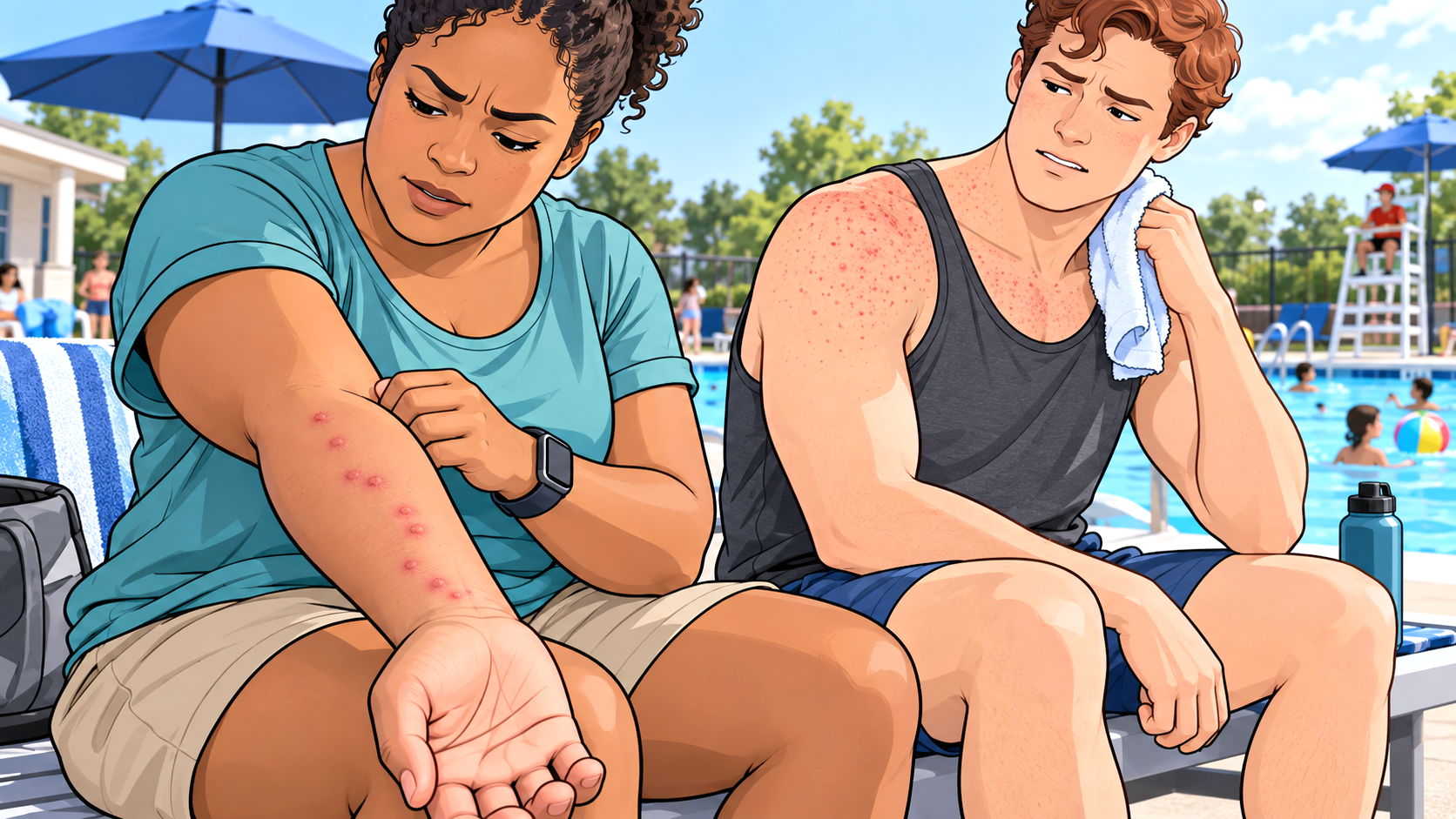
The fastest way to confuse bed bug bites with heat rash is to judge them only by redness and itching. Both can produce groups of small red bumps, especially after a warm night in bed. The better comparison begins before you inspect the bumps themselves. What was happening to your skin before they appeared, and what evidence exists in the room? Bed bug bites and heat rash can both be red and itchy, but they develop for completely different reasons. Heat rash follows trapped sweat and often affects sweaty or covered areas. Bed bug bites result from feeding and often affect exposed skin. Neither appearance nor location alone proves the cause, so the surrounding circumstances matter.
Start With What Happened Before the Bumps Appeared
Heat rash, also called miliaria or prickly heat, begins with sweating. Sweat ducts become obstructed, and the resulting irritation can produce small red, raised, itchy bumps. Hot and humid conditions make it more likely, especially when sweat remains against the skin instead of evaporating freely. Heat rash develops when sweating and blocked sweat ducts irritate the skin
That history can be surprisingly useful. A night spent in a very hot bedroom, prolonged sweating under heavy clothing, strenuous work in heat, or skin staying damp for long periods gives heat rash a plausible setup. The rash itself is only the visible end of that process. Miliaria is strongly associated with sweating and hot, humid conditions
Bed bug bites have a completely different backstory. Bed bugs feed on blood, usually while people are sleeping, and then retreat into protected hiding places around beds and other resting areas. A person may not feel the feeding as it happens, and visible marks can appear later. Bed bug bites may not become noticeable immediately after feeding
That is why we would put more weight on the preceding circumstances than on whether two red bumps happen to look alike. Sweating points you toward one investigation. Suspicious activity around a bed points you toward another.
Where Heat Rash Appears Can Be More Revealing Than Its Color
Heat rash has a strong relationship with places where heat, moisture, clothing, and skin folds keep sweat from escaping easily. Common locations include the neck, upper chest, groin, beneath the breasts, and elbow creases. Typical heat-rash locations include the neck, chest, groin, and skin creases
This can produce a pattern that looks very different from a few isolated bites. Imagine dozens of tiny irritated bumps spreading through a sweaty fold beneath clothing. That presentation makes more biological sense for heat rash than for bed bugs simply because the location matches where sweat can remain trapped.
Bed bug bite reactions are often noticed on skin that was accessible while someone slept. The face, neck, arms, hands, and other uncovered areas can be affected, and clustered red papules may occur on unclothed surfaces. Bed bug bites often affect uncovered skin
Still, body location cannot settle the question by itself. Pajamas shift. Blankets move. People sleep in different positions. A mark near your waist is not automatically heat rash, just as several bumps on an arm are not automatically bed bugs.
For a closer look at the areas these bites can affect, our guide to bed bug symptoms on the skin covers that subject without relying on location as a stand-alone diagnosis.
Stop Looking for a Perfect Bed Bug Pattern
People often expect bed bugs to leave three evenly spaced marks in a neat row. Real reactions are much less cooperative.
Bed bug marks can appear randomly or in a straight line. Several lesions may also occur together, and repeated feeding by a single bed bug has been associated with clusters of itchy papules or wheals. Bed bug marks can be random, linear, or clustered
That makes a line useful as a clue, but not much more. Our article on why bed bug bites can appear in clusters explains the feeding side in more detail. The important point here is that heat rash does not need to mimic a textbook bite line to create confusion. A patch of numerous small bumps can still look like “a lot of bites” to someone seeing it for the first time.
Heat rash usually behaves more like an eruption across an affected area than a collection of independent feeding sites. The common prickly form can produce small red raised bumps, while other types of miliaria can produce tiny vesicles. Different forms of miliaria can produce bumps or small vesicles
So rather than asking whether the rash forms a perfect line, look at the overall texture. A field of many tiny bumps across sweaty skin tells a different story from several discrete lesions separated by normal-looking skin.
The Bedroom Can Tell You What Your Skin Cannot
Suppose the bumps are still ambiguous. This is where the comparison should move away from your body.
Skin lesions are a poor way to confirm bed bugs because other insect bites, rashes, hives, and skin conditions can resemble them. Even people exposed to bed bugs do not all react in the same way. Some develop obvious marks, while others develop little or no visible reaction. Red skin lesions alone cannot confirm bed bugs
A bed bug investigation therefore has an advantage that a skin comparison does not. You can search for the pest.
Mattress seams, box springs, bed frames, headboards, cracks, and nearby furniture are common hiding places. During an inspection, look for live insects, shed skins, eggs, dark fecal spots, and rusty or reddish stains rather than trying to diagnose the infestation from your arm. Physical bed bug signs are more reliable than bite appearance alone
Our guide to checking a room for bed bugs takes you through that search. You can also compare anything suspicious with what an actual bed bug looks like rather than comparing one rash photograph against another.
Finding no insect during a five-minute inspection is not the same as proving the room is clear. Early infestations can be difficult to locate. If the skin reaction keeps raising suspicion but the bedroom looks clean, our guide to having bed bugs without seeing them explains why a more deliberate inspection may be needed.
Cooling the Skin Gives Heat Rash a Different Path Forward
Heat rash has something bed bug bites do not have: an ongoing environmental trigger that you can often remove. Reducing heat and continued sweating allows mild prickly heat to resolve, while keeping the affected skin cooler and drier addresses the conditions that produced it. Relief from heat and continued sweating helps mild heat rash resolve
That does not turn improvement after cooling into a diagnostic test. Skin conditions change for many reasons, and bed bug reactions also evolve over time. Instead, think of the response as another piece of context. A rash that arose during heavy sweating and settles as the skin stays cool and dry fits the expected course of heat rash better than a pattern of new lesions repeatedly appearing after nights in an infested room.
With suspected bed bugs, cooling the bedroom does nothing to answer whether insects are present. The useful action remains environmental inspection. When people have bites but no obvious bed bug signs, repeatedly treating the skin as proof can delay the search for the real cause.
Itching Does Not Separate the Two Very Well
Itching feels important because it is often what makes someone notice the rash in the first place. Unfortunately, both conditions can itch.
Heat rash can produce prickly or itchy red bumps because the sweat ducts and surrounding skin are irritated. Bed bug feeding can trigger inflammatory reactions that also itch. Both heat rash and arthropod bites can produce itchy skin lesions
Even the intensity varies too much to be useful as a simple separator. One person may have a strong reaction to bed bug bites, while another shows almost nothing. The same general problem applies when people compare bed bug bite reactions between individuals.
Instead of asking which one “itches more,” combine several clues. Think about recent heat and sweating, the distribution and texture of the rash, whether fresh lesions repeatedly appear after sleeping, and whether the bedroom contains actual evidence of bed bugs.
When the Skin Has Reached the Limit of What It Can Tell You
There comes a point where continuing to compare pictures adds less information rather than more. Neither heat rash nor bed bug bites has a single appearance that makes every case obvious.
Bed bug bite reactions themselves are not specific enough for a definitive diagnosis. Identifying an adult or nymph from the sleeping environment provides much stronger evidence that bed bugs are involved. Confirmation is strongest when an actual bed bug is identified
For heat rash, the surrounding heat and sweating history plus the location and appearance of the eruption usually provide the relevant context. However, other rashes can resemble both conditions. When the eruption is severe, worsening, infected-looking, unusually painful, accompanied by a broader allergic reaction, or simply cannot be identified confidently, medical evaluation is more useful than another round of image comparisons.
For confirmed or strongly suspected bed bug bites, our guide to when to see a doctor about bed bug bites covers the medical warning signs separately. Most uncomplicated bed bug bites require only minimal symptomatic care and good hygiene, while secondary infection or more severe reactions can require treatment. Clinical care for bed bug bites depends on the reaction and complications
A Better Way to Decide What You Are Looking At
Rather than trying to match your skin to a photograph, reconstruct what happened.
A rash that followed heavy sweating, spreads through areas where heat and moisture were trapped, and consists of many tiny bumps fits heat rash more naturally. Separate itchy lesions appearing after sleep, especially on accessible skin, make bed bugs worth investigating, but the skin still does not confirm them.
Then let the room break the tie. Finding the early physical signs of bed bugs changes the picture far more than finding another online photograph that resembles your arm. If you eventually capture an insect, identification of that specimen is the strongest route out of the guesswork.
That approach also prevents two opposite mistakes. You do not want to start a bed bug treatment because ordinary heat rash looked suspicious, and you do not want to dismiss a real infestation because the bites failed to form the classic row you expected.
Other Questions About Bed Bug Bites and Heat Rash
Can heat rash develop while you are sleeping?
Yes. Heat rash depends on sweating and sweat retention, not whether you are awake. A hot, humid sleeping environment, heavy bedding, or clothing that keeps sweaty skin covered can provide the conditions in which miliaria develops.
Can bed bug bites have small blisters?
Some bed bug reactions can include vesicular or blister-like lesions, although the more familiar presentation is itchy red papules or wheals. Because blistering can have many causes, a blister should not be used as evidence of bed bugs without environmental confirmation.
Can heat rash occur when the weather is not hot?
Yes. Environmental heat is common, but anything that produces substantial sweating and keeps sweat trapped against the skin can contribute. Fever, heavy or occlusive clothing, and other circumstances that promote sweating can also play a role.
Can you have heat rash and bed bug bites at the same time?
Yes. The two conditions have unrelated causes, so one does not prevent the other. Someone sleeping in a hot room with a bed bug infestation could develop both, which is another reason a confusing rash should not be diagnosed from its appearance alone.
How long before bed bug bites become visible?
The timing varies. Some people do not notice marks until days after feeding, and reactions can differ substantially between individuals. That delay makes it difficult to match every visible bump to one particular night. Our guide to how long bed bug bites can remain visible covers the timeline in more detail.