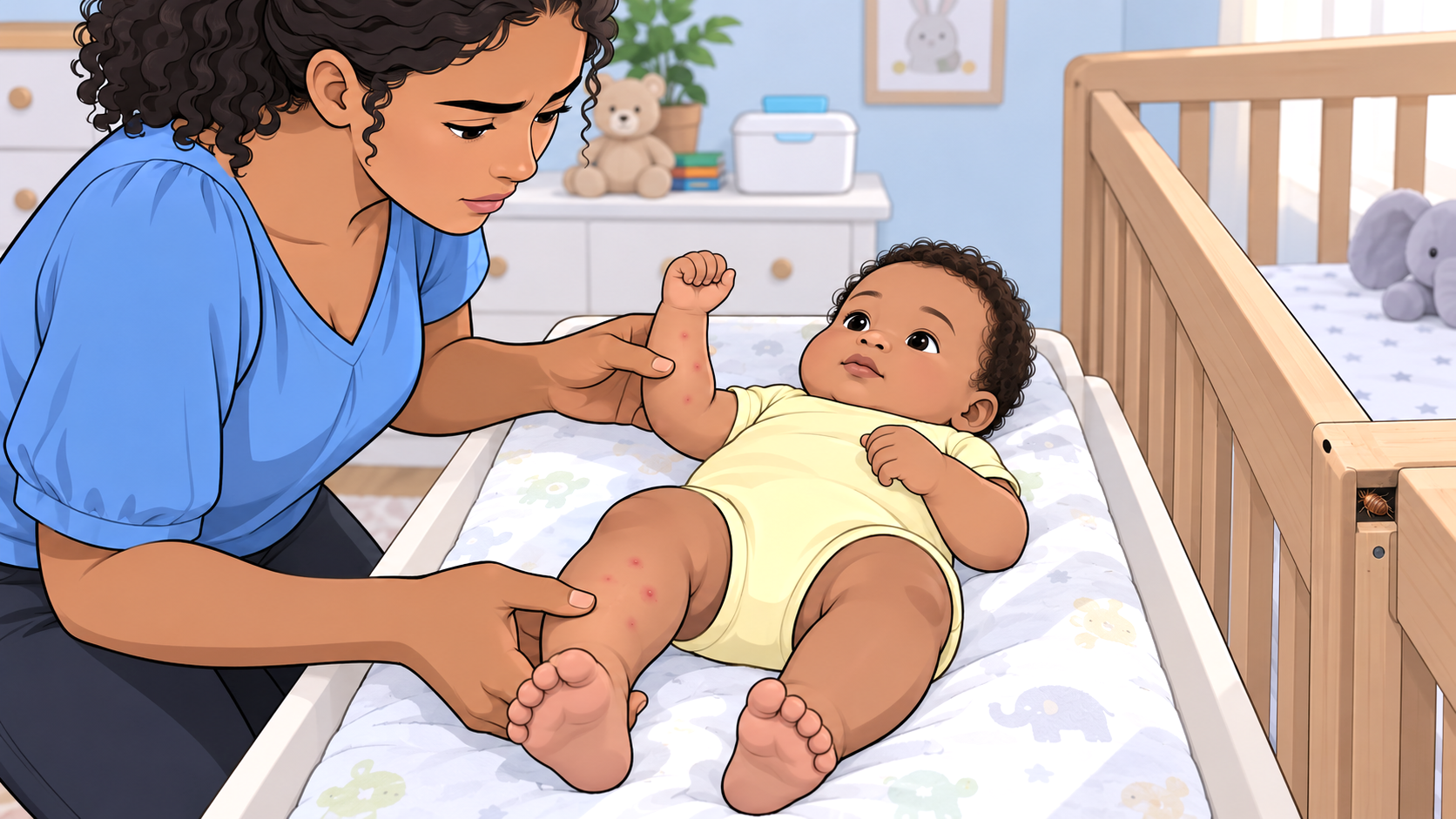
A baby cannot tell you that a spot started itching overnight, that several new bumps appeared after a nap, or that something felt different in the crib. Parents have to work backward from what they can actually observe. That makes suspected bed bug bites on babies more frustrating than the same marks on an adult, because the skin is only one part of the investigation.
Bed bugs can bite babies and infants just as they bite older children and adults. The bites may appear as itchy red bumps, lines, clusters, or barely noticeable marks, but appearance alone cannot confirm bed bugs. Check the crib and surrounding room for physical evidence, and seek medical advice when a baby’s reaction is severe, worsening, or concerning. Bed bug reactions can range from no visible mark to itchy bites
For a parent, there are really two problems to solve. The first is whether the baby’s skin needs medical attention. The second is whether bed bugs are actually present in the room. Mixing those questions together often leads to treating the wrong problem.
What You See on the Baby Is Only the Starting Point
A suspected bed bug bite may look like a small red or swollen bump. Several marks can sit close together, form a loose line, or appear without an obvious pattern. Some people develop little or no visible reaction at all, while others react more noticeably. Bed bug bites can produce very different reactions between people
That variation matters even more with an infant because you cannot ask when the itching started or whether the mark felt different yesterday. A baby may rub against bedding, become restless, or scratch when old enough to do so, but none of those behaviors identifies the cause. Instead, treat the skin appearance as a reason to investigate rather than proof that a bed bug fed there.
Our guide to how different bed bug bite reactions can look is useful when the marks seem unusual, but even a convincing photograph has limits. A rash, mosquito bite, flea bite, or another skin problem can overlap visually with suspected bed bug bites. Physical evidence in the room carries much more weight.
A Crib Gives You Better Evidence Than the Bite Pattern
Parents naturally focus on the baby first, but identification usually becomes clearer when attention shifts to the crib. Bed bugs spend most of their time hidden rather than sitting on the person they feed from. Around a sleeping area, they can shelter in seams, joints, cracks, frame connections, nearby furniture, and other narrow spaces. Physical signs around a sleeping area are more useful than bites alone
Strip the visual search down to things that can actually establish a bed bug problem. Live bugs are strong evidence. So are shed skins, eggs, dark fecal spots, and rusty or reddish staining around sleeping areas. A crib mattress may have fewer folds and structures than an adult bed, but the mattress edges, crib joints, screw recesses, nearby baseboards, and furniture still deserve careful inspection. recognized physical signs of bed bugs
This is where our bed bug mattress inspection guide and broader guide to checking a room for bed bugs become more useful than another skin photo. A baby with several bumps but a room containing no identifiable pest evidence still has an unresolved skin problem, not a confirmed bed bug infestation.
Bed Bugs Do Not Live on the Baby
Finding bites can make parents worry that insects are staying on the baby’s body or hiding in the baby’s hair or clothing. Bed bugs do not behave like head lice. They feed and then normally retreat to sheltered areas around the sleeping environment. Bed bugs are blood-feeding insects that hide between meals
So bathing the baby repeatedly will not solve an infestation in the room. Neither will continuously examining the baby’s skin for a bug that is more likely tucked into the surrounding structure. The useful inspection target is the place where the child sleeps and the objects immediately around it.
This also explains why a baby can develop new marks even though no insect is visible during the day. Bed bugs are good at remaining hidden, especially when the infestation is still small. Our article on having bed bugs without seeing them covers that problem in more detail.
The Number of Bites Does Not Tell You How Bad the Infestation Is
A baby’s skin can create a misleading sense of scale. Ten visible marks do not mean ten bed bugs are present, and a single mark does not mean there is only one insect. People vary too much in how their skin responds for bite counts to measure infestation size reliably. Bed bug bite reactions vary considerably from person to person
For the same reason, comparing the baby’s skin with a parent who sleeps nearby can confuse rather than clarify things. One family member may develop obvious itchy bumps while another shows no visible response. A parent without marks therefore cannot conclude that the baby’s bumps must have another cause.
Repeated marks after sleep deserve investigation, but infestation size should be judged from environmental evidence. Our early signs of bed bugs guide is a better place to evaluate that question than the number of bumps on the baby’s legs or arms.
Skin Care and Pest Control Should Stay Separate
Once bed bugs are suspected, it is tempting to solve both problems with whatever is already in the medicine cabinet or pest-control cupboard. That is where extra caution around infants becomes important.
For uncomplicated bed bug bites, medical guidance generally centers on symptom relief, avoiding scratching, and keeping the skin clean. Secondary infection can occur after repeated scratching, while more extensive reactions may need medical treatment. Clinical care for bed bug bites is usually based on symptoms and skin hygiene
Medication deserves more care in a baby than a generic online bite remedy suggests. Products used for itching can have age restrictions, dosing requirements, and limits on where they should be applied. Pediatric guidance, for example, cautions that some antihistamines should not be given to young children without a pediatrician’s direction, while topical hydrocortisone also has use restrictions. Children’s over-the-counter medicines have age-specific safety considerations
For an infant, we would not improvise with an adult dose, an essential oil, an insect repellent, or a pesticide on the skin. When symptom treatment is needed, use advice appropriate to the baby’s age and situation. Our bed bug skin treatment guide can provide general context, but the baby’s pediatrician or pharmacist is the better source for an age-specific medication decision.
The Crib Is Not a Place to Experiment With Pesticides
The infestation problem belongs in the room, but that does not mean every surface around the child should be sprayed. Pesticide labels specify where a product can be used, how it must be applied, and what precautions are required. Using a product indoors when it is labeled only for outdoor use, applying it to an unlabeled surface, or using more than directed can create unnecessary risk without solving the infestation. Bed bug pesticides must be used exactly according to their labels
Children and their toys should be removed from an area before pesticide application and kept away for the period specified by the product label. Pesticides and household chemicals also need to remain securely out of children’s reach. Children require specific precautions around household pesticide use
That makes a “spray everything around the crib” approach a poor starting point. Bed bug management works better as a coordinated process that combines identification, inspection, cleaning, monitoring, physical controls, and carefully selected pesticide use when needed. Integrated pest management combines multiple bed bug control methods
Our broader guide to getting rid of bed bugs covers the infestation side in more depth. Around a baby’s sleeping space, following the product label and avoiding unnecessary chemical exposure should take priority over trying increasingly aggressive home remedies.
Moving the Baby Without Moving the Bed Bugs
Parents may understandably want to move a baby out of an infested room immediately. The child can sleep elsewhere, but belongings need more thought because moving infested items into a clean room can carry bed bugs with them.
Bed bugs are effective hitchhikers and can travel on bedding, clothing, furniture, boxes, and other possessions. Bed bugs can spread by traveling on household belongings Moving a blanket, stuffed item, bassinet, or bag straight from a suspect sleeping area into another bedroom may therefore move the infestation as well.
Preparation guidance recommends keeping suspect items contained while they are being inspected or treated rather than casually transferring them through the home. Items from an infested area should be handled in ways that avoid spreading bed bugs That concern is separate from whether the baby continues sleeping in the affected room. The child and the potentially infested possessions do not have to be treated as one package.
Know When the Baby Needs Medical Attention, Not More Pest Inspection
Parents sometimes spend so much time trying to prove what caused a bite that the condition of the skin becomes secondary. With a baby, those priorities should stay in the opposite order.
Most uncomplicated insect bites in children can be managed conservatively, but persistent symptoms, significant swelling, worsening skin changes, or signs that the child is becoming unwell deserve medical attention. A systemic allergic reaction requires urgent care. Pediatric guidance explains when insect-bite reactions need medical care
Likewise, repeated scratching can damage the skin and contribute to secondary infection. Bed bugs themselves are not known to transmit disease through their bites, but the reaction to the bites can still become a medical issue. Bed bugs are not known to spread disease through their bites
Our guide to when bed bug bites need a doctor’s attention covers the warning signs more fully. With an infant, however, there is little value in waiting for the skin to become dramatically worse simply because the pest has not yet been identified.
Treat the Baby and the Bedroom as Two Separate Investigations
A parent who wakes up to unexplained marks on a baby does not need to decide immediately whether they are “definitely bed bug bites.” First look at the child. Note where the marks are, whether they are changing, whether the baby seems uncomfortable, and whether anything about the reaction warrants medical advice.
Then inspect the sleeping space as its own problem. Search the crib mattress, frame, nearby furniture, baseboards, and surrounding cracks for actual evidence. Our guide to how to tell if you have bed bugs brings those clues together.
That separation prevents two common errors. It stops a parent from assuming every mysterious infant rash is caused by bed bugs, and it stops a real infestation from being dismissed simply because the skin reaction does not look like a textbook photograph. The baby’s skin tells you what needs care. The room tells you whether bed bugs are likely part of the story.
Questions Parents Often Have About Babies and Bed Bugs
Can a newborn be bitten by bed bugs?
Yes. Bed bugs feed on human blood and do not require a host to be a particular age. A newborn in an infested sleeping environment can therefore be bitten. The appearance of a mark still cannot confirm the cause, so unexplained lesions on a newborn deserve appropriate medical evaluation alongside inspection of the sleeping area.
Can bed bugs hide inside a baby’s clothes or diaper?
Bed bugs can hitchhike on clothing and other fabric items, but they do not normally live permanently on the human body. A bug found on clothing should prompt an inspection of the surrounding environment rather than repeated treatment of the baby’s skin or clothing while the room goes unchecked.
Should stuffed animals be thrown away after bed bugs are found?
Not automatically. Many belongings can be inspected, contained, cleaned, or treated instead of immediately discarded. The appropriate method depends on the item’s materials, so avoid moving suspect toys into unaffected rooms until you know how they will be handled.
Can a baby have bed bug bites when the parents have none?
Yes. Visible bite reactions vary between people, and some exposed individuals develop no obvious marks. The absence of bites on the adults therefore does not rule out bed bugs in the baby’s sleeping environment.
Can bed bug bites interfere with a baby’s sleep?
Itching and skin irritation can be uncomfortable, and bed bug infestations are associated with sleep disturbance in people. A restless baby, however, has many possible reasons for sleeping poorly. Restlessness by itself should not be treated as evidence of bed bugs without physical signs in the room.
One thought on “Bed Bug Bites on Babies and Infants: What Parents Should Know”