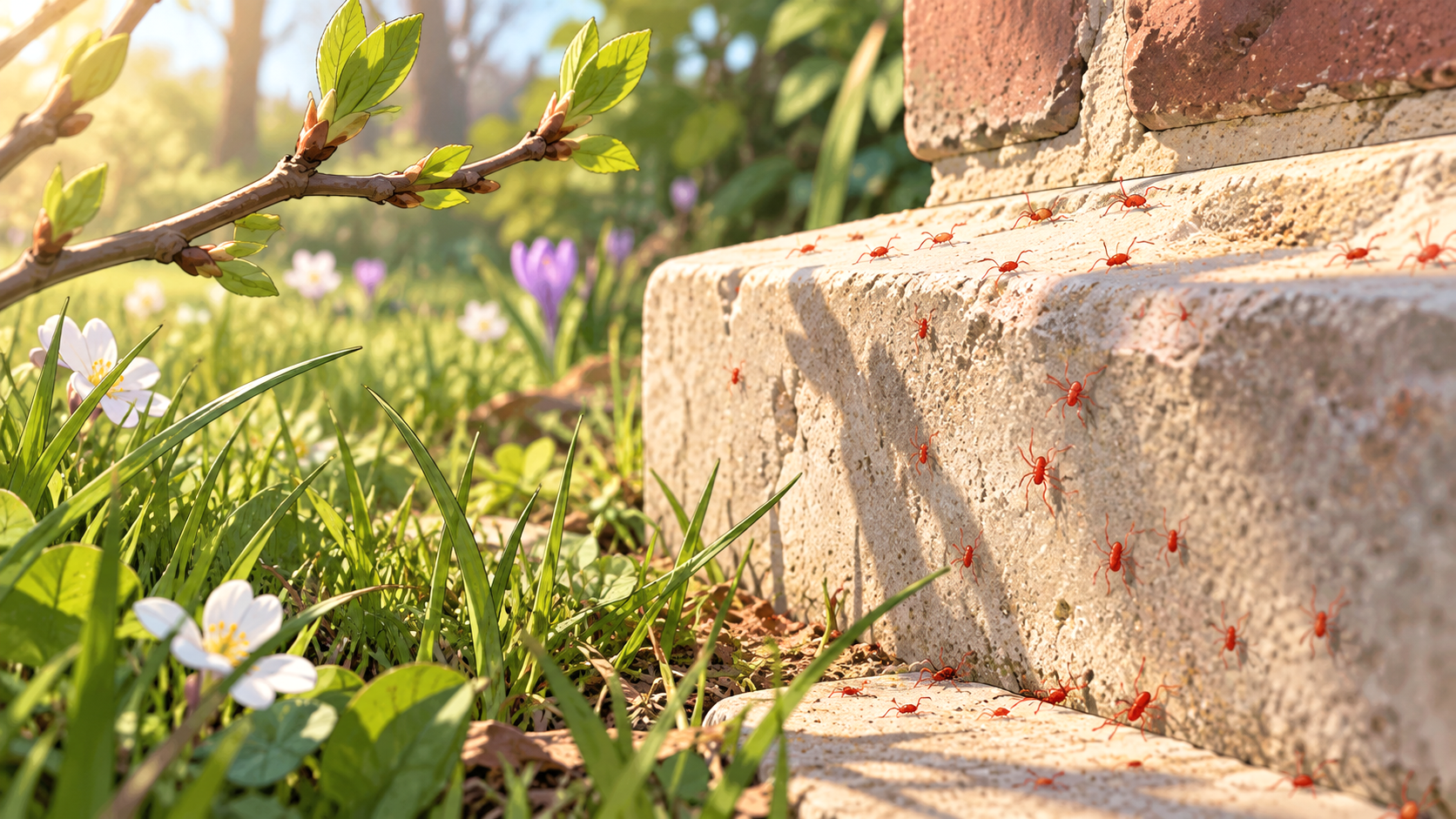
Clover mite season is mainly spring and fall. These cool-season mites become active when temperatures are moderate, while sustained summer heat greatly reduces their activity. The exact months vary by climate, so there is no single nationwide start and end date. For homeowners, spring is usually the most noticeable period. Large populations can appear on lawns, sidewalks, foundations, and exterior walls, with a smaller second period of activity often occurring in fall.
Spring Is the Main Clover Mite Season
Spring provides some of the best conditions for clover mite activity. As temperatures become mild, dormant eggs hatch and active mites begin feeding and developing. Spring and fall are their primary periods of activity, but spring populations are often the ones homeowners notice most.
Temperature gives a better indication than a fixed date. Clover mites are particularly noticeable when conditions fall roughly between 45°F and 80°F, or about 7°C to 27°C. Mild, humid spring weather can produce considerable activity, while warm sunny days encourage mites to move across turf and exterior surfaces.
Population numbers can also rise substantially during this period. Clover mite populations often peak in early spring, making large groups much easier to notice than at quieter points in the year. Their preference for lush lawns and vigorous vegetation can make activity especially conspicuous around suitable landscaping.
In parts of the United States, the most visible period can extend well beyond early spring. North Carolina observations, for example, place many problems between April and mid-June. Regional climate therefore matters more than the month printed on the calendar.
Summer Heat Usually Brings a Quiet Period
Clover mites are cool-season mites, so their activity declines as temperatures become consistently hot. Instead of continuing through summer at the same pace, development can enter a dormant period known as aestivation.
This seasonal pause is closely tied to heat. Summer heat interrupts clover mite development, while cool summers can allow greater survival and activity than hot, dry ones. That explains why the transition from spring activity to the summer lull does not occur on exactly the same date every year.
In warmer regions, the quiet period may begin earlier. Cooler climates or unusually mild summers can stretch activity further into the year. Their strong response to temperature is also why clover mite activity can change between daytime and nighttime instead of following a rigid daily schedule. Summer sightings are therefore possible. They simply fall outside the period when clover mites are usually at their most active.
Clover Mites Become Active Again in Fall
Cooling temperatures can produce a second clover mite season. Summer-dormant eggs begin hatching as conditions become favorable again, allowing another period of feeding and development before colder weather arrives.
In Oklahoma, for example, eggs begin hatching in fall as temperatures drop below about 85°F, with optimal egg hatch reported around 65°F to 70°F. Those figures illustrate why fall activity can begin at different times across regions rather than following a universal September or October schedule.
Fall populations may again become conspicuous around buildings. Large numbers can appear during both spring and fall, particularly when conditions favor movement away from vegetation. Because clover mites travel by crawling rather than flying or jumping, groups moving across foundations and other exposed surfaces can make this second seasonal peak particularly easy to see. Fall is generally the secondary peak rather than the dominant one. In many areas, spring produces the larger or more noticeable episode.
Clover Mite Season Changes With Climate
A calendar that says clover mite season begins in a particular month will inevitably be wrong somewhere. Spring warmth arrives earlier in southern areas and later farther north, shifting the timing of activity accordingly. That regional difference is well documented. The period when clover mites historically entered buildings was reported around April or May in Pennsylvania, earlier farther south, and later farther north. More recent regional guidance shows the same basic principle: seasonal temperature determines the timing more reliably than a fixed month.
Local weather can shift the season within the same region from year to year as well. An early warm spell can bring earlier activity, while prolonged cool conditions can delay development. Likewise, unusually cool summer weather can reduce the normal midsummer break.
This is why the most useful clover mite calendar is simple: expect the greatest activity during moderate spring weather, a substantial decline during sustained summer heat, and another active period as temperatures moderate in fall.
Other Questions About Clover Mite Season
What month are clover mites most common?
There is no universal month because climate changes the timing. In many temperate areas, spring is the main period, with some regions experiencing substantial activity from April into June.
Are clover mites worse in spring or fall?
Spring is generally the more prominent season. Fall can produce another substantial period of activity, but spring populations are commonly the most noticeable.
Are clover mites active during summer?
They can occasionally be seen, particularly during cooler weather, but sustained summer heat normally suppresses activity and development.
Does a cool summer extend clover mite season?
It can. Cool summers favor clover mite survival, while hot, dry conditions encourage summer dormancy.
3 thoughts on “When Is Clover Mite Season?”