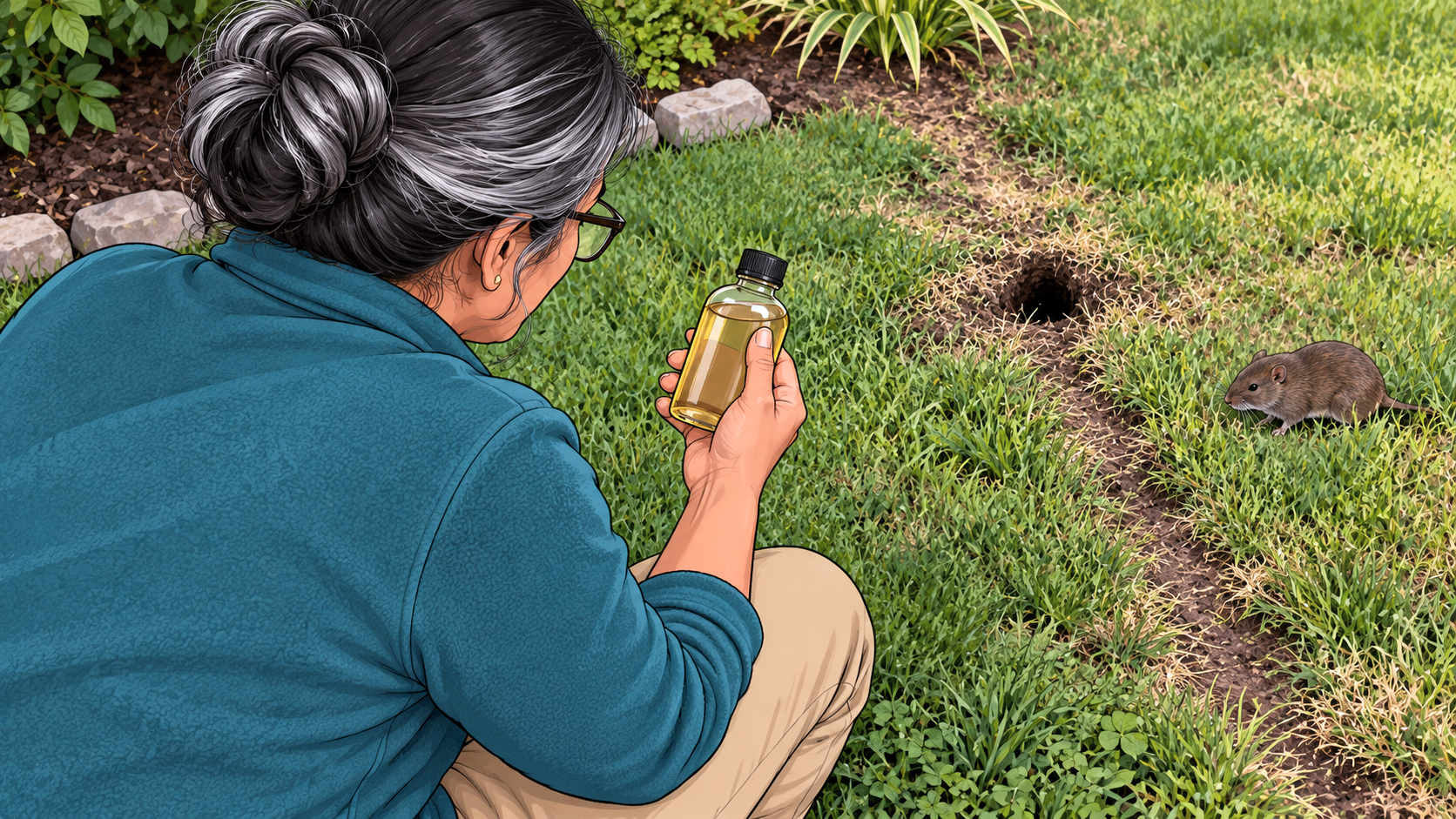
Castor oil may repel voles under certain conditions, but it has not been shown to reliably eliminate them from lawns, gardens, or other outdoor areas. Laboratory experiments have demonstrated avoidance responses to concentrated castor-oil treatments. Evidence that ordinary applications provide lasting protection against vole damage is much weaker. Castor oil is a repellent, not a population-control treatment, and its presence in the soil does not mean the animals have been removed.
The difference becomes apparent when voles have access to untreated vegetation nearby. An animal may avoid an unpleasant feeding location without abandoning the surrounding property. A homeowner could notice fewer signs in one flower bed while fresh vole runways through the grass appear a short distance away.
What Has Research Actually Shown About Castor Oil?
Castor oil has demonstrated some repellent potential against voles in controlled experiments, but those results have not established dependable field performance.
In experiments involving Microtus voles housed in soil-filled enclosures, several substances were evaluated for their ability to discourage feeding or movement. Castor oil, capsaicin, blood meal, coyote urine, quebracho, and thiram showed repellent potential at high concentrations. The experimental conditions allowed researchers to control variables that are considerably harder to manage in an outdoor garden.
High-concentration laboratory results do not establish that a consumer lawn treatment will protect plants through irrigation, rainfall, changing vegetation, or continued vole activity. The experiments also did not establish how long castor oil would remain effective under ordinary field conditions. The practical evidence is considerably less encouraging. Available data on vole-repellent effectiveness are limited, and castor-oil products have not demonstrated consistent protection across the conditions encountered by homeowners.
We would therefore treat castor oil as an uncertain deterrent rather than a dependable solution for plants already experiencing serious damage.
Why Castor Oil Works Better in Some Mole Claims Than Vole Claims
Much of castor oil’s reputation comes from products marketed against moles. The two animals are frequently confused, but they have different feeding habits and create different kinds of underground disturbance.
Castor-oil formulations have shown some effectiveness against eastern moles in research conducted in the eastern United States. One investigation evaluated a commercial formulation containing 65% castor oil on lawns occupied by eastern moles. The experiment concerned eastern mole activity, not vole feeding or population control.
Moles primarily consume soil invertebrates, while voles feed on vegetation. The differences between voles and moles extend to how they use soil and where their feeding damage occurs.
A positive result against one animal therefore cannot be transferred to the other. Advertisements describing a product as a mole-and-vole repellent may combine two claims that do not have equally strong supporting evidence.
Can Castor Oil Drive Voles Out of Their Burrows?
An odor or taste deterrent can change an animal’s willingness to use a particular area without forcing it to abandon its burrow system.
Voles occupy connected feeding routes, sheltered vegetation, and underground spaces. A treatment covering only the surface of one bed may leave adjoining routes and concealed feeding locations unaffected. Their preferred habitats and sheltered travel areas allow them to use different portions of the same property.
Castor oil does not physically block an entrance or prevent a vole from digging another route. It also does not provide evidence that the animal has died, relocated permanently, or stopped reproducing.
Consider two adjoining planting beds. If castor oil discourages activity in one bed but the animals continue using the other, the treated area may show temporary improvement without any reduction in the local population. That outcome is displacement, not eradication.
A repellent can therefore appear successful when observations are limited to the treated spot. Checking adjacent areas is necessary before attributing a broader reduction in damage to the treatment.
How Long Does Castor Oil Repel Voles?
There is no established, dependable duration of protection for castor oil against outdoor vole damage. Product claims about extended effectiveness should not be treated as independently demonstrated vole-control results unless testing supports the specific formulation and conditions.
Repellent residues are exposed to rain, irrigation, weathering, and changes in the treated surface. Outdoor vole repellents may require repeated applications, and their effectiveness can remain uncertain even when the treatment is maintained.
Location creates another limitation. Voles can damage plants at or slightly below ground level, where adequate repellent coverage is difficult. A product distributed across the lawn surface may fail to reach the exact location where feeding occurs.
A manufacturer may provide a reapplication interval for its product, but that interval does not establish that every treated area remains protected until the next application. The label should govern any actual use; a homemade mixture has no independently established application schedule or duration of protection.
Is Castor Oil Worth Trying Against Voles?
Castor oil is a weaker choice when a valuable planting needs immediate, dependable protection. A newly planted fruit tree with fresh bark damage has little tolerance for another feeding incident, while an established ornamental bed may tolerate some uncertainty.
The type of problem should determine whether experimenting with a repellent is reasonable.
| Situation | What castor oil can realistically offer |
|---|---|
| Occasional vole activity without significant damage | A possible deterrent, with uncertain benefit |
| Repeated feeding in an ornamental bed | Uncertain protection that requires monitoring |
| Fresh bark damage threatening a young tree | Insufficiently dependable as the sole protection |
| Voles traveling through several connected areas | Possible local avoidance without population reduction |
| A garden requiring reliable exclusion | No physical barrier against entry |
The severity of vole damage in a garden determines how much uncertainty is acceptable. Repeated destruction of valuable plants calls for a method with stronger evidence.
Properly installed barriers can prevent access to vulnerable vegetation, while removing excessive ground cover reduces the shelter supporting feeding activity. These nonchemical approaches to vole management address conditions that castor oil does not physically change.
For homeowners who still choose a commercial castor-oil product, its label must specifically permit the intended application. Food crops require particular attention because a product labeled for lawns or ornamentals is not automatically approved for edible plants. Repellents should not be applied to food crops without label authorization.
How to Tell Whether Castor Oil Has Helped
Assess new feeding damage rather than relying on fewer sightings. Mark the affected planting, photograph existing injuries, and compare fresh activity after treatment. Inspect nearby untreated vegetation as well, because displacement can make one area appear improved while another deteriorates.
For example, suppose six seedlings were damaged before treatment and no additional seedlings are damaged during the following observation period. That establishes a change in the observed losses, but it does not prove castor oil caused the improvement. Vole activity, alternative food availability, weather, and other conditions may also have changed.
A stronger indication of useful protection is the continued absence of new damage while the planting remains exposed to the same local vole activity. Even then, observations from one garden cannot establish that the treatment will work elsewhere.
If fresh injuries continue, further castor-oil applications should not delay protection with a suitable physical barrier. Where plants remain undamaged, maintain observations rather than assuming the vole population has been eliminated. Castor oil can be assessed as a possible deterrent, but success should be measured by the plants it protects, not by claims that it permanently drives voles away.