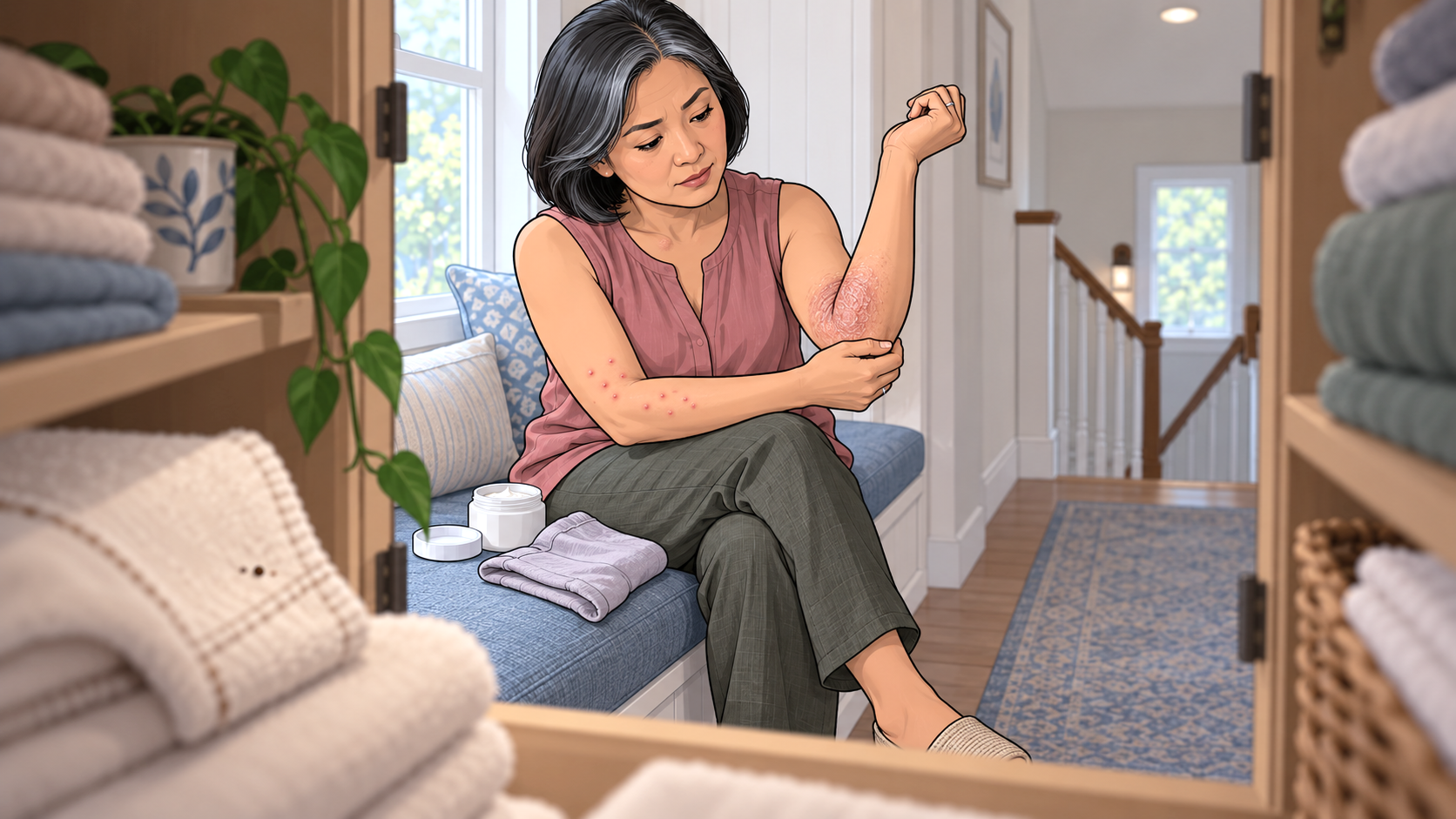
Bed bug bites and eczema can both itch badly enough to ruin a night’s sleep, and scratching can make either problem look angrier by morning. That overlap makes a single photograph surprisingly unhelpful. The better distinction often comes from looking beyond today’s bumps and asking what the surrounding skin has been doing for weeks, months, or even years. With bed bug bites vs. eczema, eczema usually behaves like an inflammatory skin condition that flares, recurs, and can leave areas dry, scaly, cracked, or thickened. Bed bug bites are reactions to separate feeding events and more often appear as individual itchy lesions. Neither can be diagnosed reliably from appearance alone.
Eczema Usually Has a Story Before Today’s Rash
A bed bug bite is an event. An insect feeds, and the skin may react afterward. Eczema is different because the skin itself is affected by an inflammatory condition that can repeatedly flare and improve.
The word eczema actually refers to a group of conditions that cause inflamed, irritated, and often itchy skin. Atopic dermatitis is the most common type, but contact dermatitis, nummular eczema, dyshidrotic eczema, and several other conditions fall under the same broad label. That variety matters because not every case of eczema will produce the same-looking rash.
Atopic dermatitis, for example, is chronic and often moves between periods of worsening and improvement. A person may recognize the same troublesome areas returning again and again. The skin can become intensely itchy, dry, scaly, cracked, thickened, or discolored as the condition evolves.
That history is extremely valuable. Someone who has had recurring dry patches inside the elbows for years and experiences another flare there has a very different pattern from someone whose previously normal forearms suddenly develop several separate itchy bumps after sleeping in a new room.
Look at the Skin Between the Spots
People comparing bed bug bites with eczema often concentrate so heavily on the individual bumps that they ignore the skin connecting them.
With eczema, the surrounding skin frequently participates in the problem. Atopic dermatitis can produce dry, scaly areas, rough bumps, swelling, scratch marks, cracking, and thickened skin. A patch may therefore look like an area of unhealthy skin rather than a collection of isolated lesions sitting on otherwise ordinary skin.
Bed bug reactions tend to make more sense as separate bite sites. They may be slightly swollen, itchy, and arranged randomly or in groups. However, the skin between individual lesions does not have to become uniformly dry or scaly simply because bed bugs fed nearby. Bite reactions also vary so much that some people develop no visible marks at all.
This gives us a useful way to change the inspection. Instead of zooming in on the reddest bump, zoom out. Ask whether you are looking at several distinct spots or at a broader piece of skin whose texture and condition have changed.
That difference will not diagnose either condition, but it can point the investigation in a more useful direction.
Eczema Often Returns to Familiar Territory
The location of eczema is not random, although it varies with age and with the particular type of eczema involved.
In teenagers and adults, atopic dermatitis commonly affects areas such as the hands, neck, bends of the elbows and knees, ankles, feet, and skin around the eyes. Children often develop it in characteristic flexural areas as well. Atopic dermatitis can occur elsewhere, but age influences where the rash commonly appears.
Other eczema types have their own distributions. Dyshidrotic eczema, for instance, produces intensely itchy small blisters on the hands, feet, or both. Nummular eczema produces persistent round or coin-shaped patches. That is why “eczema” cannot be reduced to one universal rash map.
Bed bug bites have a different reason for appearing where they do. The insect needs access to skin while a person rests. Arms, hands, face, neck, and legs can therefore be affected because clothing and bedding may leave those areas exposed. Our guide to why bed bugs bite certain body areas explains how sleeping position and accessibility can shape that distribution.
The important distinction is not simply “elbow means eczema, arm means bed bugs.” It is whether the location makes sense as a recurring skin condition or as skin that happened to be accessible during feeding.
Dryness and Scaling Push the Question in a Different Direction
An itchy bump can belong to many conditions. Persistent dryness and scaling change the character of the problem.
Atopic dermatitis affects the skin barrier, which makes it harder for the skin to retain moisture. As a result, affected skin can become very dry, itchy, irritated, cracked, and inflamed. Repeated scratching can further damage the area and eventually produce thickened, leathery skin.
Bed bug bites can certainly become crusted or damaged when scratched. They can also become secondarily infected. Yet dryness and scale extending across an established patch are not features we would use to identify bed bug feeding.
This becomes particularly useful when someone has been scratching for several days. Scratching can make almost any itchy problem look rough, so one crusted bump tells you little. A longstanding patch that repeatedly dries, scales, cracks, heals, and flares again carries a much stronger eczema history.
The skin’s texture over time may therefore be more informative than how red it happens to look today.
Color Can Mislead on Both Sides of the Comparison
Bright redness is often overemphasized in descriptions of both eczema and insect bites.
On darker skin, atopic dermatitis may appear dark brown, purple, grayish, lighter, or darker than the surrounding skin rather than obviously red. It can also produce rough bumps and changes in pigmentation after inflammation settles. These differences are well documented in how atopic dermatitis appears across skin tones.
Bed bug reactions can also look different on darker skin. They may appear faint pink, purplish, brown, or darker as post-inflammatory pigmentation develops. Our dedicated guide to bed bug bites on Black and dark skin covers those differences in more detail.
Color therefore does not provide a reliable dividing line. A purple-brown itchy patch is not automatically eczema, just as a bright red bump is not automatically an insect bite.
Texture, recurrence, distribution, timing, and physical pest evidence give the color much-needed context.
A New Laundry Product Can Matter More Than a Mattress Seam
History becomes especially useful when something changed shortly before the rash began.
Eczema flares can be associated with individual triggers. Depending on the person, these may include fragrances, harsh detergents, certain skin-care products, weather changes, wool, stress, and other exposures. Trigger patterns vary, so the point is not to create a universal list. It is to notice whether the rash followed a change that makes sense for that person’s skin.
For example, itchy dermatitis appearing after repeated contact with a new product raises a different question from isolated marks developing after nights in a room where bed bugs are later discovered. Atopic dermatitis management commonly includes identifying and reducing personal flare triggers.
That history can be much more useful than studying whether the lesions are perfectly circular.
At the same time, do not use a plausible trigger to dismiss actual pest evidence. A person can have eczema and bed bugs at the same time. The skin history and the bedroom inspection answer different questions.
Bed Bug Evidence Exists Outside Your Body
This is where the comparison becomes unusually one-sided.
Eczema does not leave fecal spots on a mattress. It does not produce shed insect skins inside a box spring. It cannot place a live bed bug in a bed-frame joint.
Bed bugs can.
When bed bugs remain a serious possibility, stop asking the skin to do all the diagnostic work. Check mattress seams, piping, labels, the box spring, headboard, frame joints, and nearby cracks. Look for live insects, eggs, shed skins, dark fecal spotting, and rusty stains associated with crushed bugs. Our guide to checking a mattress for bed bugs gives that search its own step-by-step treatment.
That environmental evidence matters because bed bug bites themselves are not diagnostic. The skin reaction can resemble other arthropod bites and inflammatory skin conditions, while some exposed people show no reaction. Accurate bed bug identification depends on finding and identifying the pest or its physical evidence.
We would give a confirmed insect far more weight than whether a rash happens to resemble an online bite photograph.
Eczema Can Make a Bed Bug Problem Harder to Read
The comparison becomes messier when someone already has eczema.
A person with an existing itchy skin condition may notice a sudden worsening and assume the eczema simply flared. Conversely, someone worried about bed bugs may reinterpret every patch of dermatitis as new feeding activity.
There is another complication. Scratching both eczema and insect bites can damage the skin. Atopic dermatitis itself already involves an itch-scratch cycle in which scratching worsens inflammation and skin damage. Bed bug bites can also provoke enough scratching to contribute to secondary infection.
This means heavily scratched skin can eventually hide the original distinction. An irritated patch may contain eczema, bite reactions, scratch marks, crusting, and secondary inflammation all at once.
At that stage, trying to diagnose the problem by comparing photographs becomes increasingly unreliable. A clinician can evaluate the skin, while a separate inspection can determine whether bed bugs are actually present.
Those two investigations can proceed together. You do not have to decide in advance that only one explanation is allowed.
The Calendar Can Reveal a Pattern the Mirror Misses
A simple record can sometimes be more useful than repeatedly checking the rash throughout one evening.
For several days, note when new areas appear, where they occur, and whether older areas are improving or returning. Also note meaningful changes such as travel, sleeping somewhere different, switching detergent or skin products, unusual weather exposure, or a known eczema flare.
Eczema often behaves in episodes. Atopic dermatitis can worsen for a period and then improve or clear, with later flares occurring in the same or different locations. That recurrent pattern is part of the disease itself.
Bed bug reactions tell a different story. Additional lesions require additional feeding events, although delayed reactions mean the time a mark becomes visible does not perfectly identify the night of exposure. The CDC notes that bite marks may not appear until one to several days after feeding.
A calendar will not diagnose either condition, but it can expose patterns that a single snapshot hides. It also gives a healthcare professional better information than “the rash looked worse yesterday.”
When the Question Should Leave the Bedroom
There comes a point when identifying an insect is no longer the only issue.
Persistent eczema deserves appropriate diagnosis and management, particularly when the rash is widespread, repeatedly disrupts sleep, cracks or bleeds, or does not respond as expected. Atopic dermatitis can also become infected after repeated scratching damages the skin barrier. Signs of infection or rapidly worsening symptoms warrant medical attention.
Bed bug bites can also become secondarily infected through scratching, and rare allergic reactions can occur. Guidance on bed bug bites recognizes a range from no visible response to much stronger reactions, which is why severe swelling or other concerning symptoms should not be diagnosed at home from appearance alone.
The practical division is simple. A dermatologist or other healthcare professional evaluates the skin condition. A careful pest inspection evaluates the sleeping environment.
Trying to force one side to answer the other’s question usually creates more confusion.
Let the Skin History and the Room Evidence Meet in the Middle
When eczema and bed bug bites look similar, avoid making the decision from one bump.
A rash with recurring dry, scaly, cracked, or thickened areas has a different history from several new discrete lesions after an exposure. Familiar flare locations and personal eczema triggers add context. So does an existing diagnosis of eczema.
Then look outside the body. A live bed bug, eggs, shed skins, or characteristic fecal spotting near a sleeping area can establish a pest problem that the rash itself cannot.
When neither side produces convincing evidence, keep the diagnosis open. Our guide to bites with no obvious bed bug signs explains why unexplained skin symptoms should not automatically become a bed bug diagnosis.
The strongest answer often comes from combining two histories: what your skin has been doing and what is actually happening around your bed.
Other Questions About Eczema and Bed Bug Bites
Can bed bug bites cause an eczema flare?
An insect bite can irritate already sensitive skin, and scratching can worsen existing dermatitis. However, a sudden worsening of eczema does not prove bed bugs caused it. Confirming bed bugs requires environmental evidence rather than attributing the flare to insects from appearance alone.
Can eczema appear as separate little bumps instead of one large patch?
Yes. Some forms of eczema can produce small bumps, and the appearance varies with the eczema type, age, and skin tone. Atopic dermatitis in darker skin tones, for example, may feature many small rough bumps. Separate bumps therefore do not automatically point to insect bites.
Can bed bug bites become dry or crusty while healing?
Scratching can damage bite lesions and lead to crusting or other surface changes. That can make older bite reactions look less like the smooth swollen bumps shown in typical photographs. Persistent scaling across a broader recurring patch, however, deserves consideration as dermatitis or another skin condition rather than being assumed to be bed bugs.
Does having eczema make it harder to notice bed bug bites?
It can make interpretation more difficult because eczema already causes itching, inflammation, scratch marks, and visible skin changes. Someone with eczema may also develop bed bug reactions at the same time. In that situation, inspecting the sleeping area becomes particularly valuable because the skin alone may not separate the two problems.
When should I see a dermatologist instead of continuing to look for bed bugs?
Medical evaluation makes sense when the rash persists, repeatedly returns, spreads, becomes painful, develops signs of infection, or remains unexplained despite a careful pest inspection. A dermatologist can evaluate eczema and other possible skin conditions, while a pest professional can address confirmed or strongly suspected bed bug activity.