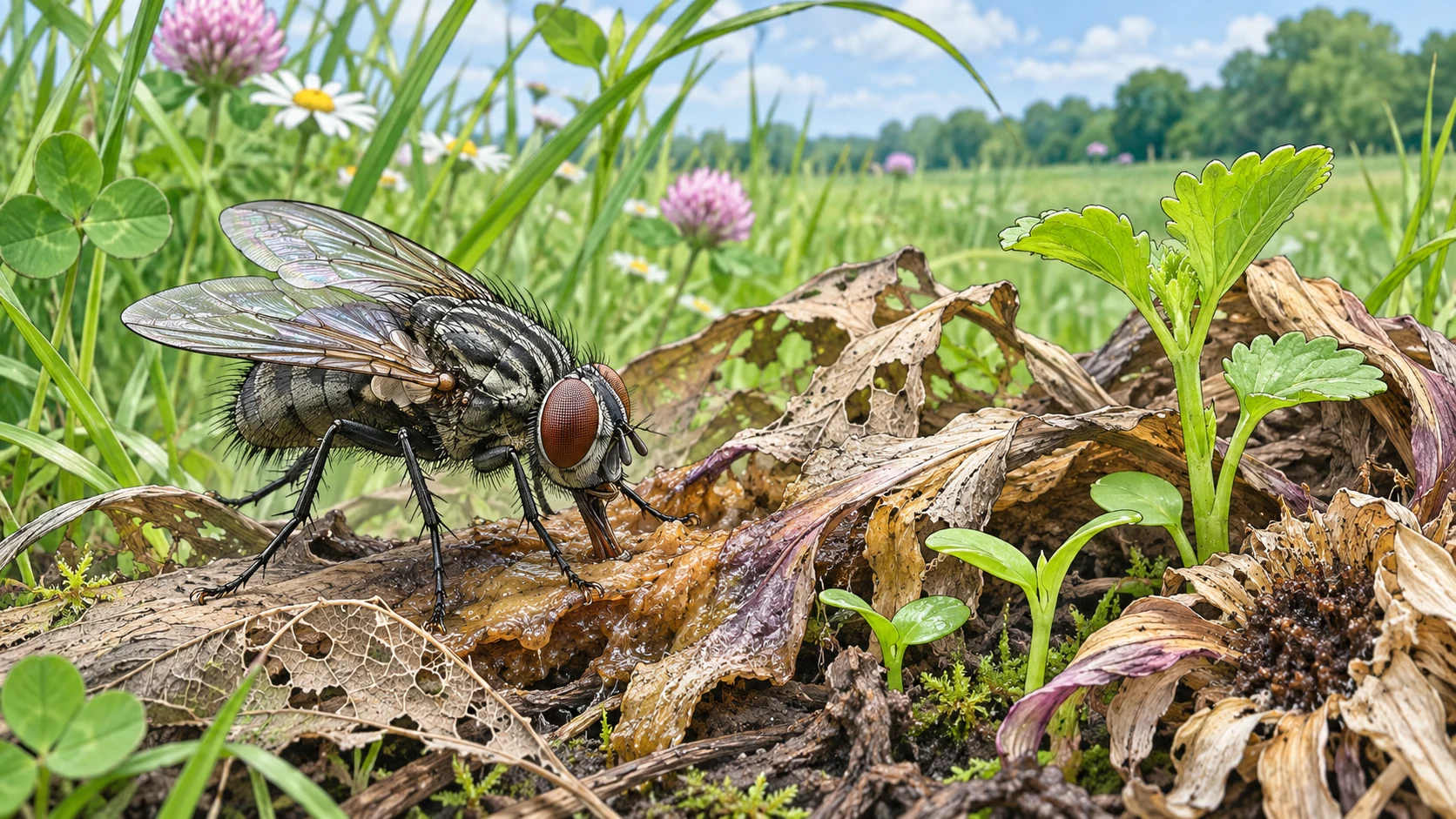
House flies (Musca domestica) serve several ecological purposes, particularly breaking down organic waste, recycling nutrients and providing food for other organisms. Their larvae feed on manure and decomposing material, helping process substances that accumulate in the environment. Adult flies also become prey for other animals and can contribute to pollination under certain conditions. Although their association with waste makes them troublesome around people, they have established functions within natural food webs.
How Do House Flies Help Decompose Organic Material?
One of the main ecological functions of house flies is helping break down organic material. Their larvae develop in moist substances such as animal manure, rotting vegetation and decomposing food. By consuming this material, maggots help process organic waste and make its nutrients available to other organisms.
The process begins when a female deposits eggs in a suitable organic substrate. After hatching, the maggots feed within the material, consuming nutrients as they grow. Microorganisms such as bacteria and fungi also break down the waste, so house fly larvae contribute to a decomposition process involving several organisms.
Animal manure is a particularly important example. It contains organic nutrients that support larval development, and house fly larvae can consume substantial quantities of this material under suitable conditions. Their feeding on decaying organic substrates is part of the process through which these insects participate in nutrient recycling.
The natural decomposition functions of flies include processing dead organisms, manure and decaying vegetation. These materials also provide food and breeding environments for immature flies.
How much organic waste can house fly larvae process?
House fly larvae have attracted scientific interest because of their ability to develop in animal manure and other organic waste.
A 2023 experiment examined the development of 4,000 house fly larvae fed one kilogram of swine, dairy or poultry manure. Researchers measured larval growth, survival and development across the different diets.
Survival to the pupal stage varied by material. Approximately 73% survived on swine manure, 67% on poultry manure and 50% on dairy manure. These results demonstrate that house fly larvae can develop in substantial quantities of animal waste, although the suitability of the material influences their survival.
The experimental research on house fly larvae processing different types of manure also examined the potential for recovering nutrients from animal waste.
This research was conducted under controlled production conditions. It demonstrates the potential of house fly larvae for waste processing, not a guaranteed rate of decomposition in an ordinary backyard or natural manure pile.
How Do House Flies Contribute to Nutrient Recycling?
Decomposition allows nutrients contained in organic material to become available again within the environment. House fly larvae contribute by consuming material that would otherwise remain as accumulated waste.
As larvae grow, they convert some of the nutrients in their food into insect biomass. That biomass can subsequently become food for predators and other organisms.
This creates a connection between decomposing material and the animals that consume insects. Nutrients originally present in manure or rotting vegetation can pass through house fly larvae into other parts of the food web.
The process has also attracted interest beyond natural ecosystems. Research into house fly waste conversion and resource recovery examines the potential uses of larval biomass, including protein for animal feed, fats for biodiesel production and insect residues as soil amendments. These are developing waste-management applications rather than evidence that wild house flies naturally produce commercial fertilizers or fuels.
Adult house flies also consume substances associated with organic waste. Their feeding range includes animal waste and other accessible organic materials, connecting their adult feeding activity with the environments used by their developing offspring.
Where Do House Flies Fit Into the Food Web?
House flies are also a source of food for other organisms. Both their developing stages and adult insects can become prey, connecting them to predators occupying different parts of their environments.
Some of the documented natural enemies of Musca domestica include histerid beetles, predatory muscid flies and macrochelid mites. These organisms are particularly associated with the manure and organic materials where developing flies are found.
Examples include the histerid beetle Carcinops pumilio and the predatory mite Macrocheles muscaedomesticae. Their feeding relationships show how house flies become part of the same environment they help process.
The species-specific predator and food-web relationships of house flies include these beetles and mites, as well as interactions with dung beetles that disturb developing larvae in manure.
House flies also contribute to food availability for larger insect-eating animals. Flies as a group are consumed by birds, fish and reptiles, while some plants, including Venus flytraps, capture insects as food. Their ecological contribution therefore extends beyond the organisms living directly in manure.
A house fly population can provide prey at different developmental stages, although individual predators do not necessarily depend on house flies as their main food source. The natural enemies of house flies illustrate how these insects fit into a broader network of predation.
Can House Flies Help Pollinate Flowers?
House flies can contribute to pollination when they visit flowers and transfer pollen between blossoms. This is an incidental ecological function associated with their movement around flowering plants.
Pollen grains can attach to the hairs covering a fly’s body when it contacts a flower’s anthers. Some of those grains may subsequently reach the receptive stigma of another flower, potentially contributing to fertilization.
Research has demonstrated that Musca domestica can pollinate particular crops, including leek and carrot, in controlled growing environments. Their effectiveness varies with the plant and the conditions under which pollination takes place.
A scientific review of non-bee insects as crop pollinators identifies house flies among the insects capable of contributing to crop pollination, while emphasizing that effectiveness measurements remain limited for many non-bee pollinators.
Pollination is therefore a supplementary contribution rather than the main ecological function associated with house flies. Their more established relationships involve decomposing material and food webs. The crop-specific evidence and limitations are discussed in the research on house flies pollinating flowers.
Do House Flies Have an Important Role in Soil and Manure Ecosystems?
House flies are particularly associated with environments where organic waste accumulates. Their larvae develop in moist manure and decomposing material, where they participate in the biological processing of these substances.
Manure contains nutrients that can support bacteria, fungi and numerous invertebrates. House fly larvae use some of these resources for growth, while other organisms compete for the same nutrients.
Dung beetles also influence these environments by disturbing and moving manure. Their activity can affect the survival of developing house fly larvae and change the availability of breeding material.
The ecological relationships between house flies and other organisms living in manure include competition with fungi and interactions with bacteria such as Klebsiella oxytoca. These relationships show that decomposition involves a community of organisms rather than one insect acting alone.
House flies are especially associated with organic waste produced in human and animal environments. Consequently, their ecological functions are often concentrated around places where suitable food and breeding material are available.
Are House Flies Necessary for a Healthy Ecosystem?
House flies contribute to ecological processes, but their functions are shared with many other organisms. Bacteria and fungi decompose organic matter, dung beetles process animal waste, and numerous insects provide food for predators.
The house fly is one participant in this larger system. Its larvae consume suitable organic material, while adults and immature flies provide prey for other organisms. Their contribution varies with the availability of breeding material and the abundance of predators.
We should also separate natural ecological functions from deliberate waste-management applications. A 2025 scientific review examines the potential of house flies as bioconversion organisms, including the production of insect-derived materials from organic waste. These applications demonstrate possible uses of their biology, but they do not establish that house flies are indispensable to natural ecosystems.
The broader ecological identity of the common house fly helps put these functions into context. Its association with people, animals and decomposing material explains why it occurs in so many different environments.
The relationship between house flies and garbage decomposition also illustrates how human-generated organic waste can support insect populations and contribute to the surrounding food web.