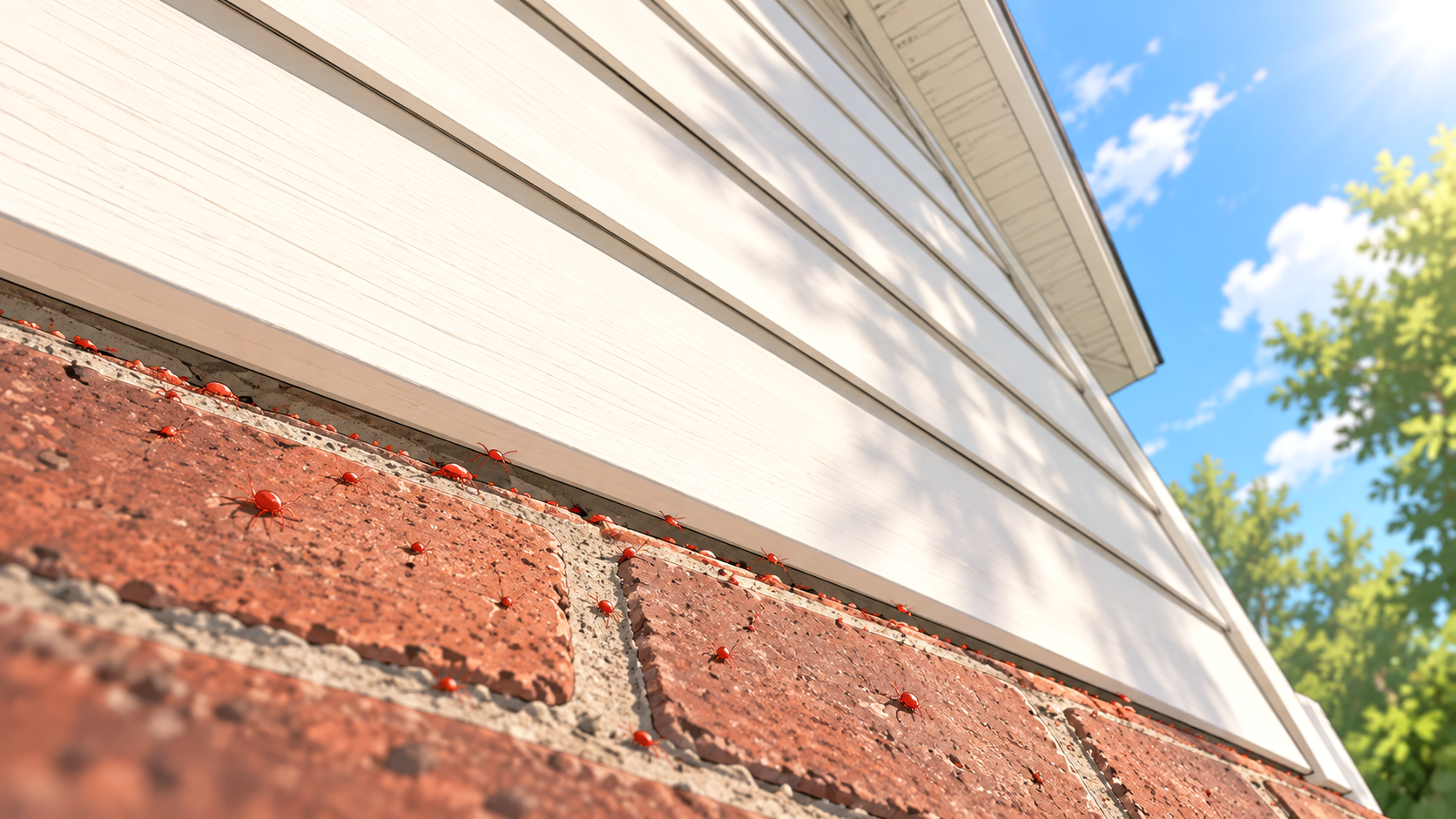
Brick walls and siding give clover mites something a lawn cannot: a continuous vertical route up a building, interrupted by joints, laps, trim, and small protected spaces. Clover mites commonly crawl from nearby vegetation onto exterior walls, then use gaps around siding, masonry, windows, and doors as shelter or possible entry points. They are not eating the brick, mortar, vinyl, fiber cement, wood, or other siding material.
Large numbers can make the wall itself look like the source, particularly when mites are spread several feet above the ground. They can climb surprisingly far. Clover mites have been documented crawling up exterior walls and entering buildings at upper levels, so finding them above a first-floor window does not require a colony living inside the siding.
Brick Gives Tiny Mites Plenty of Protected Edges
A brick facade is not a smooth sheet. Mortar joints, weep openings, window interfaces, cracks, ledges, and transitions between masonry and other materials create numerous recesses. Clover mites use dry protected locations for shelter and egg laying, with eggs documented in cracks, crevices, and spaces between building walls. These existing spaces can concentrate mites without the mites causing the cracks themselves.
Activity near the bottom of a brick wall often connects directly with the landscape. Clover mites primarily live among turfgrass and other vegetation, and when numerous they wander onto foundation walls and other structures. Grass or dense planting that reaches the masonry shortens that journey considerably. Their relationship with the landscape is covered under what attracts clover mites to a property, rather than treating brick as an attractant in its own right.
Siding Creates Different Hiding Places
Overlapping siding introduces narrow spaces that mites can crawl beneath. Clover mites are specifically documented entering under siding, shingles, and shakes, while spring populations may deposit eggs in crevices around siding, doors, windows, and foundations. Lap joints and trim therefore provide convenient protected spaces along the route even though the siding supplies no food.
Their extremely small size makes these openings more significant than they appear to us. A wall can look intact while still containing gaps large enough for mites, and ordinary insect screening may not stop them. If they begin turning up indoors on the same side of the building, inspect window and door frames, utility penetrations, trim joints, and other exterior openings. The full entry process belongs in why clover mites get inside houses.
One Wall Can Have Hundreds While Another Has Almost None
Exterior clover mite activity is often uneven across the same building. Warm, exposed walls can support far more movement than shaded elevations, and south-facing walls are commonly more heavily infested. On favorable days, mites may leave grass and climb the exposed sides of foundations and walls, then stop moving as temperatures fall.
That can produce dense clusters beneath siding edges, window sills, and other sheltered projections. The broader relationship between clover mites, sunlight, warmth, and light-colored surfaces is owned by our guide to why clover mites gather on window sills. For brick and siding, the important feature is how the wall’s construction provides a climbable surface with many places to stop along the way.
They Are Not Eating the Building
Clover mites do not cause structural damage. They feed on plants, not building materials, and public-health guidance specifically classifies them as nuisance invaders rather than structural pests. Even a wall carrying hundreds of mites is not being consumed.
The practical concern is staining and entry. Crushed clover mites can leave red pigment on surfaces, so rubbing a cluster across pale siding or painted trim can turn a harmless group of mites into a cleaning problem. Vacuuming is recommended for mites on exterior siding, while sealing suitable cracks around windows, doors, siding, and foundations reduces access to the interior. If the infestation extends across the landscape rather than remaining on the wall, use the outdoor clover mite control approach instead of repeatedly cleaning the siding.
Questions About Clover Mites on Exterior Walls
Can clover mites get behind vinyl siding?
Yes. Their tiny size allows them to enter existing gaps beneath siding and around trim. Their presence behind siding does not mean they have bored through it.
Can clover mites damage mortar between bricks?
No. They do not eat mortar or excavate masonry. Cracks and joints can provide shelter, but the mites use openings that already exist.
Why are clover mites clustered underneath a siding lap?
The narrow covered edge provides a protected place to stop while the mites are moving across the wall. Similar shelter can occur beneath window sills, shingles, trim, and other projections.
Should cracks containing clover mites be sealed immediately?
Appropriate exterior gaps that serve no necessary building function can be sealed as part of exclusion, particularly around windows and doors. Do not indiscriminately block designed drainage or ventilation openings such as masonry weep holes. If you are unsure whether an opening is intentional, identify its building function before sealing it.