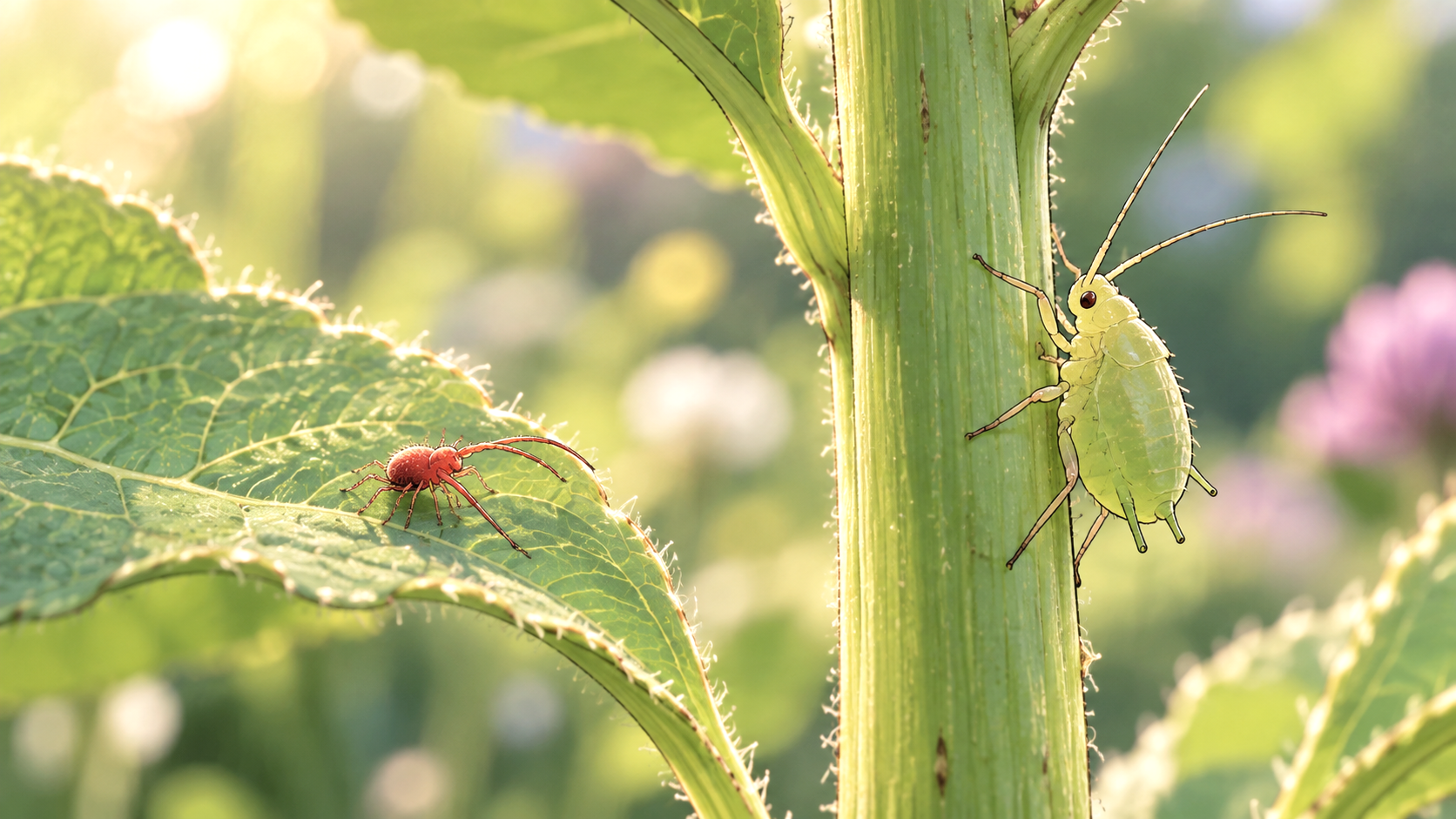
Sticky leaves narrow this identification quickly. Aphids commonly produce sugary honeydew while feeding, whereas clover mites do not. Clover mites are eight-legged arachnids; aphids are six-legged insects. Both can feed on plants and occur in substantial numbers, but they differ enough in appearance, feeding signs, and behavior that a close look at the affected plant usually settles the question.
Honeydew, Ants, and Sooty Mold Point Toward Aphids
Aphids pierce plant tissue and consume sap. Many species excrete excess sugar as honeydew, leaving foliage shiny or sticky and sometimes coating cars, patios, furniture, or other objects beneath an infested plant. Honeydew can attract ants, flies, bees, and wasps, while black sooty mold may grow on the sugary deposits. Ant activity running up and down stems can therefore reveal an aphid colony before the insects themselves are noticed.
Clover mites leave no comparable honeydew deposit. Their feeding can remove chlorophyll from plant tissue, producing silvery streaks or specks on grass blades and, when populations are high enough, pale or declining turf. Those symptoms fit the more specific question of clover mite damage on plants. Sticky foliage or sooty mold calls for another diagnosis.
Aphids Look Like Tiny Pears; Clover Mites Look Like Tiny Spiders
Aphids are generally 1 to 3 mm long, soft-bodied, and somewhat pear-shaped. Their colors are remarkably variable, including green, yellow, red, black, white, and nearly transparent forms. Many species have a pair of short tubular structures called cornicles projecting from the rear of the abdomen, a feature that can make aphids recognizable under magnification. Adults have six legs and conspicuous antennae, and depending on species and conditions, adults may be winged or wingless.
Clover mites are smaller, measuring less than 1 mm. As arachnids, later stages have eight legs, and the first pair is exceptionally long, sometimes creating the illusion that the mite has antennae. That illusion can cause confusion at a glance, but genuine antennae on a six-legged, pear-shaped insect support aphid identification. Color contributes little because clover mites vary in color and some aphid species can also be red.
| Feature | Clover mite | Aphid |
|---|---|---|
| Animal group | Arachnid | Insect |
| Legs on later stages/adults | 8 | 6 |
| Strong visual clue | Very long first pair of legs | Pear-shaped body, usually with cornicles |
| Honeydew | No | Common in many species |
| Sooty mold association | No | Can develop on honeydew |
| Typical feeding evidence | Silvering or pale speckling | Curling, distortion, yellowing, wilting or galls depending on species |
| Indoor wandering | Common around buildings | Usually remains associated with host plants |
Colonies on Tender Growth Favor Aphids
Aphids frequently feed in groups. Colonies may crowd young shoots, leaf undersides, buds, stems, flowers, and other suitable plant tissue. Their feeding can produce curled or distorted growth, yellowing, wilting, galls, or reduced vigor, although the severity varies greatly among plants and aphid species. Some aphids can also transmit plant viruses while feeding, adding a type of plant risk that should not be assumed from clover mites.
Clover mites are especially associated with turfgrass and other low-growing vegetation. High populations can produce pale grass and eventual die-off, particularly near buildings. Their movement away from plants is equally revealing. Large numbers may climb foundations and appear on concrete, brick and siding, or indoor window areas. Aphid colonies do not normally produce this type of mass household invasion.
Their Natural Enemies Also Look Different
Aphid colonies support a conspicuous community of predators and parasitoids. Lady beetles, lacewing larvae, hover fly larvae, and parasitic wasps can suppress populations naturally, and an aphid that becomes swollen, brown, and immobile may be a parasitized “mummy” rather than a healthy pest. Preserving these beneficial insects is an important part of aphid management, which is why broad insecticide use can interfere with natural control.
Clover mite management around homes has a different emphasis because migration can become the nuisance even when plant injury is limited. Repeated indoor appearances are better addressed through clover mite exclusion and appropriate outdoor management rather than applying an aphid treatment to every nearby plant.
Clues for Difficult Clover Mite and Aphid Identifications
Can aphids be as red as clover mites?
Yes. Aphids occur in numerous colors, including red, so color cannot reliably separate them.
Can both occur on houseplants?
Yes. Aphids commonly colonize houseplants, particularly tender new growth. Clover mites can also occur around potted plants, but a suspected infestation needs correct identification before using houseplant clover mite control.
What are the white flakes around an aphid colony?
They may be shed aphid skins. Aphids molt as they develop, and the pale cast skins can accumulate around a colony. Clover mites have their own molting stages, but piles of white skins beside clustered pear-shaped insects strongly support aphids.
Can aphids crawl into a house like clover mites?
Aphids can enter accidentally, especially on plants, flowers, or through open windows, and winged forms can fly. They do not normally create the large structural invasions responsible for clover mites appearing throughout a house.