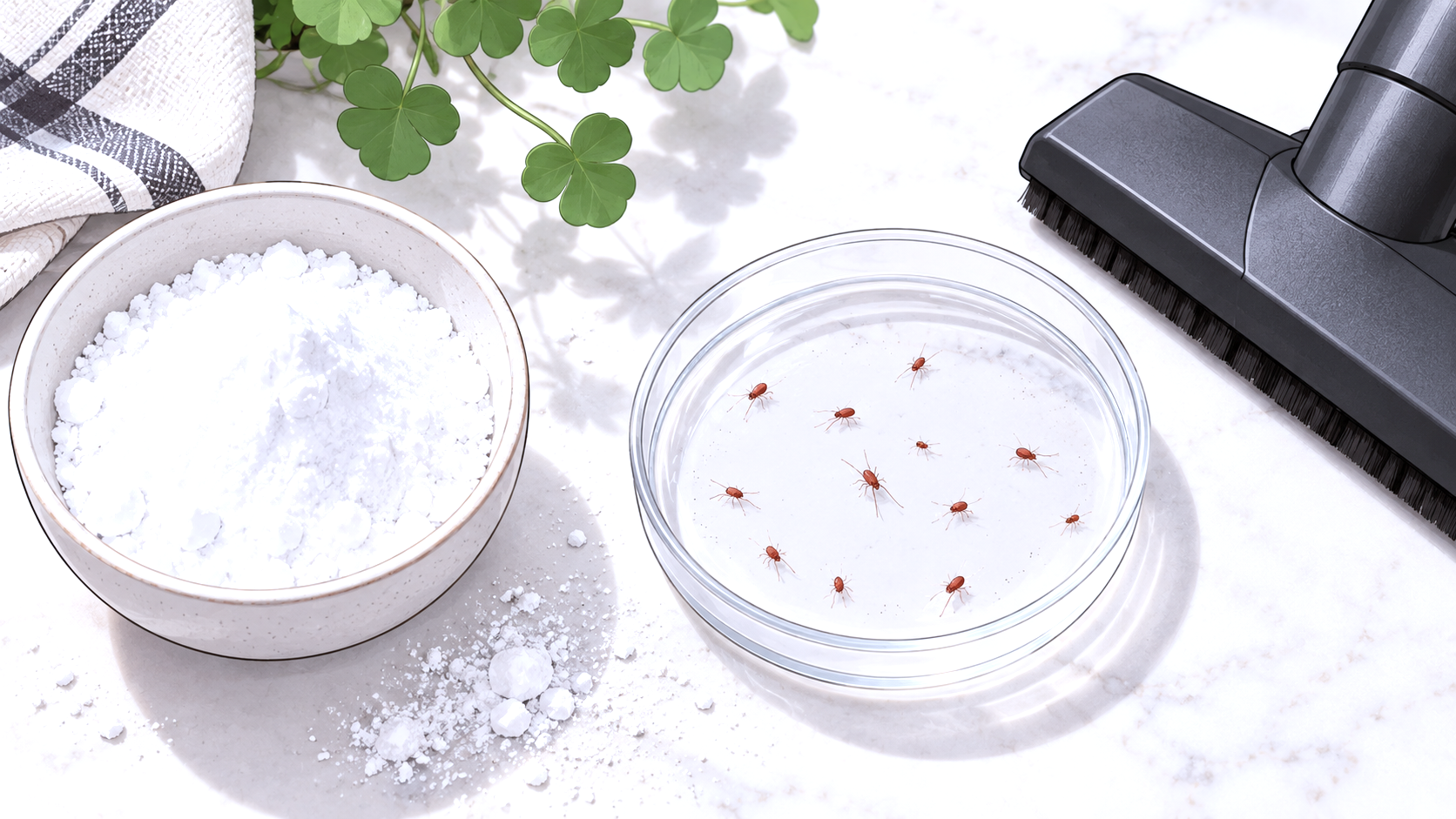
Boric acid has pesticidal activity against mites, but we would not use loose boric acid powder as a DIY treatment for clover mites unless the specific pesticide product is labeled for that pest and application site. Boric acid is a recognized insecticidal and miticidal active ingredient, yet that broad activity does not establish that an ordinary boric acid product will control Bryobia praetiosa on a lawn, foundation, patio, or inside a house. The limitation is especially relevant with clover mites because most of the familiar household uses of boric acid involve pests such as cockroaches and ants. Those applications cannot simply be transferred to a plant-feeding mite with different behavior and exposure routes.
Boric Acid Does Not Work Like a Fast Contact Spray
Boric acid can affect arthropods after ingestion and can also damage their protective exterior. Its effectiveness depends heavily on how the target pest encounters the material, which is why boric acid is available in dusts, baits, liquids, granules, pellets, and other formulations. A bait designed to be eaten by an insect is particularly irrelevant to a clover mite feeding on plant material.
Scattering powder where mites happen to be visible does not guarantee enough exposure to control them. Clover mites may travel across walls while moving through a building without remaining on the treated surface for long, while outdoor populations can occupy vegetation beyond the dusted area. A material capable of killing mites under suitable exposure conditions is not automatically an efficient treatment for the way clover mites actually live and move.
Boric Acid Around Clover Mite Plants Can Create a Second Problem
Boron occurs naturally in plants and soil, and plants require small amounts of it. Excess boron can become toxic, however, with some fruit and nut crops particularly sensitive to elevated levels. Boric acid and related borates can also injure plants through desiccation.
That makes casual outdoor dusting or drenching a poor fit for a pest whose habitat is closely tied to vegetation. Clover mites feed on grasses, clover, weeds, ornamentals, and other plants, so applying an improvised boric acid treatment to those areas could expose the plants and soil as well as the mites. Visible injury should not then be automatically blamed on clover mite feeding damage when the treatment itself can affect vegetation.
Household Boric Acid Is Not a Substitute for a Labeled Miticide
A container of boric acid sold for laundry, cleaning, laboratory use, or another non-pesticidal purpose should not be converted into a homemade clover mite treatment. Boric acid occurs in many pesticide and non-pesticide products, and the intended use of the individual formulation matters. Current household safety guidance specifically advises against making homemade pesticides with boric acid.
Even pesticide products containing the same active ingredient can have different permitted uses. The label identifies the sites, application methods, precautions, and target pests for that formulation. If chemical treatment becomes necessary, selecting a pesticide appropriate for clover mites is more defensible than assuming boric acid should work because it is classified as a miticide.
Loose Boric Acid Indoors Adds Exposure Without Much Advantage
Clover mites that wander indoors generally do not establish the kind of hidden feeding population that would make widespread boric acid dusting useful. They can instead be removed indoors with a vacuum, which avoids crushing their pigmented bodies against walls, curtains, and other surfaces.
Broadcasting powder over floors, window ledges, carpets, or other occupied areas introduces unnecessary opportunities for inhalation, ingestion, or eye contact. Boric acid exposure can occur when the material is breathed, swallowed, or transferred from contaminated hands, and pesticide products should be kept away from places accessible to children and pets unless their labels specifically permit the application. Mites accumulating along window sills are better removed and their entry routes investigated than surrounded with loose powder.
Questions About Boric Acid and Clover Mites
Is boric acid the same thing as borax?
No. Boric acid and borax are related boron compounds, but they are chemically different substances. Their boron content and properties differ, so results or directions for one should not automatically be transferred to the other.
Does boric acid keep clover mites from crossing a foundation?
There is not enough clover-mite-specific evidence to recommend an improvised boric acid barrier for that purpose. A property experiencing repeated migration is better served by reducing access around the foundation than by maintaining an unlabeled line of powder.
Can boric acid be dissolved in water and sprayed on clover mites?
Do not create a homemade spray. Dissolving a pesticidal ingredient in water changes how it is applied and potentially how people, plants, animals, and surfaces are exposed. Use only the preparation and application methods stated on a registered pesticide label.
Would boric acid make sense for a severe infestation?
A heavy outdoor population needs treatment matched to its source and scale. Repeatedly applying boric acid without a clover-mite-specific label can add exposure without addressing the outdoor conditions supporting the infestation.