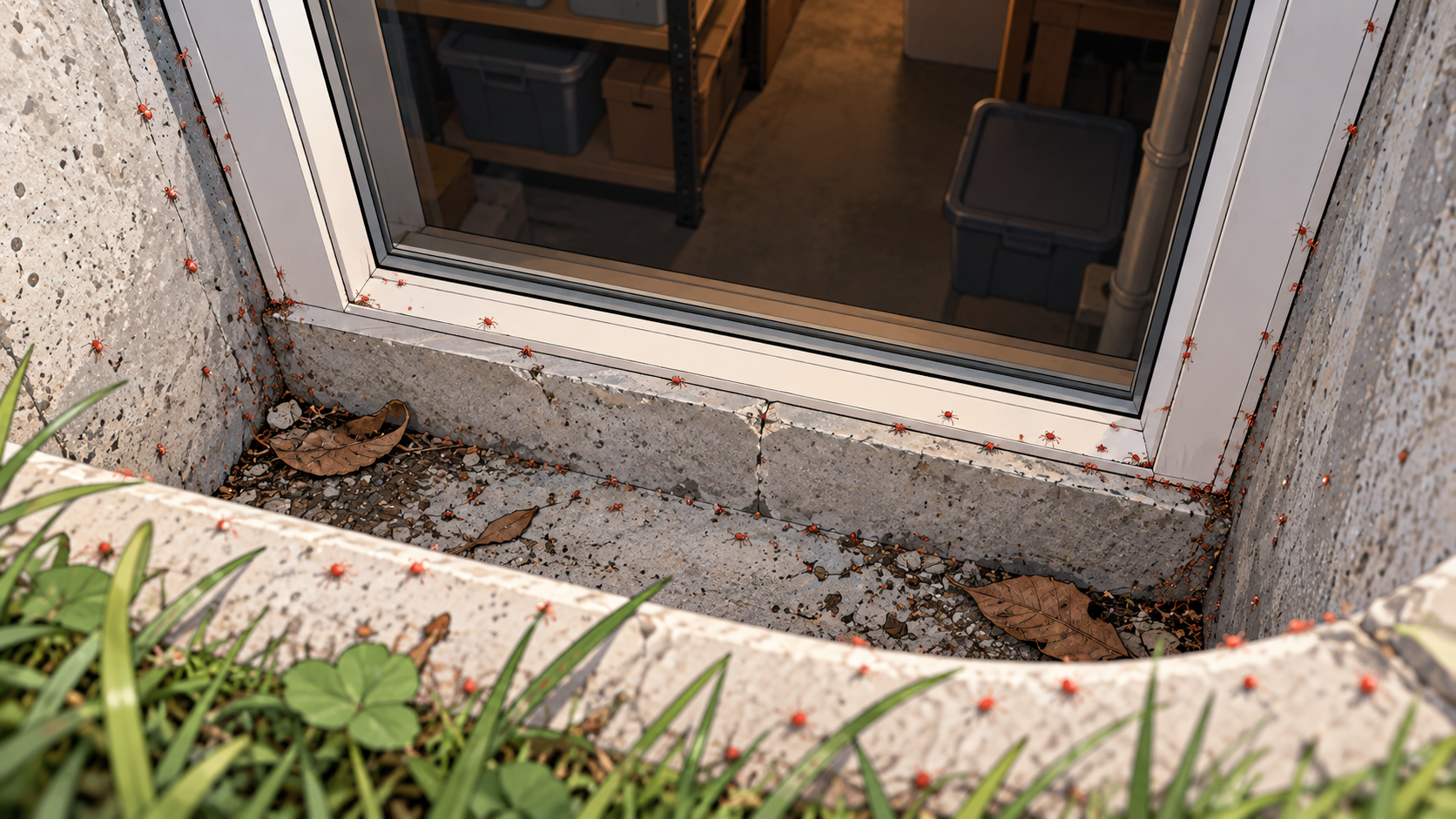
Clover mites commonly show up in basements because basements sit beside the foundation-level cracks and windows the mites can reach from outside. Their tiny bodies allow them to pass through narrow structural gaps and emerge on basement walls, window ledges, and floors. Moist conditions can coincide with greater clover mite activity, but a damp basement is not their food source. The more useful place to investigate is the boundary between the basement and the surrounding soil, vegetation, and foundation.
Foundation Cracks Can Lead Directly Into a Basement
Clover mites are small enough to exploit openings that barely look like entry points. They can crawl through cracks in foundation walls, as well as gaps that connect exterior surfaces with wall voids.
Basements are especially exposed to this route because much of the room sits at or below the level where mites encounter the building. A crack does not have to be large enough for a conventional insect to use it. Clover mites are roughly pinhead-sized, and even ordinary insect screens may not stop them.
They do not create these openings themselves. Sealing suitable foundation cracks and other exterior gaps can reduce clover mite migration into buildings, making structural exclusion particularly relevant when sightings are concentrated downstairs.
Basement Windows Are a Common Trouble Spot
Basement windows combine several features clover mites can exploit: low placement, frames with small crevices, and direct proximity to the exterior foundation. They are specifically reported as favored hiding places for clover mites.
Mites can collect within window frames and channels before appearing on the interior sill. This makes a basement window worth inspecting closely when most sightings occur immediately around it.
Clover mites also tend to gather on sun-exposed parts of buildings. On suitable days they crawl across turf and up sunny foundations, which can put large numbers near low windows. This is different from the broader question of why clover mites gather on window sills, but it explains why basement windows can become a direct route into a lower level.
Humidity Can Affect Activity, but Dampness Is Not Their Indoor Food Source
Clover mites are often most noticeable during mild conditions when the atmosphere is humid. Spring activity is associated with moderate temperatures and higher humidity, so a period of damp weather can coincide with more sightings around a basement.
That does not mean they are feeding on basement moisture. Clover mites are plant feeders, and their food comes from grasses and other living plants. They are therefore very different from pests whose indoor populations depend on persistent dampness, mold, or decaying organic material.
A humid basement may help wandering mites avoid drying out as quickly, but it does not turn the room into their normal habitat. Clover mites cannot maintain a reproducing indoor population, even when substantial numbers become visible.
The Area Outside the Basement Matters More Than the Room Itself
When clover mites repeatedly appear downstairs, inspect what is directly outside that section of foundation. Turf and other host plants growing close to the wall can support mites only a short distance from potential structural openings.
Keeping vegetation away from affected foundations can reduce that pressure. A plant-free barrier of roughly 18 to 24 inches is commonly recommended, although clover mites can sometimes cross wider areas.
Lush vegetation can be especially important because clover mite populations may become abundant in well-fertilized turf. The conditions that attract clover mites around a property can therefore explain why one basement wall experiences far more activity than another.
If mites continue appearing after the visible ones are removed, the source is still likely outside rather than somewhere beneath the basement floor. Recurring clover mite problems usually require attention to the surrounding population and building exterior, not repeated treatment of the room alone.
Other Questions About Clover Mites in Basements
Can clover mites come through a concrete foundation?
They cannot tunnel through intact concrete. They can use existing cracks, joints, and other openings associated with the foundation.
Can clover mites live in basement walls?
They can temporarily shelter in structural voids and crevices. Protected spaces within walls can also serve as overwintering locations for clover mites, but this is not the same as establishing a permanent indoor colony.
Does a dehumidifier get rid of clover mites?
A dehumidifier is not a primary clover mite control. Reducing excessive basement humidity may make conditions less favorable for wandering mites, but preventing access and addressing the outdoor population are more relevant.
Why are clover mites only in my basement?
The affected part of the basement may simply be closest to a concentrated outdoor population or accessible foundation opening. Clover mites move by crawling, so their distribution inside a building can reflect where they first gained access.