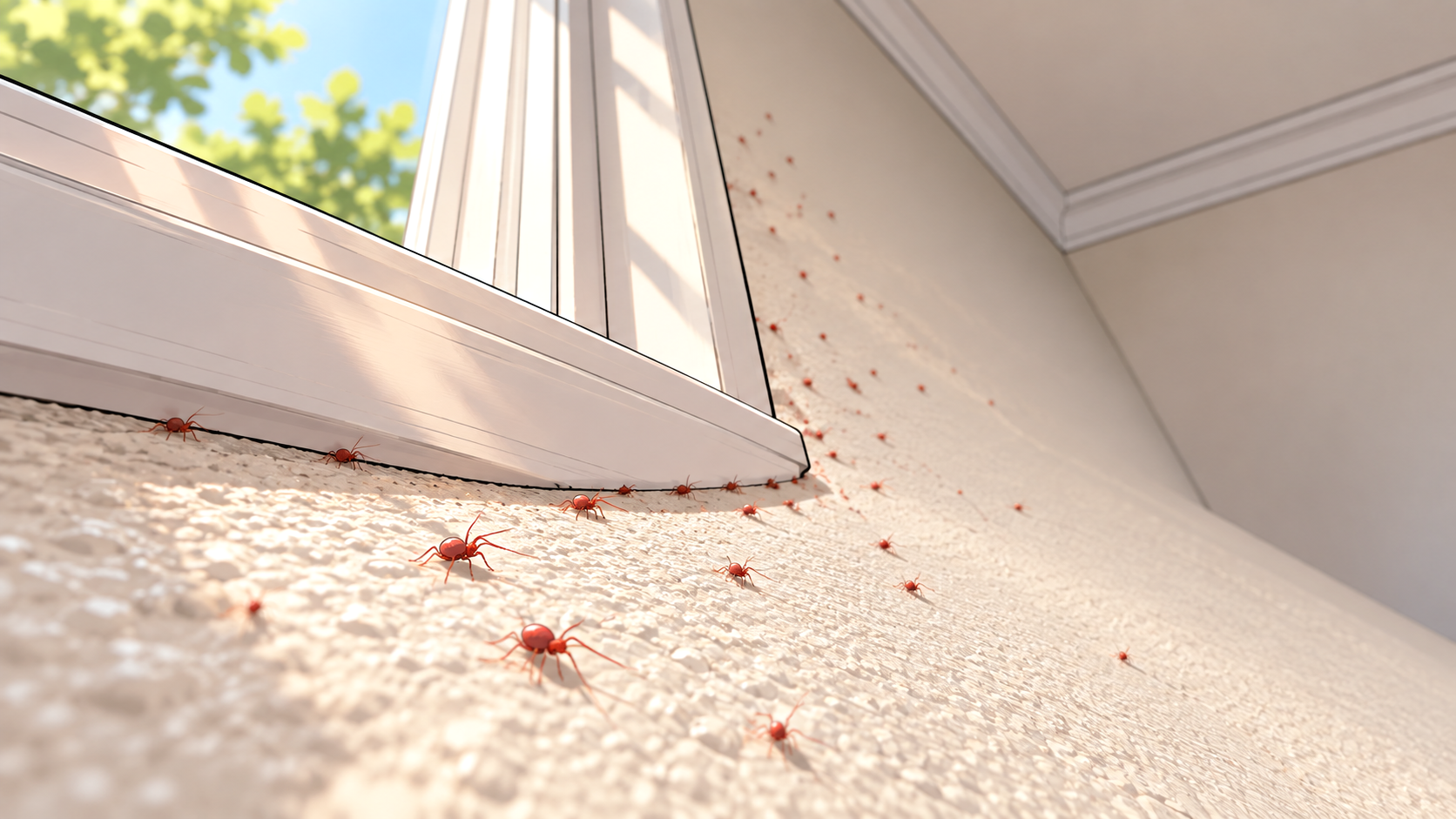
A wall can look strangely alive when dozens of pin-sized red dots begin moving across it. Clover mites crawl on walls because building walls become travel surfaces during their seasonal movements. Outdoors, they can move directly from vegetation and the foundation onto the exterior. Indoors, mites that have already entered the building may continue across drywall or painted surfaces. They are not eating the wall, and their presence does not indicate structural damage.
Exterior Walls Give Them a Route Upward
Clover mites normally occupy vegetation, particularly turfgrass. When they leave those plants, nearby buildings are easy to encounter. The mites can cross the ground and climb the sunny sides of foundations and walls, sometimes in substantial numbers.
They are capable climbers despite being extremely small. Reports of clover mites reaching upper portions of buildings are normal because they can crawl up exterior walls and enter at higher levels. A second-story sighting therefore does not require an indoor population somewhere below it.
Their movement is entirely on foot. Clover mites cannot fly or jump, so a vertical trail on siding, brick, stucco, or a foundation wall is exactly what their locomotion allows.
Some Walls Collect Far More Mites Than Others
Clover mite activity around a building is rarely distributed evenly. Warm, exposed elevations can carry far more mites than shaded sections. They are commonly reported swarming over sunny exterior walls, with south-facing walls often experiencing heavier activity.
The detailed reasons clover mites concentrate around bright, warm building surfaces belong with their window-sill behavior. On a wall, the useful clue is the pattern. Heavy activity on one elevation does not mean mites are living inside that wall.
Weather can make the pattern appear abruptly. Clover mites are most active during cooler portions of spring and fall, and suitable conditions can put large numbers in motion at once. Their broader seasonal calendar explains why the same wall may be busy for a period and then suddenly quiet.
Indoor Walls Expose Mites That Have Already Gotten Inside
Once clover mites cross into a building, an open wall gives them plenty of uninterrupted space to wander. They may appear on walls along with curtains, furniture, and carpet.
Seeing them on drywall does not show where they entered. Clover mites are small enough to pass through cracks around windows, doors, foundations, and other openings. Some may also emerge from protected structural spaces when conditions change.
Nor does a wall full of mites prove they are multiplying indoors. Clover mites cannot maintain a reproducing indoor population. The visible wall is simply where wandering individuals are easiest to notice.
Painted Walls Have One Particular Risk
The mite itself causes no structural harm. Crushing it is what can damage the appearance of the surface.
Clover mites contain pigments that produce red or rusty stains when their bodies are crushed. White and pale walls make those marks especially conspicuous. The stain is not blood, since clover mites feed on plants rather than people or pets.
Vacuum visible mites gently instead of smearing them with a hand, cloth, or paper towel. For larger indoor appearances, removing them intact protects the paint while the source of the activity is addressed elsewhere.
Wall Sightings Can Help Confirm the Identification
Tiny moving dots on a wall are not automatically clover mites. Look closely before assigning the name.
Adult clover mites have eight legs and an exceptionally long front pair. Their bodies may be reddish, reddish-brown, greenish, or darker, so color alone is unreliable. A hand lens or close-up photograph is considerably more useful than judging a speck from across the room.
Large numbers appearing repeatedly on the same walls can also provide a location clue. The mites normally originate around outdoor vegetation and do not feed once they are inside a building. Persistent wall activity therefore warrants looking beyond the painted surface rather than treating the wall as their habitat.
Wall-Specific Questions
Can clover mites climb all the way up a house?
Yes. Their crawling ability can carry them well above ground level, including to upper-story entry points.
Are clover mites eating paint or drywall?
No. Neither material is food for clover mites, and they do not cause structural damage.
Why are they motionless on the wall?
Clover mite activity changes with temperature. Individuals can stop moving when conditions cool and resume activity after temperatures become favorable again.
Should I squash clover mites on the wall?
No. Vacuum them when practical. Crushing them can leave pigment stains that are more troublesome than the mites themselves.