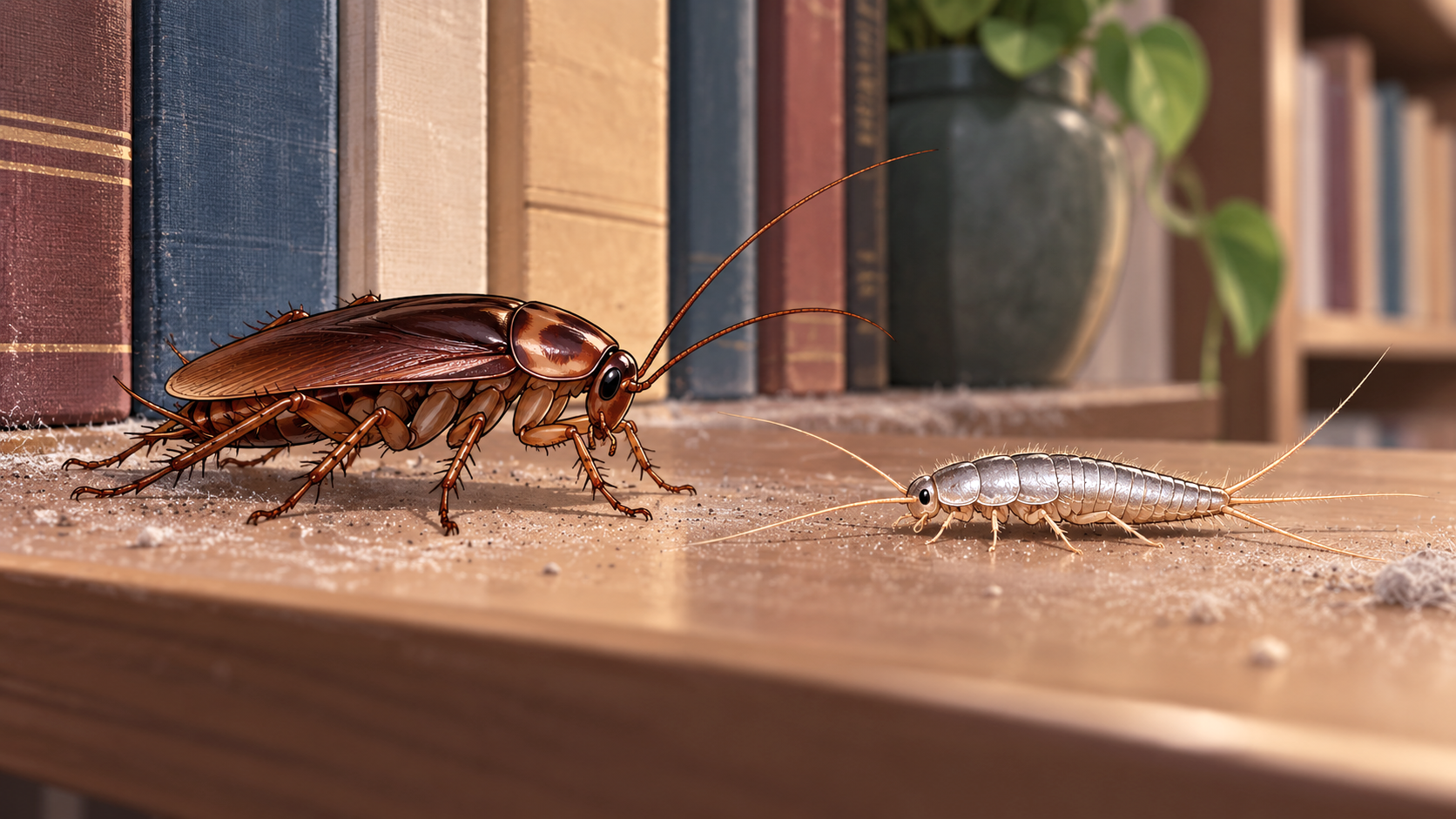
Silverfish and cockroaches share enough habits to cause a moment of doubt. Both can move quickly, hide in narrow spaces, appear after dark, and carry long antennae. Their bodies, however, are difficult to confuse once the rear of the insect is visible.
A silverfish has a tapered, carrot-shaped body ending in three long tail-like filaments. A cockroach has a broader oval body with only two short cerci at the rear. Silverfish are permanently wingless and usually covered in scales, while cockroaches have a very different body surface and many adults develop wings.
Three Long Filaments Are the Fastest Way to Recognize a Silverfish
Look at the back end before worrying about exact color or size. Silverfish have three conspicuous terminal filaments extending from the abdomen, with one running from the center and one positioned on either side. Combined with two long antennae at the head, an intact silverfish can appear to have long projections extending from both ends of its body. The three rear appendages are characteristic of silverfish and firebrats.
Cockroaches also possess paired appendages at the rear, but their cerci are much shorter and there are only two. These sensory structures form part of cockroach anatomy rather than the three elongated filaments seen on silverfish. A damaged silverfish may have lost part of a filament, so an incomplete tail should be considered alongside the insect’s overall shape rather than used alone.
The Silverfish Body Narrows Toward the Tail
A silverfish is widest toward the front and gradually narrows along the abdomen, producing its familiar carrot-like outline. The common silverfish is typically around half an inch long as an adult, excluding its long appendages, and its body remains low and elongated. The flattened body tapers noticeably toward the posterior.
A cockroach is broader through much more of its length. Viewed from above, its body is generally flattened and oval, with the head partly concealed beneath the pronotum and six prominent legs spreading outward. Even a wingless cockroach nymph retains that broader roach-like profile instead of narrowing into the pointed rear typical of silverfish.
Silverfish Get Their Sheen From Tiny Scales
The metallic appearance of a common silverfish is not simply gray pigmentation. Its body is covered with tiny scales that create the characteristic silvery sheen. Detailed examination of silverfish species shows that scale color, shape, and distribution vary considerably, so not every member of the group looks bright silver. Some household relatives are grayish, brownish, mottled, or much paler.
Cockroaches do not have the same scaly covering. Their hardened exoskeleton can appear glossy, particularly in darker species, but the surface does not create the fish-like metallic texture responsible for the silverfish name. Color therefore works best as supporting evidence. A gray insect with three long tail filaments is highly informative; a gray insect by itself is not.
Silverfish Never Develop Wings
A silverfish remains wingless throughout its life. Its entire lineage belongs to an ancient group of primitively wingless insects, and adults retain the same fundamental wingless body plan. Household silverfish are consequently described as wingless insects even at full adult size.
Cockroaches follow a different developmental pattern. Nymphs begin without developed adult wings, then pass through a series of molts during the cockroach life cycle. Depending on species and sex, the resulting adult may have long wings, shortened wings, or reduced wing structures. Seeing developed wings rules out a silverfish immediately, although seeing no wings does not rule out a cockroach.
Their Legs Create Different Silhouettes
Silverfish have six relatively short legs concentrated toward the front portion of the body. Their long antennae and tail filaments often attract more attention than the legs themselves. Despite those short legs, silverfish can run rapidly when exposed, which contributes to the confusion when one suddenly appears in a bathroom or basement.
Cockroach legs are considerably more prominent around the body and are equipped with numerous spines. Their three pairs of running legs create a wider stance, particularly when viewed from above. If a photograph is too poor to show scales or fine details, the combination of conspicuous spiny legs and a broad abdomen can still favor a cockroach over a silverfish.
Firebrats Can Complicate a Color-Based Identification
Not every bristletail found indoors is silvery. Firebrats have essentially the same tapered form and three long terminal filaments but commonly appear mottled with brownish and lighter scales. They also favor warmer conditions than common silverfish. Firebrats share the characteristic three-tailed body plan, despite their different coloration.
A brown firebrat can therefore produce a stronger superficial resemblance to a cockroach than a classic silver-gray silverfish does. The rear filaments resolve much of that ambiguity. A separate firebrat and silverfish comparison becomes useful when the insect clearly has the bristletail body plan but its exact identity remains uncertain.
A Few Details Can Help With an Incomplete Specimen
Can a baby silverfish look like a baby cockroach?
Young silverfish resemble smaller versions of the adults and retain the elongated, tapering body plan. Cockroach nymphs are broader and have the characteristic long antennae, spiny legs, and paired cerci associated with cockroaches.
What if the silverfish has lost one of its tails?
The terminal appendages are delicate and can be damaged or broken. Use the remaining filaments together with the tapered body, scales, short legs, and absence of wings rather than rejecting the identification because all three are not intact.
Can silverfish climb walls?
Yes. Silverfish can move across many household surfaces, although smooth vertical surfaces can be difficult for them to climb. Finding an insect on a wall therefore does not by itself separate it from a cockroach.
Is every three-tailed insect indoors a common silverfish?
No. Firebrats and other members of the silverfish group share the basic arrangement of two antennae and three terminal filaments. Species identification may require details beyond the quick features needed to distinguish them from cockroaches.