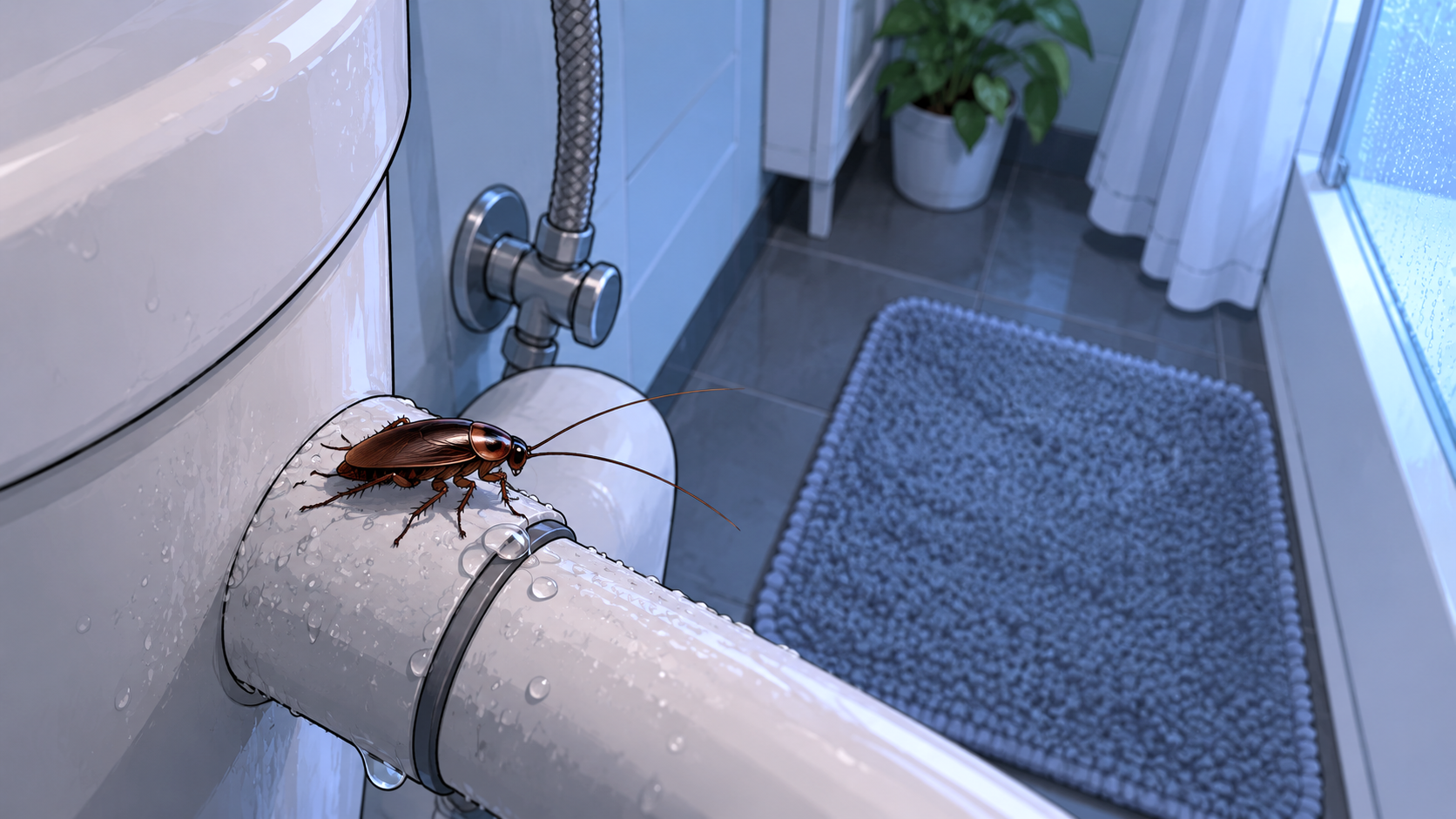
Bathrooms can provide usable moisture long after the shower has stopped and the sink looks dry. Water collects beneath fixtures, condensation forms on cool surfaces, dampness persists around plumbing, and small leaks may remain hidden inside cabinets or walls. Add the openings created for pipes and drains, and a bathroom can become both a favorable resting place and a route through the building.
Cockroaches may appear in bathrooms because these rooms can provide moisture, humidity, protected crevices, and access around plumbing. Leaks, condensation, damp cabinets, pipe openings, wall voids, and gaps around fixtures can all contribute. Some cockroach species favor damp environments more strongly than others, so identification can help explain the sighting.
A Dry Floor Can Hide a Persistent Moisture Source
Bathroom water does not need to form a puddle to be useful to cockroaches. Moisture can remain beneath a sink, around a leaking supply line, behind a toilet, under loose flooring, beside a tub, or on surfaces where humid air condenses. Even small plumbing defects can repeatedly replenish a damp area after visible water has evaporated.
Moisture control is consequently part of established cockroach management guidance. Health Canada recommends repairing leaking faucets and pipes, reducing condensation, and ventilating damp areas, while EPA guidance likewise calls for repairing leaks and eliminating standing water. Cockroaches require adequate body water, although their survival without water varies with species and environmental conditions.
Humidity Changes the Bathroom Even When Nothing Is Leaking
Bathing and showering can raise local humidity without any plumbing failure. A poorly ventilated bathroom may remain humid enough for condensation to collect on pipes, walls, windows, toilet tanks, or other cool surfaces. Experimental research on German cockroaches has found that relative humidity affects survival under resource deprivation, showing that surrounding moisture conditions influence their ability to conserve water.
Bathrooms differ considerably in this respect. A frequently used room with weak ventilation can maintain a very different microclimate from a dry, well-ventilated bathroom. Running an exhaust fan, correcting persistent condensation, and investigating surfaces that remain damp hours after use can remove moisture conditions without assuming that every bathroom cockroach was attracted there from another part of the house.
Plumbing Creates Concealed Space Around the Pipes
Look beneath a bathroom sink and the plumbing rarely fits perfectly into the surrounding cabinet or wall. Openings may remain around supply lines and drainpipes, while toilets, tubs, vanities, and access panels can conceal additional gaps. Cockroaches can use these protected spaces as harborages or travel routes because their flattened body structure allows them to enter narrow crevices.
Public-health IPM guidance recommends sealing cracks, crevices, and openings around plumbing as part of cockroach prevention. In apartment buildings, plumbing penetrations deserve additional attention because German cockroaches have been documented moving between units through building connections. Research has found substantial inter-apartment movement associated with common plumbing, so bathroom activity in multifamily housing may involve more than conditions inside one unit.
The Species Can Explain Why the Bathroom Is Being Used
Oriental cockroaches have a particularly strong association with cool, damp locations and may occur around basements, plumbing areas, floor drains, and other moist environments. German cockroaches can also occupy bathrooms, especially where water and protected crevices are available. Brown-banded cockroaches tolerate comparatively dry conditions and are less dependent on moisture-rich rooms.
Identifying the type of cockroach in the bathroom can therefore change the investigation. California pest-management guidance describes Oriental cockroaches as favoring cool, dark, damp locations, while German cockroaches are more strongly associated with indoor environments containing readily available resources. A large dark cockroach beside a basement bathroom floor drain and a small German cockroach nymph beneath an upstairs vanity do not necessarily have the same explanation.
A Bathroom Cockroach Did Not Necessarily Come Up the Drain
The drain is an obvious suspect because a cockroach may be found in a sink, bathtub, or shower. Its position does not establish its route. The insect may have entered the fixture from the surrounding room, emerged through a gap around plumbing, or moved through another structural opening.
Some cockroach species can occupy sewer and plumbing environments. American cockroaches, for example, are documented in sewers and other warm, moist underground locations. Properly functioning plumbing traps contain water that helps block movement from sewer gases and organisms, while unused or defective plumbing can present different conditions. Determining whether cockroaches are actually coming through a drain requires examining the plumbing rather than assuming the fixture itself identifies the entry route.
Bathrooms Can Support Cockroaches Without Supplying Much Human Food
A bathroom does not need to contain kitchen-style food deposits to be useful. Cockroaches can move between rooms to feed, while the bathroom supplies moisture and shelter. Some organic material may also be available locally, but a bathroom sighting should not be interpreted primarily through the wide range of materials cockroaches can eat.
This is especially relevant in apartments and other connected buildings. An insect can use resources in several rooms or move from another unit altogether. If neighboring apartments are also affected, tracing cockroach movement between units can be more informative than trying to identify a missing food source inside the bathroom.
Bathroom Sightings That Need a Different Explanation
Why do cockroaches appear in my bathroom mainly at night?
Many household cockroaches are predominantly nocturnal, so a quiet, dark bathroom may reveal activity that remains concealed during the day. Nighttime appearance does not establish where the insects originated.
Why did I find a baby cockroach beneath the vanity?
The insect may be a nymph if it has the wingless, immature appearance of a baby cockroach. Repeated nymph sightings in the same protected area warrant closer inspection for local activity or movement through nearby structural openings.
Can cockroaches live behind bathroom walls?
Wall voids can provide protected travel and resting spaces, particularly where plumbing creates penetrations between cavities. Whether cockroaches are actually established there requires evidence rather than assuming every bathroom sighting originated inside the wall.
Does one bathroom cockroach mean the bathroom is infested?
No. A single insect cannot establish the size or source of a population. Species, life stage, surrounding evidence, and follow-up monitoring determine what one cockroach sighting can reasonably tell you.