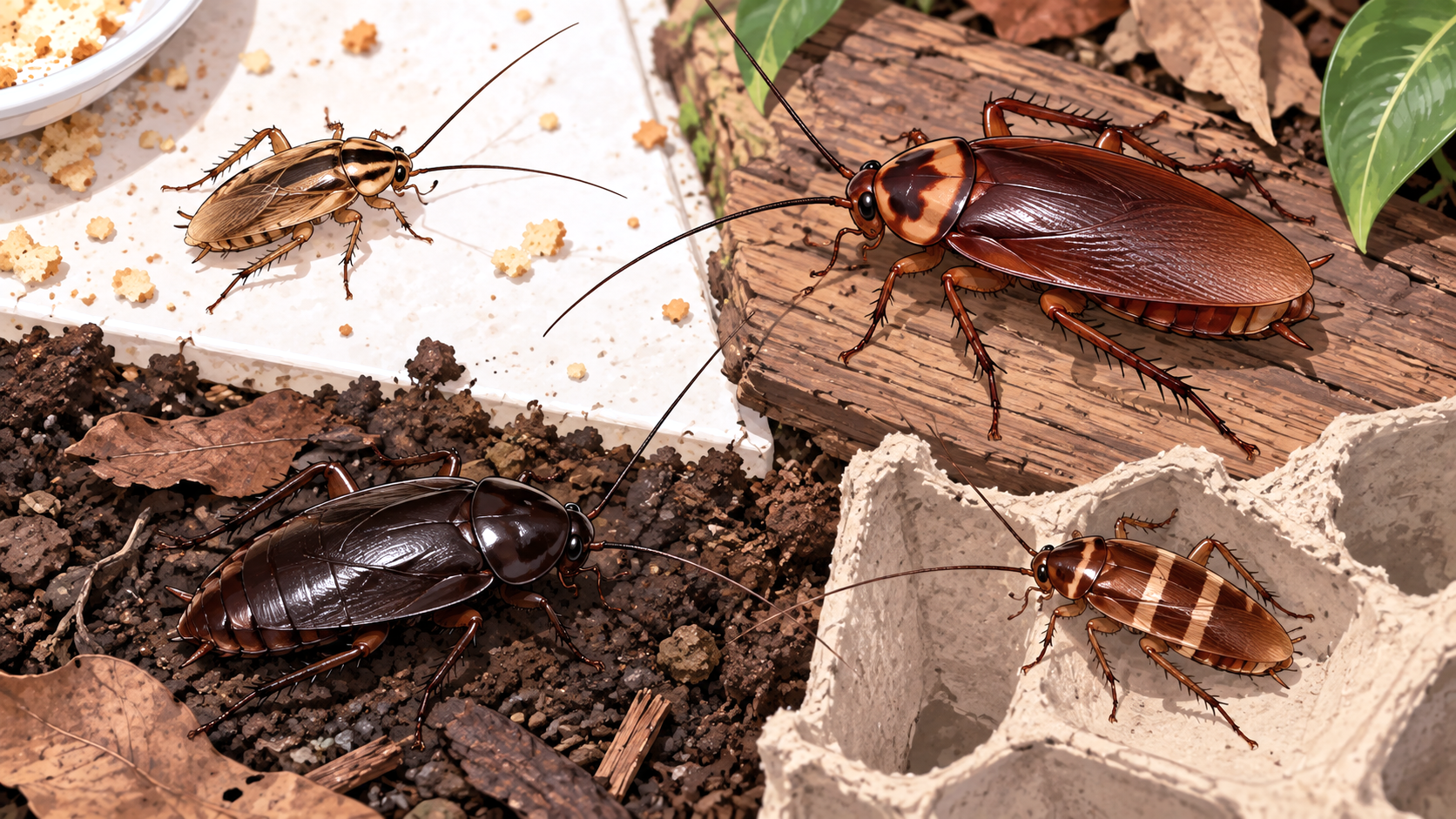
The cockroach in a warm apartment kitchen and the one that flies toward a porch light may belong to the same insect order, but they can represent very different pest situations. Among the cockroaches encountered around North American buildings, German, American, Oriental, brown-banded, smokybrown, and wood cockroaches are among the types worth recognizing. Their preferred habitats differ enough that identifying the type can tell you far more than simply confirming that you found a cockroach.
Some readily establish indoor infestations. Others are strongly associated with sewers, basements, attics, landscaping, or decaying wood. Wood cockroaches can even enter houses accidentally without becoming established indoor pests. For us, that behavioral difference is more useful than treating every roach sighting as the same problem.
German Cockroaches Are the Classic Indoor Infesters
German cockroaches (Blattella germanica) are small adults, usually about 1/2 to 5/8 inch long, with tan to light-brown bodies and two dark parallel stripes on the pronotum behind the head. They are widely distributed urban pests that commonly infest buildings, including homes, apartments, restaurants, hotels, and institutions. Kitchens and bathrooms provide particularly favorable combinations of food, warmth, moisture, and tight hiding spaces.
This is the cockroach we would take especially seriously after repeated indoor sightings because it is so well adapted to living with people. It can also be transported between locations in belongings, boxes, and other materials. In apartments, movement between neighboring units can complicate the source of an infestation, so cockroaches appearing in an apartment may involve more than conditions inside one unit.
A German cockroach should not be identified from small size alone. Its paired dark stripes provide a much stronger clue, while adult cockroach coloration and body shape help separate a suspected specimen from unrelated small brown insects.
American Cockroaches Are Much Larger
An adult American cockroach (Periplaneta americana) can reach roughly 1 1/2 inches or more, placing it among the largest cockroaches regularly encountered around buildings. The body is reddish brown, and a pale yellowish margin around the pronotum helps distinguish it from similarly large dark species. Despite its common name, the American cockroach originated outside North America and is now distributed widely.
American cockroaches favor warm, moist environments. Sewers, boiler rooms, basements, utility areas, commercial buildings, and other protected damp locations can support them. Their association with sewer systems also explains some indoor appearances, although a large cockroach near plumbing should not automatically be assigned to this species. The popular term “water bug” is applied inconsistently to several insects, making cockroach versus water bug identification more reliable than the nickname.
Adult American cockroaches have developed wings and can fly or glide under suitable conditions, particularly in warm environments. Their large size, reddish coloration, and pale pronotal border together provide a more useful identification than flight by itself.
Oriental Cockroaches Prefer Cooler, Damp Places
Oriental cockroaches (Blatta orientalis) look quite different from German cockroaches. Adults are dark brown to nearly black and approximately an inch long. Males have shortened wings that do not cover the abdomen, while females have greatly reduced wing structures. Their glossy dark appearance has contributed to another use of the name “water bug.”
Cool, moist environments suit this species particularly well. Oriental cockroaches commonly occupy damp basements, drains, crawl spaces and similar areas, and outdoor populations can occur around decaying organic matter, trash areas, and other protected sites. They may enter buildings through gaps and around utility penetrations or move through plumbing-related areas.
Location can therefore strengthen an identification. A nearly black cockroach repeatedly appearing in a damp basement presents a different pattern from small tan cockroaches concentrated around kitchen cabinets. When roaches seem associated with plumbing, however, cockroaches appearing around drains should be investigated rather than assuming the drain itself proves which species is present.
Brown-Banded Cockroaches Can Turn Up Away From Wet Areas
Brown-banded cockroaches (Supella longipalpa) are small, with adults around 3/8 to 1/2 inch long. Their name comes from pale transverse bands visible across portions of the body, particularly conspicuous in immature stages. Adult males are slender and fully winged, while females have shorter wings and broader bodies.
Their indoor distribution can surprise someone expecting every cockroach to congregate beside a sink. Brown-banded cockroaches tolerate drier conditions than German cockroaches and may occupy bedrooms, living areas, furniture, closets, and locations higher on walls or inside appliances. They have been documented in warm, relatively dry portions of buildings, including areas away from plumbing.
Finding small cockroaches in a bedroom or office therefore should not automatically rule out an established infestation simply because the room lacks obvious water. Conversely, identifying the insect first prevents an unrelated household bug from being treated as a cockroach. Several bugs can resemble cockroaches at a glance, especially after a brief sighting.
Smokybrown Cockroaches Often Connect the House With the Outdoors
Smokybrown cockroaches (Periplaneta fuliginosa) are large, dark mahogany-brown cockroaches with wings extending over the abdomen in adults. Unlike the American cockroach, they lack the conspicuous pale pronotal border. They are especially important in warmer regions, including much of the southeastern United States.
These cockroaches have a strong association with moist outdoor habitats. Trees, mulch, woodpiles, gutters, leaf litter, and other protected areas can provide harborage, while structures may offer additional shelter. They can also occupy attics and other building areas under favorable conditions. Both sexes have functional wings, and adults may fly toward lights.
A smokybrown cockroach found indoors can consequently have an outdoor connection that would be less characteristic of an established German cockroach population. Accurate identification fits the broader integrated pest management principle of identifying the pest before choosing control measures. Treating every cockroach as though it lives and enters buildings the same way can direct effort toward the wrong places.
Wood Cockroaches Are a Good Example of a Roach That May Not Be an Indoor Pest
Wood cockroaches in the genus Parcoblatta live primarily outdoors. They inhabit wooded environments and sheltered places with decaying organic material, including leaf litter, beneath bark, fallen logs, and woodpiles. Adult males of some species are capable fliers and can be attracted to outdoor lights at night, occasionally bringing them into homes.
An indoor wood cockroach can create an alarming first impression because it is unmistakably roach-like. Yet these cockroaches generally do not reproduce successfully inside ordinary buildings. A stray male that flew through an open door or window is therefore not equivalent to finding a German cockroach living behind a kitchen appliance.
This is one situation where finding a single cockroach needs context before it is interpreted as evidence of infestation. Outdoor habitat, season, proximity to wooded areas, and repeated versus isolated sightings can materially change what the discovery suggests.
Identification Changes Where You Look Next
Species identification narrows the places worth inspecting. Small German cockroaches around warm kitchen equipment suggest a different source from Oriental cockroaches in a cool basement or wood cockroaches arriving near exterior lights. Even federal cockroach-management guidance emphasizes that common urban species occupy different preferred harborages within and around structures.
Start with a clear photograph or specimen, note exactly where it was found, and look for additional activity in habitat consistent with the suspected type. Cockroach infestation signs become much more informative once they are considered alongside species and location. Control can then target the places actually supporting or admitting the cockroaches instead of applying pesticides indiscriminately. A prevention-first approach that removes food, water, shelter, and entry opportunities can also reduce reliance on chemical pesticide treatments.
Other Cockroach Types People Encounter
What is a palmetto bug?
“Palmetto bug” is a regional common name rather than a precise species name. It is frequently applied to large cockroaches, including American and smokybrown cockroaches, so palmetto bug and cockroach terminology should not be used as a species identification by itself.
Are there green cockroaches?
Yes. The Cuban cockroach (Panchlora nivea) is pale green and looks strikingly different from familiar brown household species. It occurs primarily in warm climates and is an outdoor species rather than a typical indoor infestation cockroach.
Are Asian cockroaches the same as German cockroaches?
No. Asian cockroaches (Blattella asahinai) closely resemble German cockroaches but differ behaviorally. Asian cockroaches are strong fliers, live mainly outdoors, and can be attracted to lights, while German cockroaches are strongly associated with indoor environments.
Does every part of North America have the same common cockroaches?
No. Climate, region, building conditions, and surrounding habitat affect which species are likely to occur. A species common around buildings in a warm southern state may be much less relevant farther north, so geographic location should be considered alongside appearance and habitat.