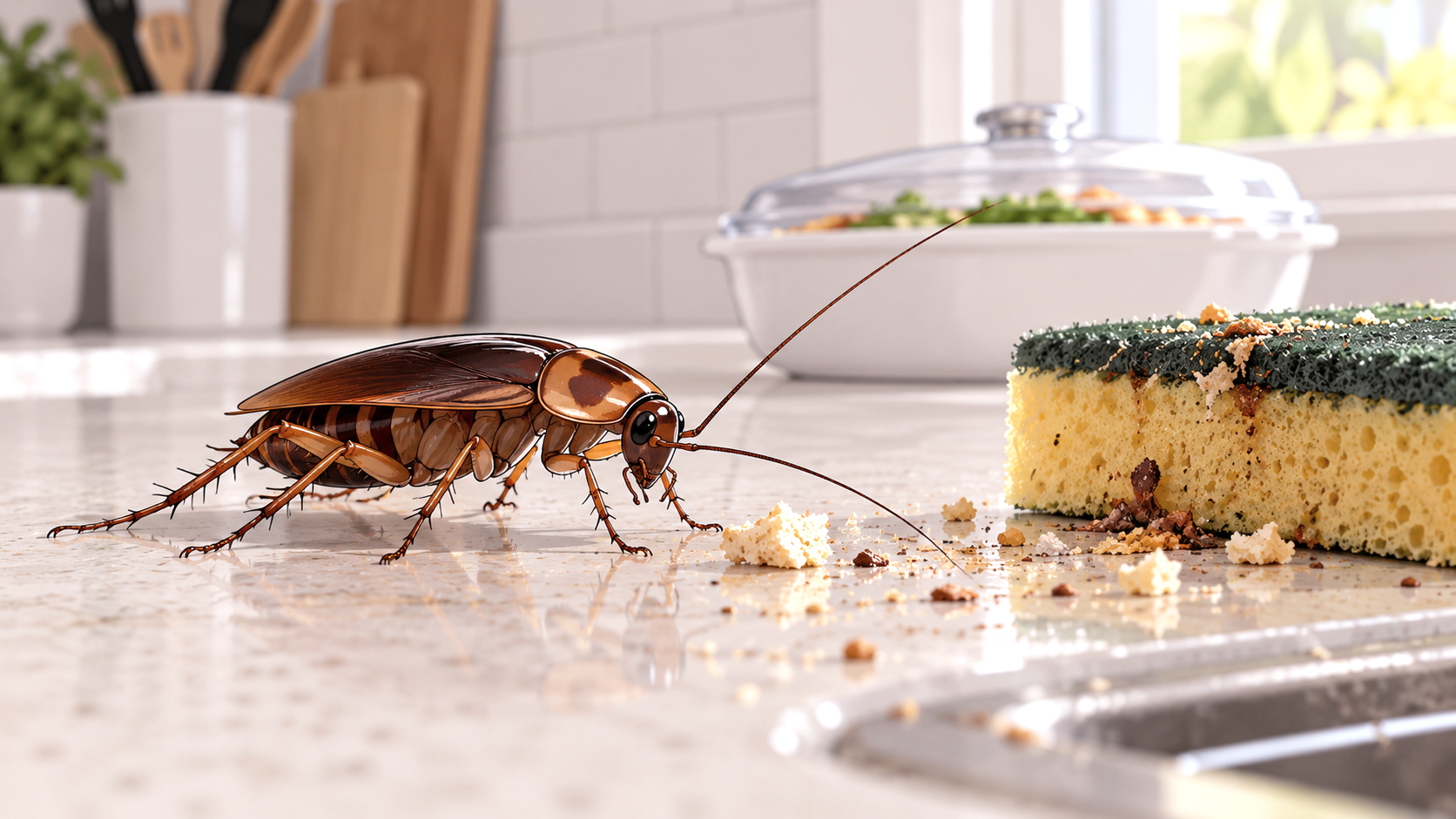
Calling a cockroach “poisonous” sounds plausible when the insect has come from a drain, garbage area, or filthy crevice. But poison has a specific meaning. An animal is poisonous when toxins in its body can harm another organism through contact or ingestion. That is not how ordinary household cockroaches pose a risk to people.
Household cockroaches are not considered poisonous to humans. They do not contain a poison that makes normal contact with the insect toxic, and they do not inject venom. Their genuine health concerns come from contamination and allergenic material associated with infestations, not from cockroach poison.
Poisonous and Contaminated Are Two Different Things
A cockroach can be unsanitary without being poisonous. Household species forage across food residues, garbage, drains, sewage-associated areas, and other contaminated environments. Microorganisms can be transported on their bodies or through their digestive systems, which is why food and preparation surfaces exposed to cockroaches can become contaminated after the insects travel through garbage or sewers. That risk comes from material the cockroach encounters and carries, not a toxin naturally present in its body.
The same separation applies when discussing microorganisms carried by cockroaches. Bacteria or other pathogens associated with an insect do not make the insect poisonous any more than bacteria on spoiled food turn that food into a venomous organism. If a cockroach has crossed exposed food, fecal matter, or a food-contact surface, contamination is the relevant concern.
Cockroaches Are Not Venomous Either
Poison and venom describe different biological routes. Venomous animals actively deliver toxins through structures such as fangs or stingers. Household cockroaches have neither. Their mouthparts are built for chewing, and their six legs carry prominent spines, but none of these structures functions as a venom-delivery apparatus.
Cockroaches can physically use their jaws, although cockroach bites on living humans are exceptionally uncommon and associated with unusual conditions. A bite would be a mechanical injury rather than envenomation. Someone who develops a concerning skin reaction should not interpret the mark as evidence that a cockroach injected a toxin.
Defensive Chemicals Do Exist in Some Cockroach Species
The broad statement that cockroaches possess no biologically active chemicals would go too far. Cockroaches are a large and diverse group, and chemical research has identified defensive or signaling secretions in numerous species. Identified compounds include quinones, phenols, acids, aldehydes, ketones, alcohols, and other substances, with some secretions deterring predators or functioning in communication. Research on Therea petiveriana, for example, found that its glandular secretion functions as an alarm signal.
That biology does not turn the German, American, Oriental, or brown-banded cockroaches encountered in buildings into poisonous household pests. The cockroach species found around homes differ considerably from the many wild species included in chemical-defense research. A specialized secretion documented in one species should not be generalized into a claim that touching a household cockroach exposes a person to poison.
Cockroach Debris Can Cause a Reaction Without Being Poison
Feces, saliva, secretions, shed material, and body fragments can contain proteins that act as allergens. In susceptible people, these materials may contribute to allergic symptoms or asthma. Cockroach proteins in feces and saliva are recognized indoor asthma and allergy triggers, and cockroach droppings and body parts are also recognized as biological indoor contaminants.
An immune reaction to an allergen is not poisoning. Someone sensitized to cockroach proteins may react to environmental debris even without touching a live insect, while another person exposed to the same material may have no allergic symptoms. The relationship between sensitization and exposure therefore belongs to the separate question of cockroach allergies and asthma, rather than evidence that the insects contain a general-purpose toxin.
Eating a Cockroach Is Not the Same as Eating Poison
Accidentally swallowing a cockroach does not constitute poisoning from the insect itself. The more defensible concern is what may be on or inside an insect that has lived in an unsanitary environment. Food-safety rules consequently focus on preventing pest access and contamination rather than treating cockroaches as intrinsically toxic ingredients.
This also explains why an insect discovered in food deserves a different response from one merely crossing a wall. Cockroaches have an extremely broad scavenging diet and can move between contaminated material and human food. Discarding visibly contaminated food and cleaning affected food-contact surfaces addresses that exposure without mislabeling the cockroach as poisonous.
Questions About Cockroaches and Toxicity
Can touching a cockroach poison you?
Normal skin contact with a household cockroach is not considered a poisoning exposure. Wash your hands after handling one because the insect may have contacted unsanitary material.
Is the smell from a cockroach poisonous?
Cockroaches can produce odors from secretions and accumulated infestation material, but smelling a characteristic cockroach odor is not evidence of poisoning. A persistent odor can accompany a substantial population and may occur alongside other signs of an established cockroach infestation.
Are dead cockroaches poisonous?
A dead household cockroach does not become poisonous simply because it has died. Its body can still contribute allergenic debris, however, so removing dead insects is preferable to allowing them to accumulate indoors.
Can a cockroach become dangerous after walking through insecticide?
Pesticide residue is a separate chemical exposure from the cockroach’s natural biology. An insect that has contacted a pesticide may carry some product on its body, so avoid unnecessary handling and follow the pesticide label’s safety directions. The risks posed by cockroaches themselves should not be confused with the hazards and precautions of a control product.