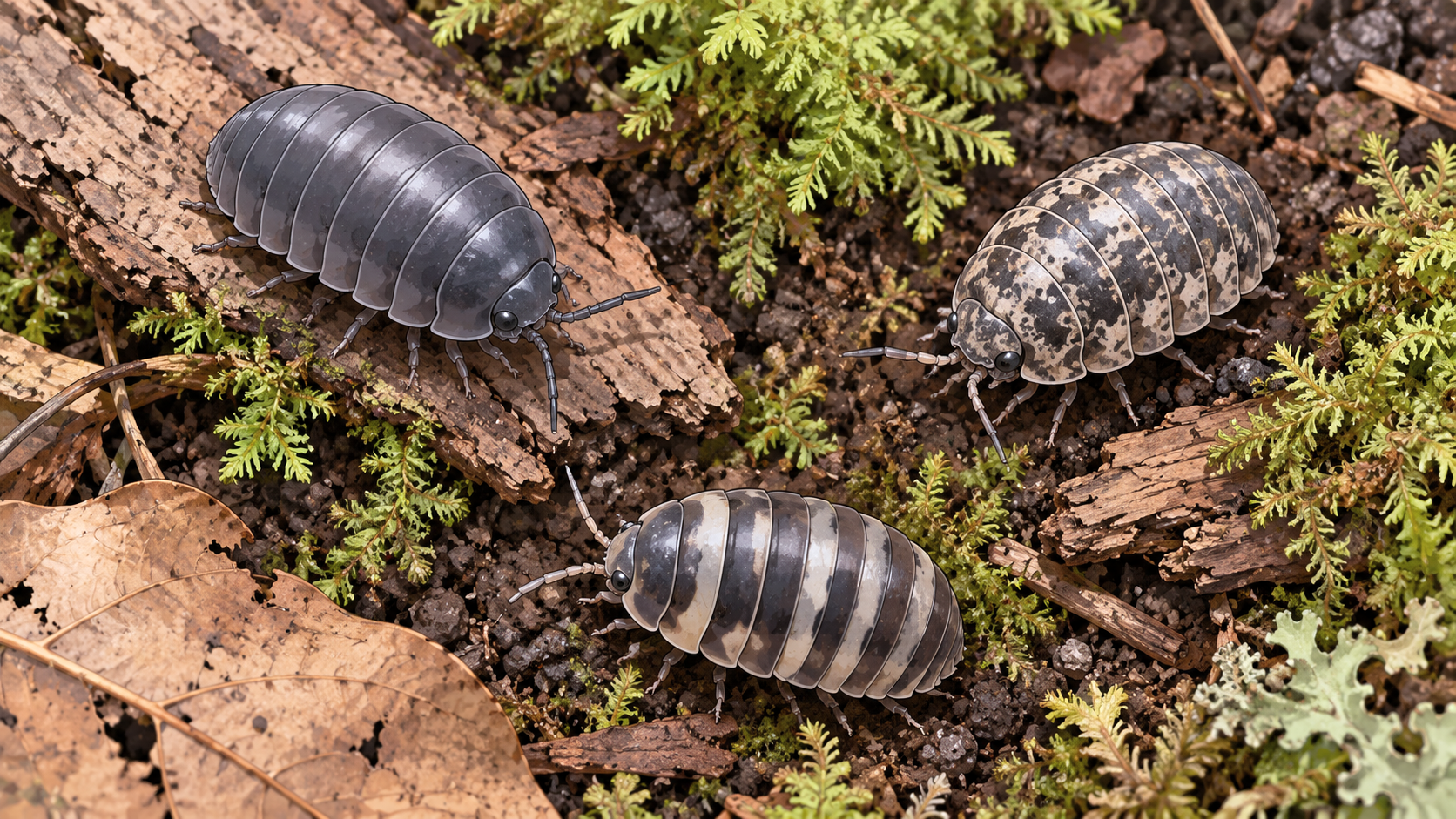
There are many species that can reasonably be called roly-polies, rather than one animal with a single worldwide appearance. The common pillbug (Armadillidium vulgare) is the familiar example across much of North America and Europe, but other ball-forming terrestrial isopods differ in body shape, markings, size and geographic range.
Species also need to be separated from the named color forms sold in the isopod hobby. A white, orange or patterned captive roly-poly is not automatically a separate species. Some are selectively maintained color varieties of species that also occur in much less conspicuous forms.
Common Pillbug (Armadillidium vulgare)
If you picture a dark gray roly-poly that forms a neat ball when touched, Armadillidium vulgare is a strong match. Adults can reach about 18 mm, and although slate gray is common, A. vulgare varies considerably in coloration and mottling. Its uropods are short and end approximately flush with the rear of the body, contributing to the smooth outline when it rolls up.
This species has spread far beyond its original European range. It is introduced in the continental United States and Alaska, and populations occur widely elsewhere. That extensive distribution is one reason descriptions of the typical roly-poly appearance often resemble A. vulgare closely.
Color is not sufficient for a confident species identification. A. vulgare can be mottled, and similar-looking pillbugs occur alongside it. Body proportions, structures around the head and rear, and sometimes sex-specific features provide stronger evidence.
Nosy Pillbug (Armadillidium nasatum)
Armadillidium nasatum can initially resemble A. vulgare, but the front of the head provides an unusually useful clue. It has a projecting scutellum that looks like a small nose or the peak of a cap, the feature behind the common name “nosy” or “nosey” pillbug. Its telson has a more rounded tip, and when disturbed it may form an imperfect ball with the antennae still projecting.
North American records include populations in both eastern and western parts of the continent. The species is native to southwestern Europe but has been introduced elsewhere, with records extending from parts of eastern Canada and the United States to British Columbia, California and Colorado. Gardens and greenhouses are among the places where it can occur.
The nose-like projection is considerably more useful than trying to identify A. nasatum from its color. Although pale longitudinal markings are common, pigmentation overlaps with other species. An animal’s ordinary color and pattern variation should not override structural features that point to a different identification.
Southern Pill Woodlouse (Armadillidium depressum)
Armadillidium depressum is another large pillbug that can be mistaken for A. vulgare. Individuals can reach about 20 mm. The body has a somewhat flatter, more splayed appearance, and the scutellum forms a broad raised plate visible between the antennae. Adult A. depressum may be slate gray with yellow flecking, while immature individuals can look considerably more patterned.
Geography greatly changes the likelihood of encountering it. A. depressum is established particularly in Britain, where records are concentrated in England and Wales with an expanding distribution farther north. Walls, quarries, exposed rock and human-modified limestone environments are characteristic locations. An identification guide written for one country can therefore give a misleading impression of how likely this species is to appear somewhere else.
Zebra Isopod (Armadillidium maculatum)
The zebra isopod, Armadillidium maculatum, has become especially recognizable because of the pale transverse markings crossing its darker back. Those contrasting bands give the animal its zebra-like appearance and make a well-marked adult visually distinctive compared with the more uniformly gray A. vulgare.
Its natural distribution is centered in parts of Europe, particularly Mediterranean and nearby regions, rather than matching the broad introduced North American distribution of A. vulgare. Outside its natural range, people may be more likely to encounter A. maculatum in captive isopod collections than beneath an ordinary garden stone.
A striped animal still requires more than pattern recognition for a firm identification. Terrestrial isopods can vary within species, and superficial markings sometimes overlap. The segmented external structure shared by roly-polies provides the starting body plan, while species determination depends on finer characters.
Other Ball-Forming Isopods Extend Beyond Armadillidium
Roly-poly is an informal name, so it does not map neatly onto a single genus. Ball-forming terrestrial isopods also occur outside Armadillidium. Cubaris murina, for example, belongs to family Armadillidae rather than Armadillidiidae, and its accepted classification places it within the terrestrial isopods while retaining it as a distinct species in the genus Cubaris.
The rear of the body can help separate major groups. Uropod form is an important identification feature among woodlice, and the short, truncated uropods characteristic of many Armadillidium contrast with the projecting structures of numerous non-pillbug woodlice. Accurate identification can eventually require small anatomical details that are difficult to judge from a casual photograph.
The diversity is substantial even within a single region. British records alone include A. album, A. depressum, A. nasatum, A. pictum, A. pulchellum and A. vulgare among multiple members of family Armadillidiidae. A roly-poly found elsewhere should not automatically be assigned one of those names because local species composition can be entirely different.
Sowbugs Are Related, but They Are Not Another Type of Roly-Poly
Common names become especially confusing when all woodlice are grouped together. Sowbugs such as Porcellio scaber are terrestrial isopods, but their flatter bodies and projecting rear appendages differ from the compact pillbug form. Most importantly for everyday recognition, they cannot close into the complete defensive sphere associated with roly-polies.
A roly-poly and a sowbug are therefore close relatives rather than two names for the same body form. “Woodlouse” can include both, while “roly-poly” is normally applied to the pillbug side of that informal division. The ability to roll into a protective ball is consequently useful when narrowing an unknown terrestrial isopod toward a pillbug, although species identification requires additional features.
Captive Morphs Are Not Automatically New Species
Pet isopod culture has produced a large vocabulary of morph and trade names. Breeders may select unusual pigmentation, spots, reduced pigment or other inherited appearances and maintain those traits through captive breeding. A morph remains part of its underlying species unless it represents a genuinely different taxon.
For example, two captive animals can look dramatically different while still belonging to the same species. Conversely, two gray wild pillbugs can resemble each other while belonging to different species. Treating every color label as a species name therefore reverses the way biological identification works. The scientific name identifies the species; a morph name describes a particular captive appearance or breeding line.
Naturally occurring pigmentation can also vary without creating another species. An unusually colored specimen needs to be considered in the context of normal roly-poly color variation, while a conspicuous blue roly-poly can reflect iridovirus infection rather than either a new species or a stable color morph.
Questions About Roly-Poly Species
Can two different roly-poly species live in the same place?
Yes. Terrestrial isopod species can overlap where suitable habitat and geographic ranges coincide. British records, for example, note A. depressum occurring alongside A. vulgare and other woodlice, so finding several similar pillbugs under nearby objects does not prove they are all the same species.
Can you identify a roly-poly species from a photo?
Sometimes, especially when a photograph clearly captures a distinctive feature such as the projecting scutellum of A. nasatum. Other identifications may require a clear view of the rear structures, underside or male reproductive characters, making a distant top-down photograph insufficient.
Are all Armadillidium species found worldwide?
No. Species have different native and introduced ranges. Even the widely distributed A. vulgare is recorded as introduced in North America, while other members of the genus remain much more geographically restricted.
Does a roly-poly changing color mean it changed species?
No. An individual cannot change from one species into another. Development, molting, natural pigmentation and some biological conditions can alter appearance without changing the animal’s species identity.