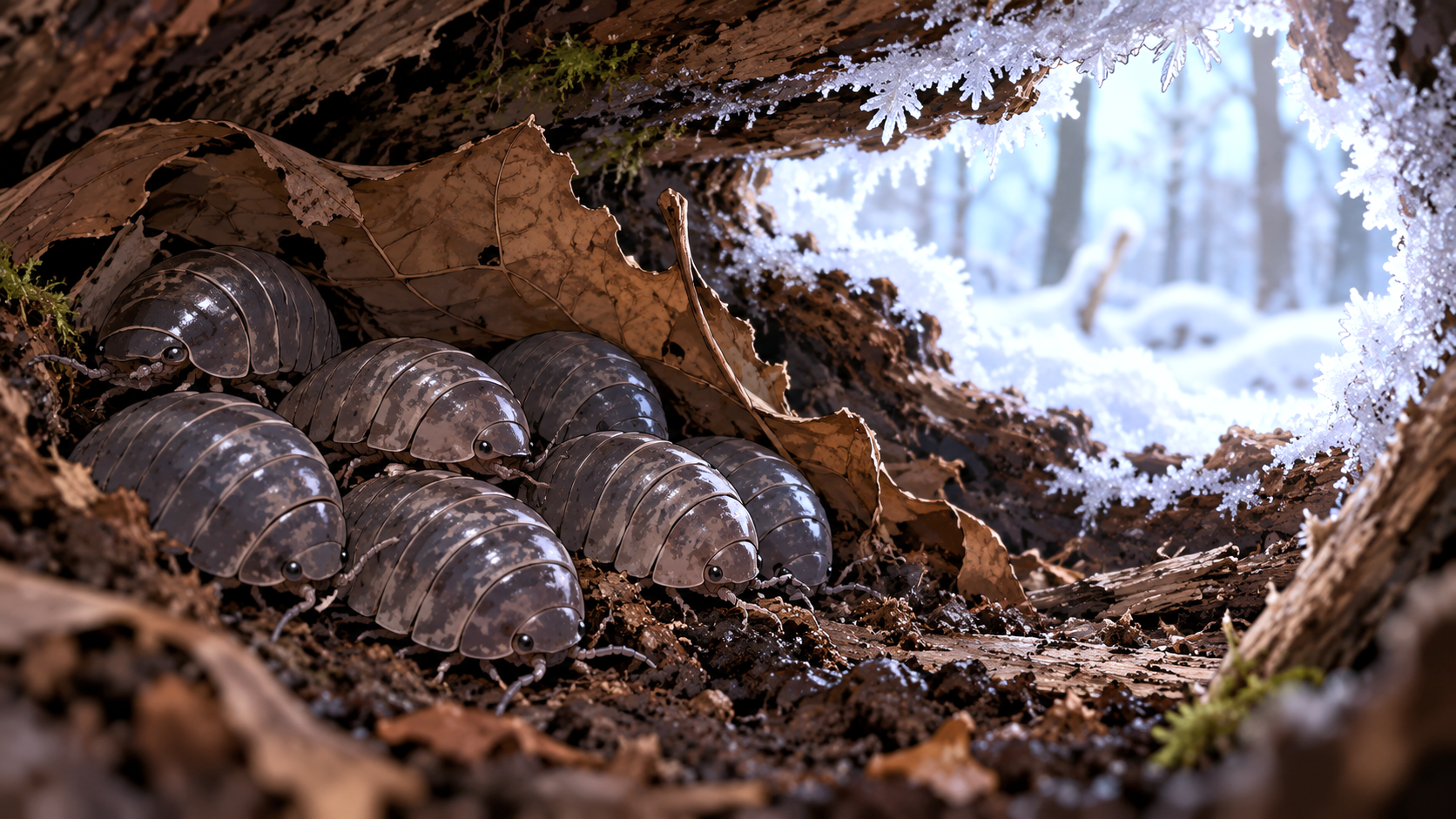
Roly-polies can enter winter dormancy or prolonged seasonal inactivity when temperatures become sufficiently cold, a state often described as hibernation. They retreat into protected sites where temperatures are less extreme and greatly reduce their surface activity. Their winter behavior is flexible, however: where the ground remains warm enough, terrestrial isopods can remain active throughout winter. Temperature is therefore more useful than the calendar for understanding what happens to roly-polies in cold weather. A mild winter, heated environment or unusually warm patch of soil can produce a very different response from deeply frozen ground.
Winter Usually Pushes Roly-Polies Deeper Into Shelter
As temperatures fall, terrestrial isopods become much less conspicuous at the soil surface. Instead of disappearing from an area, they can retreat beneath insulating material and farther into soil or other protected spaces. Fall and winter burrowing has been documented as a response to cold temperatures, while long-term ecological work on Armadillidium vulgare found seasonal changes in abundance and surface availability associated with weather. (onlinelibrary.wiley.com)
Soil, litter and objects resting against the ground buffer temperature changes compared with an exposed surface. These are already among the sheltered places roly-polies occupy, allowing an individual to move into a more protected part of its surroundings without undertaking a long seasonal migration. Common pillbugs can burrow into suitable soil, and sites where the ground freezes completely are unfavorable for their populations. (animaldiversity.org)
Sheltering itself also changes across the year. Field research comparing four terrestrial isopod species found seasonal changes in refuge use, with the measured sheltering index declining after the breeding period and remaining low through winter. Winter disappearance from exposed surfaces should consequently be understood as part of a broader seasonal change in behavior rather than evidence that the population has vanished.
Cold Slows an Animal Whose Body Temperature Follows Its Surroundings
Roly-polies are ectotherms. They do not maintain a high, internally regulated body temperature in the way mammals do, so environmental temperature strongly influences their physiological performance and behavior. Modern experiments with A. vulgare continue to find substantial behavioral changes when ambient temperature changes.
Low winter temperatures consequently reduce the conditions suitable for normal surface movement. The common pillbug is capable of considerable locomotion under favorable laboratory conditions, including about 50 metres of movement within an hour at 22°C, but measurements made at a comfortable experimental temperature cannot be extrapolated to a cold winter surface.
The slowdown also reduces opportunities for normal foraging. Although roly-polies consume decomposing organic material and several other foods, remaining protected during cold periods can take priority over moving across the surface to find it. Reduced winter activity therefore does not mean the animals require a fundamentally different winter diet.
Warm Ground Can Interrupt the Usual Winter Dormancy
A particularly revealing natural experiment occurs around thermal waters. Researchers surveyed warm shoreline habitats in western Romania from December through February and found 12 terrestrial isopod species active during winter, including A. vulgare. The animals behaved normally when disturbed, and the investigators concluded that elevated local temperatures allowed winter activity to continue instead of the usual cold-season hibernation.
The finding shows why “roly-polies hibernate all winter” is too absolute. Winter inactivity depends substantially on the thermal conditions the animals actually experience. The same study recorded active isopods in 35 habitats bordering thermal waters, providing more than an isolated observation of one animal moving during an unusual warm spell.
Temperature can also influence other seasonal processes. Temperate populations of A. vulgare have strongly seasonal reproduction, with environmental conditions contributing to variation in the timing and duration of reproductive activity. (pubmed.ncbi.nlm.nih.gov) Those reproductive changes belong to the broader roly-poly life cycle, but they reinforce the importance of environmental conditions when interpreting apparent seasonal disappearance.
A Warm Winter Day Does Not Mean the Population Never Became Dormant
Dormancy is not necessarily an uninterrupted state lasting from the first cold day until spring. Conditions within soil and surface refuges fluctuate. A period of unusually mild weather can warm protected ground enough for some animals to become mobile, while another cold period can sharply restrict activity again.
Local microclimate can produce even larger differences. The Romanian thermal-water study demonstrates that terrestrial isopods can remain active throughout a season normally associated with dormancy when their immediate surroundings stay warm. Likewise, the common pillbug occurs across a wide geographic range, including temperate and comparatively cold regions, so one population’s winter conditions cannot define every population’s behavior.
Species also differ. “Roly-poly” can refer to more than one pill-forming terrestrial isopod, and different roly-poly species have different distributions and environmental tolerances. A fixed temperature at which every roly-poly supposedly begins or ends hibernation would therefore be misleading.
Finding Roly-Polies in Winter Is Not Unusual in a Protected Warm Spot
A winter sighting does not indicate that something is biologically wrong with the animal. Heated greenhouses can support A. vulgare, and Canadian records include populations found in greenhouses as well as outdoor sites. A recent national review describes the common pillbug as widespread across Canada, illustrating its ability to persist in regions with substantial winter cold when suitable refuges are available.
Outdoor individuals exposed by moving a log, board or stone may also be encountered without having been active on the surface beforehand. Disturbing the refuge physically uncovers the animal, so its presence there cannot by itself show how active it was before the shelter was lifted.
An indoor winter sighting raises a different question. Warmth can allow activity, but the reasons roly-polies appear inside houses involve entry routes and indoor conditions rather than winter dormancy alone.
Questions About Roly-Polies in Winter
Do roly-polies die when the weather turns cold?
Cold weather does not automatically kill an established population. Individuals can avoid dangerous exposure by occupying buffered refuges, although severe conditions and deeply frozen soil can reduce survival.
Can frozen roly-polies come back to life?
A motionless, extremely cold pillbug should not automatically be assumed to be frozen solid. Dormancy and cold-induced inactivity can greatly reduce visible movement, but actual freezing can damage or kill animals that lack sufficient freeze tolerance.
Should you dig up dormant roly-polies to check whether they are alive?
No practical benefit comes from repeatedly exposing sheltered animals to colder surface conditions. Leaving an undisturbed refuge intact preserves the buffered microclimate they selected.
Is winter dormancy the same as a roly-poly resting during daylight?
No. Winter dormancy is a seasonal response strongly influenced by cold conditions, whereas roly-poly nocturnal activity concerns changes in activity across the daily light-dark cycle.