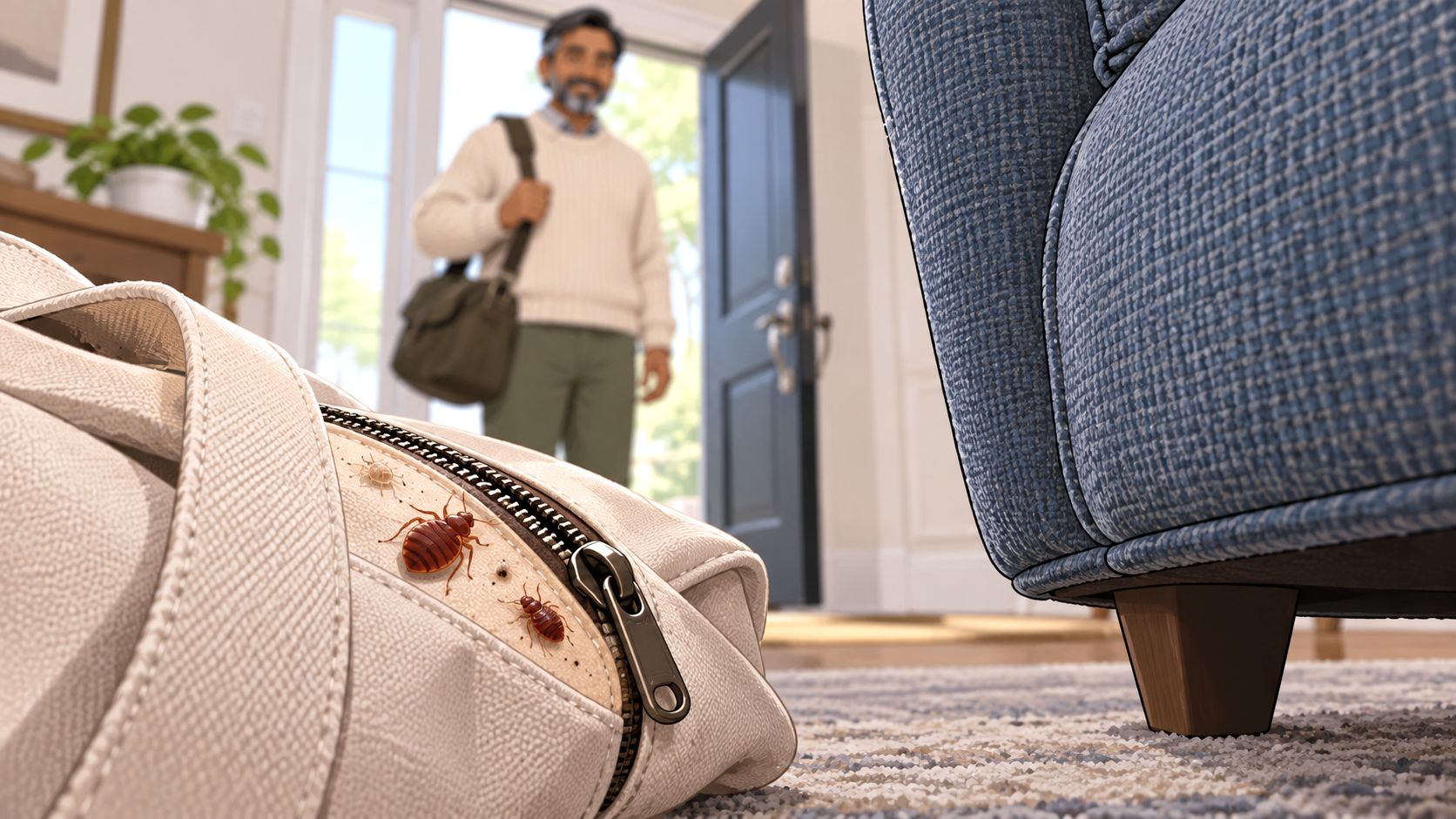
You can get bed bugs from visiting someone’s house, especially if the home has an active infestation. The main risk is carrying a hidden bug home in a purse, backpack, coat, clothing, or another belonging. Simply entering the house does not mean you will bring bed bugs back with you.
What Makes One Visit More Likely to Bring Bed Bugs Home?
Bed bugs spread efficiently by hiding in objects that move between locations. They can enter seams and folds in luggage, clothing, bedding, and other belongings, then emerge after those items reach another home. The same hitchhiking behavior that allows bed bugs to travel in luggage and backpacks can occur with an everyday bag carried into an infested house. A visit becomes more concerning when belongings spend time on beds, sofas, upholstered chairs, or near areas where bed bugs are already hiding. Public-health guidance specifically identifies purses and backpacks placed on upholstered surfaces as possible transport routes.
Duration alone does not determine whether exposure occurs. A person who spends several hours at a house but keeps a small bag away from infested furniture may create fewer opportunities for hitchhiking than someone whose coat and backpack sit on an infested sofa during a shorter visit. Bed bugs can move onto belongings without remaining permanently attached to a person, so clothes can transport bed bugs between locations even though humans are not their normal living surface. Keeping personal items separate from other people’s belongings is one of the precautions recommended when bed bug exposure is possible in shared environments.
Sitting on an Infested Sofa Deserves More Attention Than Walking Through the Door
Furniture where people regularly sit or sleep provides the type of sheltered, host-adjacent environment bed bugs favor. They commonly hide around beds and sofas, including seams, folds, cracks, and furniture joints. Guidance for people entering infested rooms advises them to avoid putting belongings on beds, couches, or chairs. A coat draped over an infested couch or a handbag pushed against its cushions creates a direct opportunity for a concealed bug to enter the item.
Ordinary brief contact with hard surfaces carries a different practical concern from placing belongings in established harborages. Bed bugs crawl rather than fly or jump, so exposure requires a bug to reach something that later leaves the house. You do not need to assume every object in an infested property contains them. Concentrating precautions on upholstered furniture, sleeping areas, clothing, bags, and objects stored near known activity is more useful than treating the entire building as though every surface creates equal risk.
What to Do With Your Belongings After Visiting an Infested House
Keep potentially exposed items away from beds and upholstered furniture when you return home. Clothing that can safely tolerate machine drying can be handled separately, and sufficiently hot dryer conditions can kill bed bugs. The role of dryer heat in killing bed bugs makes it more dependable for suitable garments than simply washing them. Travel guidance likewise recommends unpacking clothing directly for laundering and high-temperature drying after possible exposure.
Bags, shoes, and objects that cannot go into a dryer need inspection rather than automatic pesticide treatment. Check seams, folds, pockets, zipper areas, and other protected spaces where a small insect could hide. Keeping belongings contained until they have been inspected or treated prevents a possible hitchhiker from immediately gaining access to bedrooms or living-room furniture. Broadly spraying bags, clothing, or your body with an insecticide is not an appropriate substitute for following a product’s labeled uses.
We would also avoid carrying exposed belongings from room to room while deciding what to do with them. Bed bugs are effective hitchhikers on furniture, boxes, clothing, bedding, and luggage, so unnecessary movement creates additional opportunities for a hidden insect to change locations.
A Possible Exposure Is Not the Same as Bringing Home an Infestation
Visiting an infested home gives bed bugs an opportunity to hitchhike, but exposure does not establish that one actually came home with you. Inspect rather than assuming the worst. Early evidence may include a live insect, shed skin, eggs, fecal spotting, or characteristic staining around places where people sleep. Knowing the early signs of bed bugs is more useful after a questionable visit than repeatedly checking your skin for bites.
Bites are particularly poor proof of what happened during the visit. Skin reactions may appear later, vary between people, or have another cause entirely. Anyone concerned about a possible introduction can perform a focused room-by-room bed bug inspection around beds, nearby furniture, and other likely hiding areas rather than searching randomly throughout the house. Public guidance also emphasizes early detection and prompt control when an actual bed bug is found.
Questions That Come Up After Visiting a Home With Bed Bugs
Can a bed bug ride home directly on your body?
Bed bugs can crawl onto a person temporarily, but they do not normally remain on human bodies the way lice do. The more important transport routes are clothing, bags, and belongings that provide protected folds or seams.
Should you throw away the clothes you wore during the visit?
No. Washable clothing normally does not need to be discarded merely because it may have been exposed. Appropriate heat treatment is a practical option for suitable garments, while disposal can create needless expense without proving that a bed bug was present.
What should you do if you actually find a bed bug after getting home?
Capture the insect if possible and avoid moving potentially exposed belongings into additional rooms. The next steps after finding a bed bug in your house depend on confirming the insect and checking nearby hiding areas for additional evidence.
Can you safely visit someone again while their home is being treated?
Risk depends on whether live bed bugs remain and where you spend time or place belongings. Bed bug control often takes repeated measures rather than a single event, so the fact that treatment has started does not by itself establish that every insect has been eliminated. Until the infestation is confirmed under control, keeping bags and outerwear away from upholstered furniture remains a sensible precaution.