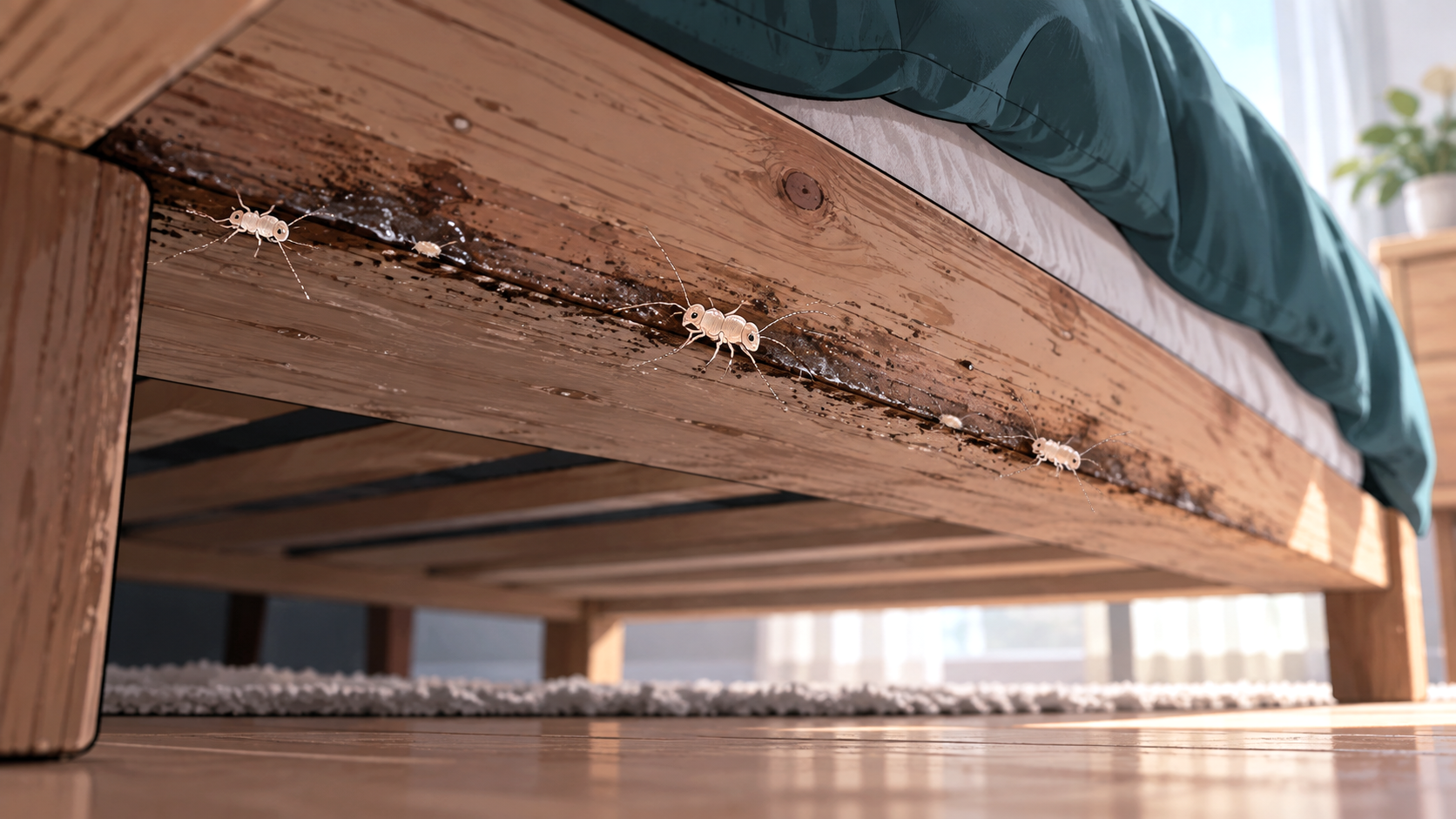
Booklice can live in a bed if the mattress, bed frame, bedding, or material around it stays humid enough to support them and their food. They are not attracted to sleeping people, blood, or mattresses themselves. A dry, regularly used bed is usually poor habitat, while a damp or mold-affected mattress can support a genuine population.
A Mattress Can Become a Breeding Site, but Only Under Unusual Conditions
A bed is not automatically unsuitable for booklice. One documented infestation involved thousands of psocids emerging from a damp straw mattress, with the breeding population estimated to be vastly larger inside it. The Canadian Conservation Institute records the case while emphasizing the same environmental factor associated with psocids elsewhere: excessive dampness can turn an object into a major breeding area.
Modern mattresses contain different materials, but the biological requirement remains similar. Fabric layers, foam, natural fibers, cardboard components, wooden slats, dust, and organic debris can all provide protected spaces. None makes a bed inherently attractive to booklice. Enough retained moisture to support fungi or other suitable food must usually be present before those materials become useful habitat. Their normal diet consists largely of fungi, mold, grains, starches, and related organic material, not mattress foam or human blood.
The Bed May Only Be Where You Notice Them
Finding booklice on a sheet does not establish that they are reproducing inside the mattress. A bed offers a broad, light-colored surface where a tiny moving insect is easier to notice than it would be against flooring, furniture joints, or a wall cavity. Booklice from a damp headboard, cardboard box beneath the bed, exterior wall, window area, bedside books, or another nearby source can wander onto the bedding.
Indoor psocids favor warm, humid, relatively undisturbed locations containing mold or fungi. Repeatedly finding insects only after they cross the exposed top of the mattress may therefore reveal little about where they are actually breeding. Concentrated activity inside seams, underneath the mattress, beneath a bed base, or around one damp section of the frame provides much stronger evidence that the bed structure itself is involved.
The tiny body size and flattened shape of booklice also allow them to move through gaps around furniture and trim that are easy to overlook. A visible insect may have traveled only a short distance from a concealed source.
Moisture Beneath the Mattress Deserves More Attention Than the Top Sheet
The underside of a mattress can have a different microclimate from the sleeping surface. Restricted airflow, contact with a solid platform, condensation against a cool exterior wall, spilled liquid, high room humidity, or storage directly beneath the bed can leave concealed materials damper for longer periods.
Beds positioned against poorly ventilated walls can create similar conditions around headboards and frames. Psocids occur wherever temperature and humidity support their food, so an infestation concentrated behind a headboard may have more to do with wall moisture than with the mattress several centimeters away.
Their dependence on atmospheric moisture is unusually strong. Household booklice generally fail to persist once relative humidity remains sufficiently low, which is why humidity determines whether booklice can maintain a population. A bedroom can feel comfortable overall while a poorly ventilated space beneath the bed remains humid enough to behave differently.
Booklice in Bed Do Not Feed on You
The word “lice” often creates the impression that booklice in bedding must be using the sleeping person as a host. They are not parasitic lice. Psocids have chewing mouthparts and feed on environmental material rather than human blood. Oxford City Council describes booklice as harmless household insects associated with bacteria, yeasts, mold, and algae in damp conditions.
They therefore have no reason to remain near your body for a blood meal. Booklice do not bite people, and finding one on a pillow or sheet does not explain unexplained bite-like marks on skin. Itching, welts, or suspected nighttime bites require a separate explanation rather than being attributed to booklice simply because one specimen was found near the bed.
A Damp Bed Is More Plausible Than a Clean, Dry Mattress Infestation
A dry mattress in a low-humidity bedroom provides little of what booklice require. By contrast, a bed affected by persistent condensation, water intrusion, damp natural filling, or fungal growth can develop the same conditions that support booklice in books, cardboard, cupboards, and wall voids.
The University of California’s urban entomology reference places psocids in damp, secluded environments where molds and mildews grow. Mold does not have to be obvious. Microscopic fungal growth can provide food well before a mattress develops a dramatic visible patch, just as booklice can feed on mold that is difficult to see.
A persistent musty odor, known water exposure, visible spotting consistent with fungal growth, or unusually damp material makes the mattress itself more credible as a source. A completely dry bed with occasional isolated booklice makes a nearby source more plausible.
Do Not Identify a Bed Bug From Location Alone
Beds immediately raise concern about bed bugs, but an insect found on bedding is not automatically a bed bug. Adult household booklice are commonly around 1 to 2 millimeters long, while newly hatched bed bugs can overlap that size range. Penn State notes that booklice are flatter and proportionally broader-headed than bed bug nymphs, so an intact specimen is much more useful than the fact that it was found on a mattress.
The surrounding evidence is also different. Bed bugs are blood feeders whose typical harborages occur close to sleeping or resting hosts. They can leave reddish-black fecal spots on mattresses and furniture, and established infestations may include cast skins and attached eggs. The biological differences between booklice and bed bugs become especially important when both insects are small and pale.
Booklice do not create the characteristic blood-derived fecal spotting associated with bed bugs. Their own droppings are too small and nonspecific to serve as a reliable household identification sign. Dark spotting on a mattress should therefore not be assigned to booklice merely because psocids have also been seen in the room.
Eggs and Nymphs Can Show Whether the Bed Is Actually Supporting Reproduction
One adult booklouse on a pillow may have wandered there. Finding several sizes of psocids repeatedly within the same mattress seam or bed component gives a different picture. Booklice develop from eggs into nymphs that resemble miniature adults, so a localized mixture of adults and very small booklice nymphs can indicate reproduction nearby.
The eggs themselves are much harder to use. Booklice eggs are minute and usually laid individually, sometimes with debris concealing them. They do not form an obvious mattress egg cluster that can be recognized easily with the naked eye.
Canadian grain guidance likewise records females laying eggs within suitable food environments under warm, humid breeding conditions. If a bed genuinely provides those conditions, reproduction is possible, but the evidence is more likely to be repeated insects of different sizes than a visible concentration of eggs.
Questions About Booklice in Beds
Can booklice live in pillows?
They could occur in a damp pillow or its seams if moisture and fungal food were available, but pillows are not a normal required habitat. An isolated insect on a pillow may simply have wandered there.
Can booklice live in a box spring?
A box spring contains fabric, wood, cardboard, joints, and protected voids, so it offers many hiding places. It becomes meaningful booklice habitat only if humidity and food sources make those spaces suitable.
Can booklice live in bedding after it has been washed?
Clean, thoroughly dried bedding is poor long-term habitat. Finding booklice again after washing suggests insects are arriving from another part of the bed or bedroom rather than surviving indefinitely on clean sheets.
Can booklice crawl on you while you sleep?
An individual could accidentally crawl onto skin just as it could cross any nearby surface, but it is not seeking a host or blood meal and will not establish on the body.
Does replacing the mattress solve a booklice problem?
Only when the mattress itself is the breeding source. If insects are coming from a humid wall, bed frame, stored cardboard, books, or another damp location, replacing a dry mattress leaves the source untouched. The broader signs of an established booklice infestation can help determine whether activity extends beyond the bed.
Should insecticide be sprayed on a mattress for booklice?
Routine mattress spraying is not appropriate for an ordinary booklice problem. Moisture reduction is the principal management method for indoor psocids, and Minnesota notes that insecticides are normally unnecessary when moisture is corrected. The wider approach to getting rid of booklice should focus on the breeding environment rather than treating a sleeping surface without establishing that it is the source.