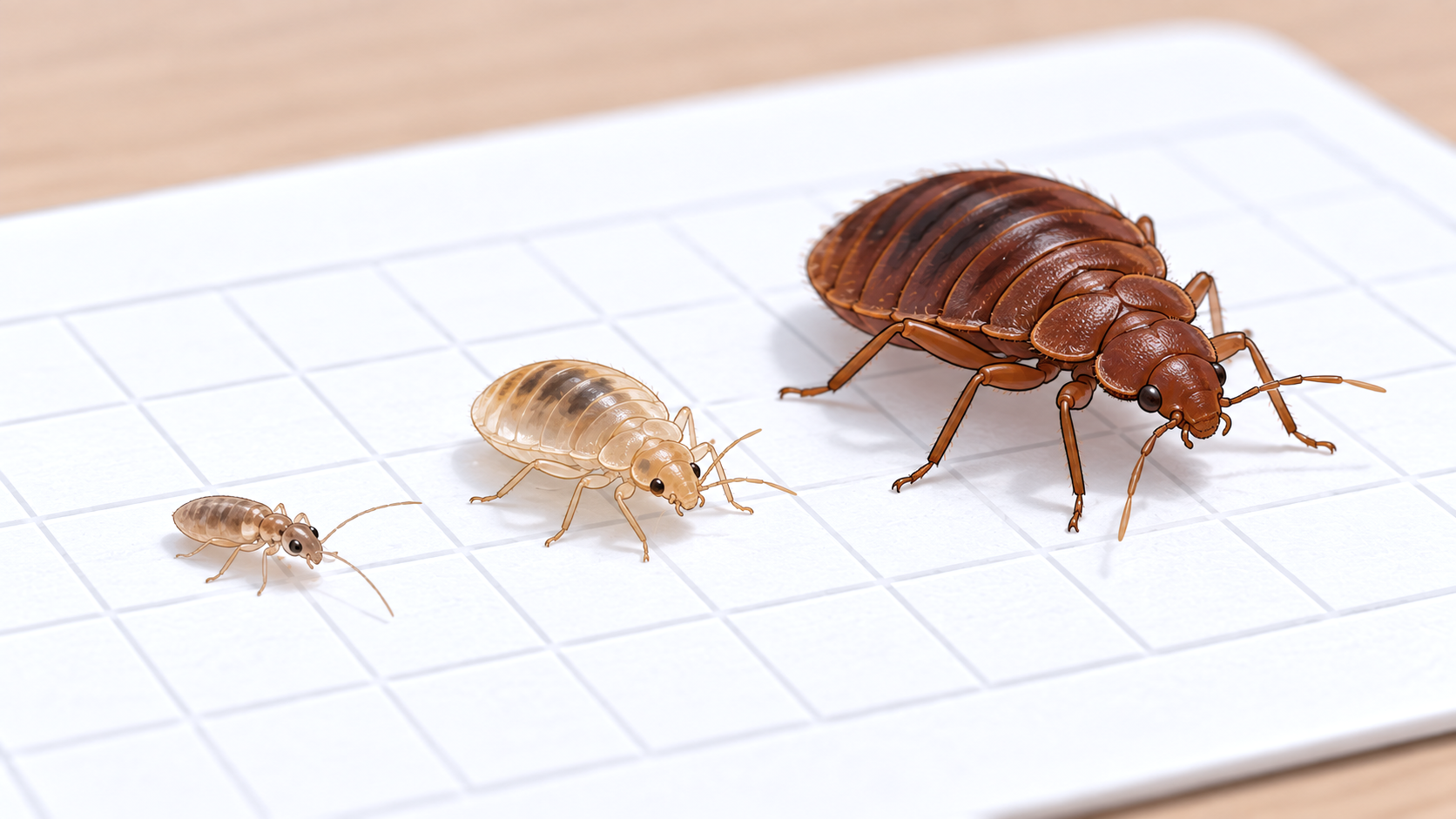
Booklice and adult bed bugs are not especially difficult to separate once you compare them at their real size. The harder comparison is booklice vs. newly hatched bed bug nymphs. Both can be tiny, pale, wingless, and flattened enough to look similar in a quick photograph.
Booklice are usually 1 to 2 millimeters long, with long slender antennae and a head that is broad relative to the body. Adult bed bugs are much larger, about 5 to 7 millimeters long, with broad oval bodies. A first-stage bed bug nymph is about 1.5 millimeters long, making it close to the size of an adult booklouse, but its body proportions, feeding behavior, and infestation signs are different. The insect’s location can provide another clue, but it should not decide the identification by itself. A booklouse can wander near a bed, and a bed bug can occur away from one.
Booklice vs. Bed Bugs at a Glance
| Feature | Booklice | Bed Bug Nymphs | Adult Bed Bugs |
|---|---|---|---|
| Size | Commonly 1–2 mm | About 1.5–4.5 mm across the five nymph stages | About 5–7 mm |
| Unfed color | Nearly clear, gray, tan, brown, orange-brown | Translucent to whitish-yellow when young, darker as they mature | Brown |
| Body shape | Small, soft, flattened, relatively large head | Broad, oval and flattened when unfed | Broad, oval and flattened when unfed |
| Head | Broad relative to body | Narrow relative to thorax and abdomen | Narrow relative to thorax and abdomen |
| Antennae | Long and slender | Shorter-looking relative to body | Shorter-looking relative to body |
| Wings | Common indoor species wingless | Wingless | Wingless |
| Jumping | No | No | No |
| Food | Mainly fungi and mold | Blood | Blood |
| Bites people | No | Yes | Yes |
| Typical clue | Humidity and fungal growth | Bed bug signs near resting areas | Bed bug signs near resting areas |
The biggest trap in this comparison is size. A first-stage bed bug nymph and an adult booklouse can be almost the same length, so “it is too small to be a bed bug” is not a safe conclusion.
Adult Bed Bugs Are Much Larger Than Booklice
Adult size provides the easiest comparison. Common indoor booklice are generally 1 to 2 millimeters long, while adult bed bugs are about 5 to 7 millimeters long.
That makes an adult bed bug roughly several times the length of many booklice. At normal viewing distance, an adult bed bug is clearly recognizable as an insect, whereas a booklouse can initially look like nothing more than a moving speck.
The difference is well illustrated in booklouse identification material, which notes that an adult bed bug is approximately three times the length of an adult booklouse in its scale comparison.
This is also why online images can be misleading. A macro photograph of a one-millimeter booklouse can fill your screen just as completely as a photograph of a much larger bed bug. Knowing how big booklice actually are prevents magnification from distorting the comparison.
Bed Bug Nymphs Make the Comparison Harder
Bed bugs pass through five nymphal stages before adulthood, and the youngest stage is small enough to overlap with booklice in size.
A first-stage bed bug nymph is about 1.5 millimeters long. Later stages increase to approximately 2, 2.5, 3, and 4.5 millimeters before the insect reaches adulthood. These measurements are shown in the bed bug life cycle.
That means a newly hatched bed bug nymph can be approximately the same length as an adult booklouse. Penn State specifically notes this overlap when explaining why booklice are sometimes mistaken for bed bugs.
Size therefore works extremely well for separating booklice from adult bed bugs but becomes much less dependable when the suspected bed bug is a first-stage nymph.
Look at the Head Instead of Just the Size
When size overlaps, body proportions become much more useful.
Booklice have a conspicuously broad head. It is wider than the thorax and can be nearly as wide as the body. The large clypeus at the front contributes to the characteristic big-headed appearance seen under magnification.
A bed bug has a proportionally narrower head. Its thorax and abdomen create a broader, more oval silhouette, so the head does not dominate the body in the same way.
This is one of the strongest visual differences because it works even when comparing an adult booklouse with a similarly sized young bed bug. A clear photograph showing a very broad head, long antennae, and narrower body behind the head fits the characteristic appearance of booklice much better.
Bed Bugs Have a Broader, Rounder Body
An unfed bed bug has the flattened oval shape for which the pest is well known. After feeding, the abdomen expands and becomes more elongated.
Booklice are also flattened, which contributes to the confusion, but their proportions are different. Their prominent head, narrower thorax, and smaller overall body produce a less broadly oval appearance.
The difference becomes especially obvious with adults. The EPA describes adult bed bugs as flat and oval when unfed, while recently fed individuals become more elongated and reddish-brown.
A booklouse never develops the swollen blood-filled abdomen of a recently fed bed bug because booklice do not feed on blood.
Young Bed Bugs Can Be Nearly Colorless
Color is one reason bed bug nymphs cause identification problems. Young nymphs can be translucent or whitish-yellow, and an unfed first-stage nymph may be difficult to see against a pale surface.
Booklice can also be nearly clear. Depending on species and age, they may appear gray, tan, light brown, dark brown, orange-brown, or almost transparent. Young booklice can be particularly pale.
Consequently, a tiny translucent insect cannot be identified as a bed bug nymph or booklouse from color alone. The full range of booklice colors overlaps too much with the pale appearance of young bed bugs.
The difference can become more obvious after a bed bug nymph feeds. Blood becomes visible through its lightly pigmented abdomen, creating a red appearance that is not expected in a booklouse.
A Recently Fed Bed Bug Nymph Is Easier to Recognize
A blood meal can transform the appearance of a young bed bug.
Bed bug nymphs require blood meals as they develop. After feeding, the abdomen expands and the ingested blood can be visible through the relatively translucent body of a young nymph. As digestion proceeds, its appearance changes again.
A booklouse does not undergo anything comparable. Indoor booklice feed largely on fungi and molds rather than blood. They may vary naturally in color, but they do not become red because they have fed on a person.
This is a useful distinction when the specimen is intact. A tiny, pale insect with a conspicuous blood-filled abdomen fits a recently fed bed bug nymph far better than a booklouse.
Booklice Do Not Bite, but Bed Bug Nymphs Feed on Blood
The feeding difference is fundamental. Booklice are not human parasites.
Indoor booklice feed largely on fungi and mold and do not bite people or transmit disease. Their misleading common name does not make them similar to blood-feeding lice or bed bugs.
Bed bugs are blood-feeding insects. Nymphs must obtain blood meals to continue developing through their successive stages. The EPA notes that each developmental stage requires at least one blood meal before the bed bug can molt.
However, skin marks should not be used to identify the insect. Bed bug reactions vary considerably between people, and many other conditions can produce similar-looking marks. The presence of an unfamiliar tiny insect plus itchy skin does not prove that the insect caused the reaction.
That distinction is particularly important if you have already established that the specimen is a booklouse because booklice do not bite.
Bed Bug Evidence Extends Beyond the Insect
When a specimen is difficult to identify, inspect the surrounding area instead of relying on the insect alone.
A bed bug infestation can produce dark fecal spots, rusty or reddish stains, pale shed skins, eggs and live bed bugs. The EPA recommends looking for these physical signs of bed bugs, particularly around mattress seams, box springs, bed frames, headboards, and nearby furniture.
Booklice do not create this collection of blood-feeding pest evidence. You will not get bed bug fecal spotting from booklice, nor will booklice leave blood stains after being crushed following a blood meal.
Their environmental clue is different. Persistent booklice usually point toward moisture and fungal growth.
Moisture Points Toward Booklice
Booklice thrive in warm, humid places where microscopic fungi can develop. They may appear around damp books, cardboard, cupboards, stored foods, wall voids, condensation, leaking pipes, and other moisture-prone locations.
Utah State describes booklice as indicators of moisture problems. Their presence may therefore reveal a dampness problem that was not otherwise obvious.
If dozens of tiny pale insects are concentrated on moist cardboard in a humid basement and there are no bed bug signs, booklice fit the circumstances far better. Looking into how humidity supports booklice can also explain why populations sometimes appear suddenly after moisture increases.
Location remains supporting evidence rather than proof. Booklice can wander into bedrooms, and bed bugs can be transported away from beds.
Finding a Tiny Bug on Your Bed Does Not Make It a Bed Bug
This is probably the most costly identification mistake in the comparison. Where an insect happens to be standing is not its identity.
Booklice can occur around bedrooms when humidity, mold, damp paper, cardboard, or other suitable conditions exist nearby. A booklouse crawling across a headboard or bedsheet does not become a bed bug because of its location.
Conversely, bed bugs are not restricted to mattresses. They can hide in bed frames, headboards, couches, recliners, furniture, wall cracks, and other protected spaces near places where people rest. They can also be transported in belongings.
When a mystery insect appears on a bed, preserve the specimen if possible and examine its anatomy. The difference between booklice and other bugs that resemble them is much easier to judge from an intact insect than from the location where it was found.
Booklice and Bed Bugs Both Crawl
Movement is less helpful here than it is when comparing booklice with springtails.
Booklice cannot jump. Bed bugs cannot jump either. Neither pest flies in the household forms involved in this comparison, so watching the insect remain on the surface does not eliminate either possibility.
That means the quick movement test that works so well for springtails vs. booklice does not resolve a bed bug comparison. You need to rely more heavily on size, head-to-body proportions, feeding evidence, and the signs around the infestation.
A tiny insect that jumps is unlikely to be either one.
Booklice Eggs and Bed Bug Eggs Are Also Different Clues
Eggs can provide useful supporting evidence when you find them alongside the insects.
Bed bug eggs are about 1 millimeter long, pearl-white, and attached to surfaces. They are commonly hidden in protected cracks and crevices associated with bed bug harborages.
Booklice also lay extremely small eggs, but their reproductive sites reflect their own habitat. Booklice eggs are deposited individually and can be concealed with debris. Finding them is difficult, and they are unlikely to be the first evidence that alerts someone to an infestation.
Neither should be identified from a random white speck alone. Context matters. Eggs accompanied by bed bug fecal spotting, cast skins, and recognizable bed bugs have a very different significance from tiny eggs found among an established population of moisture-associated booklice. Understanding what booklice eggs look like can help prevent one from being interpreted through the biology of the other.
Baby Booklice and Baby Bed Bugs Develop Differently
Both insects have immature stages called nymphs, but their development reflects very different lifestyles.
Booklice hatch as tiny versions of adults and pass through nymphal stages as they grow. Common building-dwelling booklice usually have four nymphal stages. They continue feeding on fungi and other suitable material as they develop.
Bed bugs have five nymphal stages. A first-stage nymph starts at approximately 1.5 millimeters and progresses through increasingly larger stages before adulthood. Each nymphal stage requires a blood meal before the insect can molt into the next one.
That means two almost equally small nymphs may be doing completely different things in the same house. Baby booklice are moisture-associated fungal feeders, while baby bed bugs are already blood-feeding parasites.
Other Questions About Booklice and Bed Bugs
Can booklice live in a mattress?
A booklouse can occur on or around bedroom furniture if suitable humidity and fungal food are present, but mattresses are not required for its life cycle. Finding an insect on a mattress should prompt identification rather than an assumption that it is a bed bug.
Can booklice leave black spots on a mattress?
Booklice do not produce the characteristic dark fecal spotting associated with bed bug infestations. Dark spots around mattress seams, particularly alongside other bed bug evidence, should be investigated rather than attributed automatically to booklice.
Can a bed bug nymph be as small as a booklouse?
Yes. A first-stage bed bug nymph is approximately 1.5 millimeters long, which falls within the size range of common adult booklice. Body proportions and surrounding evidence become especially important at this stage.
Can you have booklice and bed bugs at the same time?
Yes. The presence of one does not prevent the other. If insects with different appearances are present, do not assume they represent different life stages of a single pest without identifying them individually.
Do Not Treat Until You Know Which One You Have
Confusing these insects has practical consequences. A booklice problem usually calls for finding and correcting excess moisture. Lowering relative humidity below about 50 percent inhibits the mold and booklouse development that sustain indoor populations, and pesticides are normally unnecessary for ordinary household booklice problems.
A confirmed bed bug infestation requires a completely different management strategy. Because bed bugs hide in numerous protected locations and can spread through belongings, treatment can involve inspection, monitoring, physical controls, heat or other approved methods, and carefully selected pesticides when appropriate.
If the specimen is too small to identify confidently, capture it intact in a sealed container or clear bag rather than crushing it. A pest professional, university extension service, or other qualified identifier can examine features that are difficult to resolve from a blurry photograph.
The distinction is worth making before any treatment begins. A tiny pale insect with a broad head and long slender antennae may simply point toward where a booklice problem is coming from. A broad, oval nymph accompanied by fecal spots, shed skins, eggs, or other characteristic evidence near sleeping areas deserves investigation as a possible bed bug.
One thought on “Booklice vs. Bed Bugs (and Bed Bug Nymphs)”