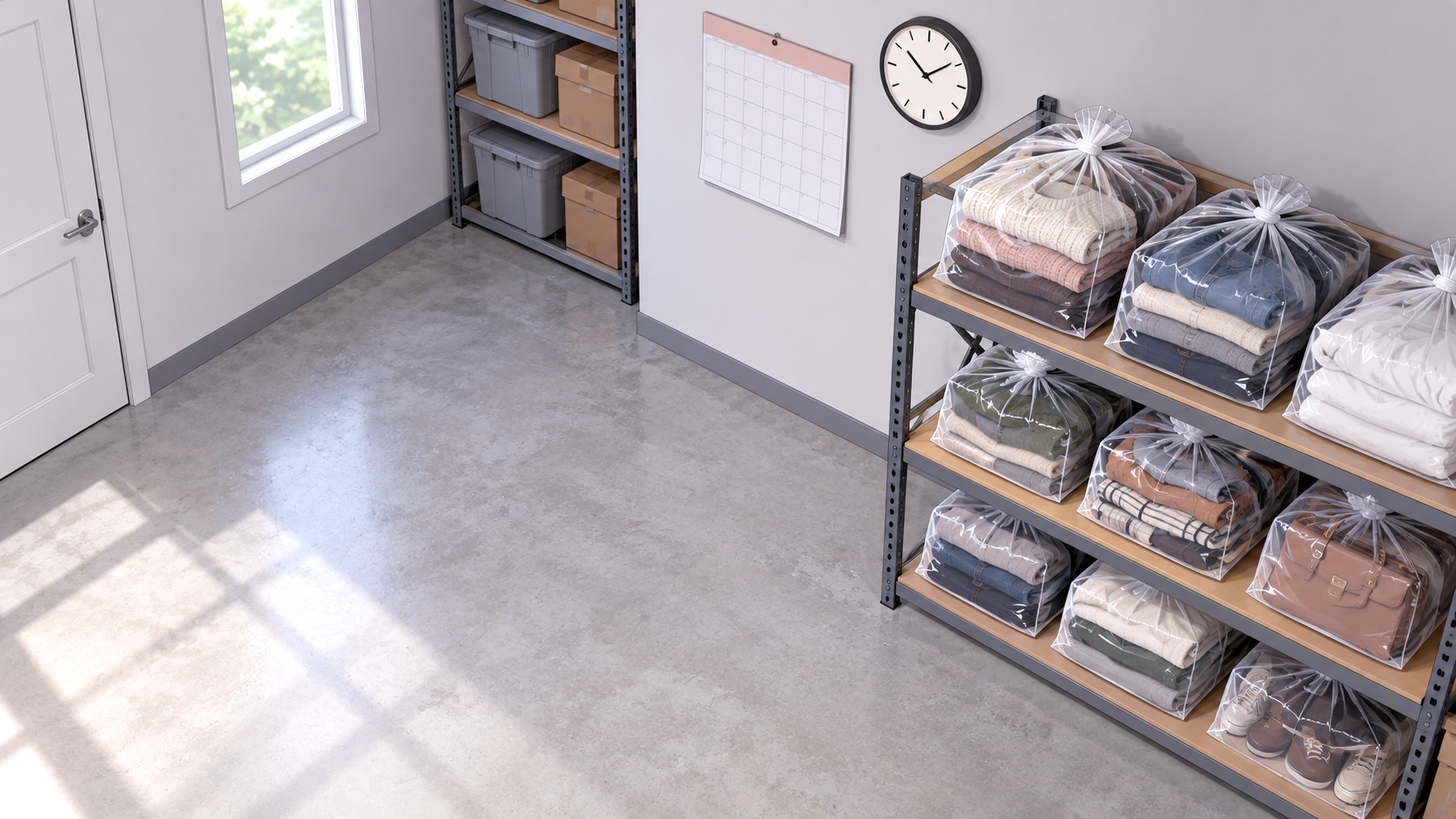
For items that cannot be treated another way, sealing them continuously for up to one year is the safest simple household guideline. Bed bugs die because they are deprived of blood for long enough, not because a plastic bag quickly suffocates them. Shorter isolation periods can work under controlled warm conditions, but ordinary room-temperature storage is too variable for a universal 30-, 60-, or 90-day rule.
A Year Is the Conservative Rule for Untreated Household Items
For possessions that cannot be laundered, heated, frozen, steamed, or otherwise treated, sealed storage for up to one year provides a practical margin for surviving bed bugs. That interval is intentionally longer than many laboratory starvation times because a household bag may contain adults and nymphs of different ages, the storage temperature may fluctuate, and you usually do not know when the insects last fed.
Starvation experiments illustrate why a short waiting period is unreliable. Depending on strain and developmental stage, unfed Cimex lectularius survived for widely different periods, with mean survival reaching 142.6 days among some fifth instars and adults. Laboratory averages are not suitable countdown timers for a household bag because individual survivors can outlast the mean. The broader ability of bed bugs to survive without feeding is the limiting factor when isolation is the only treatment.
Three to Six Months Applies Only Under Warmer Isolation Conditions
A shorter interval sometimes appears in bed bug guidance because temperature affects starvation survival. Cornell recommends keeping difficult-to-treat belongings in airtight storage bags in a warm location for three to six months. That is not equivalent to placing a bag in a cool basement or garage for the same length of time.
Bed bugs conserve water efficiently and reduce metabolic activity while deprived of food. Their physiological adaptations allow prolonged survival between blood meals, while cooler temperatures can slow metabolism further. Unless storage conditions are deliberately controlled, using the longer one-year interval avoids treating a warm-storage recommendation as a universal deadline.
Thirty Days Is Too Short for Starvation Treatment
A month in a sealed bag may contain the infestation, but it should not be expected to kill every mobile bed bug. First-instar nymphs are relatively vulnerable to starvation, while older nymphs and adults can persist much longer. Opening a bag simply because nothing has moved visibly for several weeks can therefore release a survivor.
The absence of visible activity inside an opaque or densely packed bag is weak evidence anyway. Bed bugs spend much of their time concealed, and their ability to remain unnoticed is part of why established infestations can be difficult to eliminate. If an item needs to be available sooner than a reliable isolation period allows, use a treatment appropriate to its material rather than shortening the waiting time arbitrarily.
Eggs Are Not the Reason You Need to Wait a Year
Bed bug eggs hatch much sooner than the recommended isolation period. Under favorable conditions, they generally complete embryonic development within days rather than months. The bed bug egg-hatching timeline therefore does not explain the long storage recommendation.
The concern is what happens after hatching. A nymph emerging inside the sealed bag still has no host, and any older nymphs or adults present may remain alive for a substantial period. Keeping the container closed continuously allows the entire trapped population to pass through the starvation interval without gaining access to another blood meal.
Visible eggs are also easy to miss because bed bug eggs are only about 1 mm long. You should not shorten isolation because an inspection failed to find them.
Use Heat Instead of Months of Storage When the Item Can Tolerate It
Washable and dryer-safe fabrics usually do not need to spend months in bags. A household dryer on high heat for about 30 minutes is included in bed bug treatment preparation for clothing and bedding, provided the material can safely tolerate that treatment.
The advantage is speed and certainty. Sufficient heat can kill adults, nymphs, and eggs without waiting for starvation, although lethal exposure depends on both temperature and time. Experimental work found eggs more heat-tolerant than adult bed bugs, which is why merely warming an object is not equivalent to a validated heat treatment.
For suitable clothing, dryer heat can kill bed bugs throughout the load much faster than passive storage. Once treated, place the items into a new clean bag or container so they are not re-exposed.
Freezing Is a Treatment, Not Just Cold Storage
A bag kept in a chilly garage is not the same as a properly controlled freezing treatment. EPA household guidance specifies that items held at 0°F (-18°C) should remain there for at least three days, with the actual freezer temperature verified rather than assumed. Effective household freezing requires sufficiently low and sustained temperatures.
Cold exposure becomes less predictable when a bag contains thick, insulated objects because the center takes time to reach freezer temperature. The practical requirements for killing bed bugs by freezing therefore differ from leaving untreated belongings sealed at ordinary temperatures.
Do not combine an uncertain cold period with an arbitrarily shortened starvation interval and assume the two guarantee control.
The Bag Must Stay Completely Closed for the Whole Interval
The clock only has value if the trapped bugs remain deprived of a host. Opening the bag to retrieve an object creates an opportunity for a surviving insect to escape and can expose the contents to bed bugs from the surrounding room.
Use heavy, undamaged plastic bags that can be securely closed. Double-bagging may be useful for sharp or awkward objects that could puncture the first layer. Sealed containers are also appropriate when they prevent insects from entering or escaping. Rutgers recommends isolating infested belongings in sealed plastic bags or containers as part of non-chemical management.
Label each bag with the sealing date and its status so treated belongings are not confused with possessions still undergoing isolation.
Bagging Is Useful for Containment Even When You Plan to Treat the Contents
Not every sealed bag needs to remain closed for months. Bags are also useful for transporting exposed clothing directly to a dryer, holding belongings while a room is treated, and separating cleaned objects from untreated ones. Purdue recommends moving potentially exposed clothing in sealable plastic bags so hitchhiking insects are not distributed through the home.
In that situation, the bag is a transport barrier rather than the killing method. Once the contents receive an effective treatment, they can be moved into a fresh clean bag instead of completing a starvation period.
This separation is particularly valuable while following a broader bed bug elimination plan, because clean and untreated possessions can otherwise become mixed repeatedly.
Cool Garages and Basements Are Poor Places to Try a Short Isolation Period
Lower temperatures generally slow bed bug metabolism, which can prolong the usefulness of stored energy reserves. A bag left in a cool garage for three months therefore should not be treated as equivalent to one kept continuously warm for three months.
Seasonal temperature swings create an additional problem. A garage might be hot during the day, cold overnight, and moderate for long periods without ever delivering a reliably lethal heat or cold exposure. Passive environmental storage is difficult to validate because the conditions inside the bag and deep within its contents are unknown.
If you plan to rely entirely on starvation under uncontrolled indoor or storage conditions, the conservative year-long interval is easier to apply correctly.
Do Not Add Pesticide or Mothballs to a Sealed Bag Unless the Label Specifically Allows It
Sealing an insecticide inside a bag with belongings does not create a legitimate fumigation chamber. Pesticide concentration, exposure, permitted treatment sites, and ventilation requirements are defined by the product label. Improvised treatments can contaminate clothing, toys, books, or other possessions without producing reliable bed bug mortality.
Plain isolation requires no chemical additive. When an item needs faster treatment, use a method appropriate to the material or include it in the preparation process for professional bed bug treatment rather than trying to accelerate starvation with an unlabeled substance.
Questions About Sealing Bed Bug-Exposed Items
Is six months in a sealed bag long enough?
It can be under consistently warm conditions, and Cornell uses a three-to-six-month interval for airtight bags kept warm. For uncontrolled household storage, a full year provides a more conservative margin.
Can bed bugs survive 90 days in a plastic bag?
Yes. Older nymphs and adults can survive longer than 90 days under some conditions, so three months is not a dependable universal starvation period.
Does vacuum-sealing kill bed bugs faster?
Do not assume so. Household vacuum bags are designed for storage, not validated insect control, and removing some air does not create a predictable lethal atmosphere.
Can you leave sealed bags outside in the sun to speed things up?
Solar heating is inconsistent. Bag temperatures depend on weather, bag color, shade, object density, and location, so lethal temperatures may not penetrate the contents evenly.
Should treated clothes stay bagged for a year?
No. Once clothing has received an effective heat treatment, long-term starvation storage is unnecessary. Keeping it sealed afterward is useful only to prevent reinfestation while the room remains under treatment.
Can you reuse the original bag after heat-treating the contents?
Avoid doing so unless the bag itself has been confirmed clear. A bug or egg could remain in the original container. Moving treated items into a clean bag eliminates that uncertainty.
Does seeing no bugs inside the bag mean the items are safe?
No. Bed bugs and eggs can remain concealed between folds, inside objects, or beneath seams. Visual silence should not replace the chosen treatment interval.
When should you choose bag isolation instead of another treatment?
It is most useful for nonessential possessions that cannot safely tolerate heat, laundering, steam, freezing, or another validated treatment. Frequently needed items are usually better handled with a faster material-compatible method.