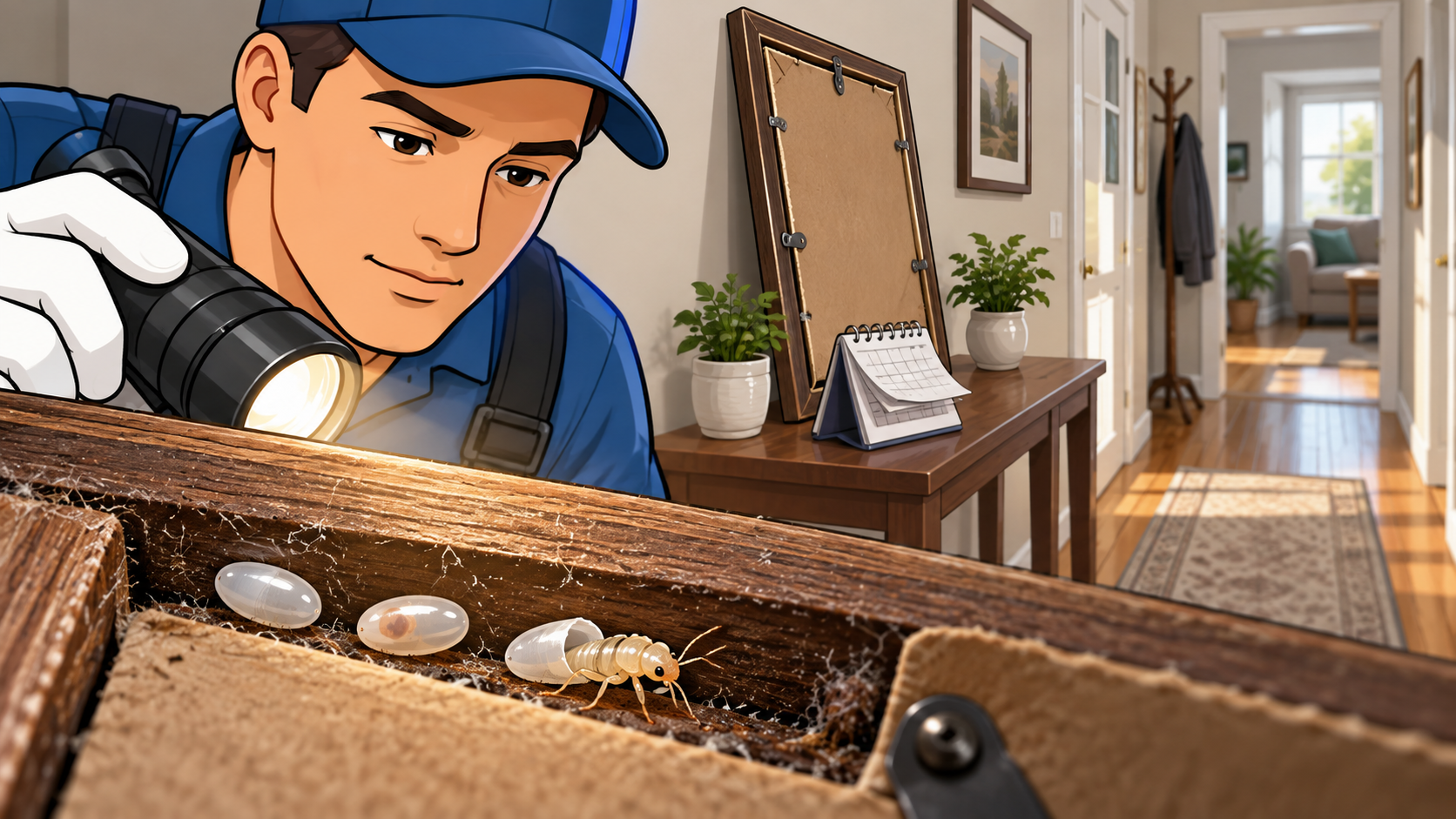
Bed bug eggs usually hatch in about six to ten days under typical warm indoor conditions, but there isn’t one fixed incubation period. Temperature has a major effect on development, with warmer favorable conditions generally producing faster hatching and cooler conditions slowing it considerably.
Virginia Tech reports that at room temperatures above 70°F, about 60% of eggs hatch by day six and more than 90% by day nine. Eggs can take longer when temperatures fall.
How Fast Can Bed Bug Eggs Hatch?
Recent laboratory research shows just how quickly development can occur under warm conditions. A 2024 Scientific Reports study tested common bed bugs at 20°C, 25°C, and 30°C under several humidity levels.
At 30°C (86°F) and 90% relative humidity, hatching began after an average of 5.19 days and was completed after 7.23 days. At 20°C (68°F) and 50% relative humidity, hatching didn’t begin until about 9.24 days and finished around 10.66 days.
The highest percentage of eggs hatched at 25°C (77°F) and 90% relative humidity, where the study recorded a 98.23% hatch rate. That doesn’t mean 90% humidity is required in homes. It simply shows how the eggs performed under those particular laboratory conditions.
Cold Temperatures Can Delay Hatching for a Long Time
The relationship between cold and bed bug eggs is more complicated than a simple cutoff temperature.
Classic experimental work found that 13°C (55.4°F) was the lowest constant temperature at which eggs laid at 23°C could complete development and hatch under the tested conditions. However, researchers observed hatching at approximately 8°C under other experimental circumstances and found evidence that some embryonic development may occur at temperatures as low as 4°C.
Cold also doesn’t necessarily kill the eggs quickly. In the same research, the longest estimated exposure needed to produce 99.99% egg mortality below 13°C was 79.8 days, recorded at 12.1°C (53.8°F) and 73% relative humidity. Eggs with more advanced embryos were actually killed faster by one cold exposure than newly laid eggs.
For that reason, a cool spare room, garage, or temporarily unheated space shouldn’t be treated as a reliable way to eliminate bed bug eggs. Cold weather can affect bed bugs, but effective cold treatment depends on reaching sufficiently low temperatures for long enough, not simply making a room chilly.
What Hatch Time Means During an Infestation
In a normally heated home, it’s reasonable to expect many viable eggs to hatch within roughly a week or somewhat longer. They also won’t necessarily hatch together because females lay eggs over time, so eggs found in the same harborage may be at different stages of development.
Once an egg hatches, a first-stage nymph emerges and must obtain blood meals as it progresses through the bed bug life cycle. This staggered hatching is one reason monitoring can’t stop simply because no adult bed bugs are visible for a few days. Where you find the eggs also matters. Bed bugs commonly attach them inside protected cracks and harborages, so knowing where bed bugs lay their eggs makes follow-up inspections more effective.
Questions About Bed Bug Egg Hatching
Can bed bug eggs hatch in a cold house during winter?
Potentially, yes. Cooler temperatures can greatly slow development, but simply keeping a house cool isn’t a dependable method of preventing eggs from eventually hatching.
Does humidity affect how quickly bed bug eggs hatch?
Temperature is the stronger influence on development time. Classic research found atmospheric humidity didn’t significantly affect the duration of the egg stage across ordinary favorable conditions, although humidity can influence survival near temperature extremes.
Do all bed bug eggs hatch at the same time?
No. Eggs may have been laid on different days and can develop at different rates depending on their conditions. A group of eggs can therefore produce nymphs over several days rather than all at once.