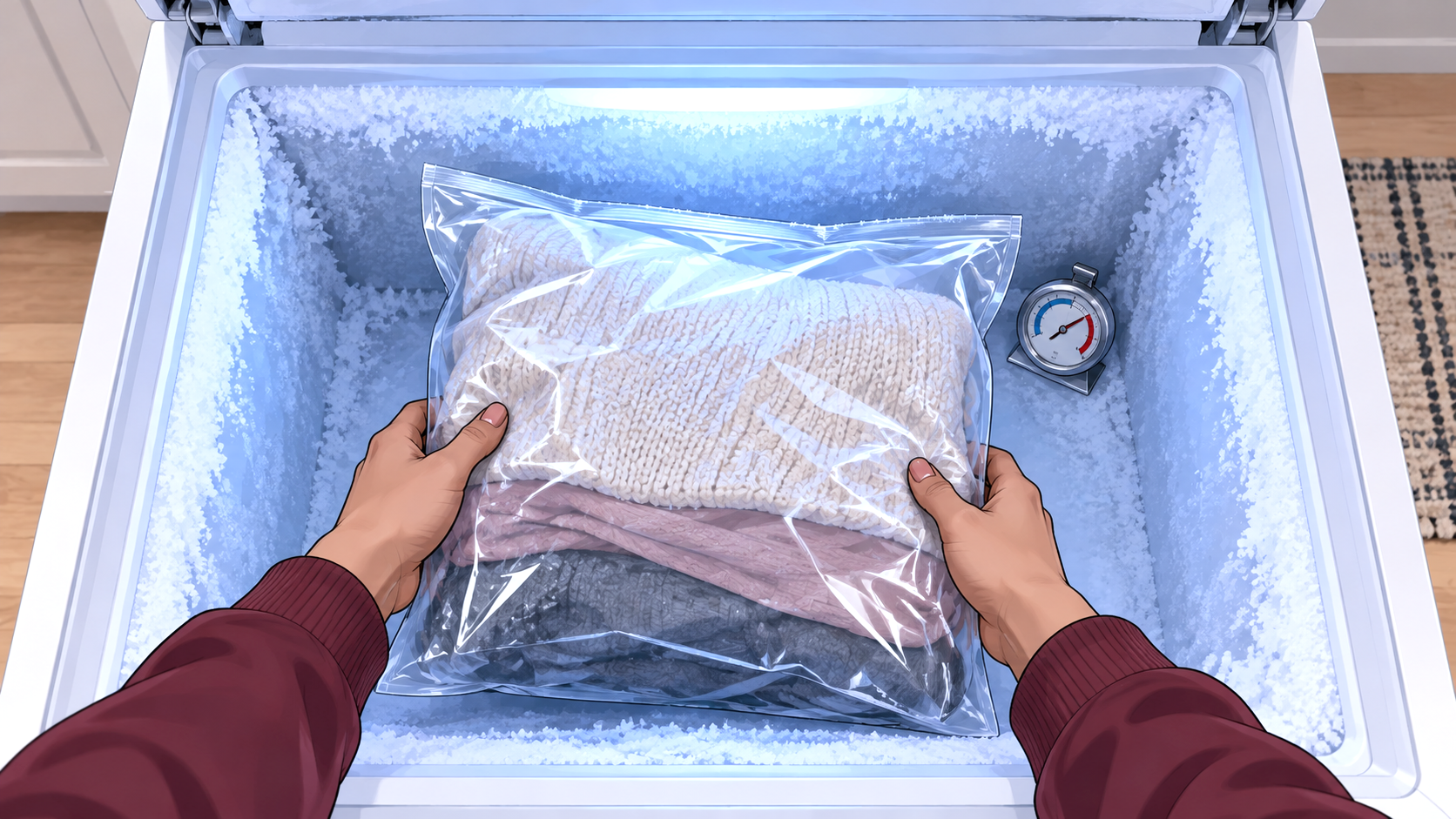
Freezing can kill bed bugs, including eggs, but simply exposing them to winter weather or a chilly freezer is not enough. For household treatment, use a freezer that maintains 0°F (-18°C) or colder and keep the item frozen for at least four days after its center reaches that temperature.
Four Days at 0°F Is a Practical Household Target
Cold treatment depends on both temperature and exposure time. Bed bugs tolerate temperatures near freezing surprisingly well, so 32°F (0°C), or even temperatures several degrees below it, should not be treated as immediately lethal. Experimental work found that bed bugs could survive temperatures above about -12°C even after a week of continuous exposure, while colder conditions produced progressively greater mortality.
For a household freezer, 0°F (-18°C) for at least four days provides a practical treatment target. Bed bug control guidance uses temperatures below 0°F for at least four days as an effective cold treatment, provided the freezer actually maintains the required temperature. Using a freezer thermometer matters because the temperature displayed on an appliance does not always reflect the temperature surrounding the item.
Start Counting After the Center of the Item Is Frozen
Putting an object into a 0°F freezer does not mean every hidden bed bug immediately experiences 0°F. Cold must penetrate through fabric, padding, stacked papers, shoes, books, bags, and other insulating material. A thick object may remain considerably warmer in its center for hours after the surrounding freezer air has reached the target.
Professional guidance recommends holding items around 0°F for at least 72 hours, with 96 hours providing an additional safety margin. For bulky belongings, count the four-day treatment interval only after the cold has reached the item’s core. Avoid packing several thick objects tightly together because doing so slows temperature penetration.
A small remote temperature probe can provide much more confidence than guessing from the freezer thermostat.
Bed Bug Eggs Can Be Killed by Freezing Too
Cold treatment is not limited to adult insects. Eggs, nymphs, and adults can all be killed when sufficiently low temperatures reach them for the necessary period. Eggs are particularly relevant because their small size and protected placement in seams and crevices make them easy to overlook during visual inspection.
Bed bug eggs can tolerate considerable cold before their tissues freeze. Across different life stages, recorded supercooling points reached approximately -21°C to -30°C, with eggs among the most cold-tolerant stages. Bed bugs are nevertheless freeze-intolerant once sufficiently severe cold is achieved. Research examining thermal and dehydration tolerance in Cimex lectularius also found complete mortality of tested adults following sufficiently intense subzero exposure.
You do not need to reach an egg’s instantaneous freezing point when using a household freezer. A less extreme temperature can still kill it when exposure continues long enough.
A Refrigerator Will Not Kill Bed Bugs
Refrigeration temperatures are far too warm for dependable bed bug control. Keeping an infested object at 35°F or 40°F may slow insect development and activity without eliminating the population.
Moderately cold conditions can actually allow bed bugs to remain alive for substantial periods. Their capacity to survive without frequent meals already gives them considerable endurance, and starvation survival can extend for months under suitable conditions. Cooling an object without reaching lethal temperatures should therefore be considered storage, not treatment.
A refrigerator compartment, cool basement, air-conditioned room, or unheated closet is not a substitute for a freezer.
Putting Infested Belongings Outside in Winter Is Unreliable
An outdoor temperature of 0°F does not guarantee that a bed bug hidden deep inside a suitcase, sofa cushion, cardboard box, or pile of clothing reaches the same temperature. Sunlight can warm exposed surfaces, buildings radiate heat, daytime temperatures fluctuate, and insulating materials slow cooling.
Gradual cooling can also leave insects exposed to sublethal cold for long periods rather than the sustained deep freeze required for dependable control. Bed bugs subjected to intermediate cold can suffer mortality and reproductive effects, but some survived prolonged exposure between 0°C and -10°C. Outdoor weather therefore gives much less control over treatment conditions than a monitored freezer.
Leaving furniture on a porch during a cold night should not be treated as proof that the furniture is bed bug-free.
Small, Dry Items Are the Best Candidates for Freezing
Freezing is most useful for belongings that fit comfortably inside a freezer, tolerate low temperatures, and cannot conveniently be placed in a clothes dryer. Potential candidates include some shoes, modern books, jewelry, toys, pictures, and dry household objects. Clothing that cannot tolerate tumbling may also be suitable if the fabric itself is freeze-safe.
Certain items deserve more caution. Electronics with LCD displays, valuable antiques, irreplaceable books, objects containing liquids, and materials vulnerable to condensation can be damaged. Bed bugs can hide inside electronic devices, but freezing a laptop or television without checking its permitted storage temperature can trade a pest problem for a damaged device.
Seal suspect objects in a plastic bag before moving them to the freezer so a mobile bed bug cannot escape during transport. Keep the bag closed while the item warms back toward room temperature, particularly when condensation could form on the object.
A Clothes Dryer Is Faster for Heat-Safe Fabrics
Freezing works, but it is rarely the most convenient treatment for ordinary clothing, bedding, towels, and other dryer-safe textiles. Heat can kill all life stages much more rapidly when the material tolerates it. A properly used clothes dryer is therefore generally preferable for washable household fabrics.
The effectiveness of dryer heat against bed bugs depends on getting the entire load sufficiently hot, just as successful freezing depends on getting the entire object sufficiently cold. Temperature treatments fail at protected cool or warm spots, not because the insects are immune to the method.
Freezing earns its place mainly for small objects that cannot be exposed safely to dryer temperatures.
Do Not Use Freezing to Treat an Entire Infested Room
Household freezing is an item-treatment technique. Air conditioning, opening windows during winter, turning off the heat, or attempting to freeze an occupied building does not produce a controlled lethal temperature throughout mattresses, wall voids, furniture interiors, baseboards, and other harborages.
Cold treatment of whole rooms or buildings is uncommon partly because achieving and verifying lethal temperatures everywhere is difficult. A bed bug concealed in an insulated wall or deep furniture joint may remain much warmer than the room air.
An established infestation still requires the broader bed bug elimination process. Freezing selected possessions can reduce the number of untreated objects, but it does not replace inspection, monitoring, treatment of harborages, and follow-up.
Freezing Luggage Requires More Than Putting the Empty Case in a Chest Freezer
A suitcase can contain thick walls, padding, reinforced corners, telescoping-handle channels, fabric seams, and pockets that slow cooling. Remove loose contents and treat them separately where possible rather than freezing one tightly packed case.
A suitcase known to have been exposed during travel should remain contained while it is moved and inspected. The procedures used to remove bed bugs from luggage depend on the suitcase material and construction, and some bags may be easier to inspect, vacuum, steam, or otherwise treat than freeze.
If freezing is selected, allow enough time for the cold to reach the deepest part of the case before beginning the four-day exposure period.
Freezing Does Not Leave Any Residual Protection
An item can be completely cleared by cold treatment and become infested again later if it is returned to an untreated room. Once frozen belongings have warmed safely, store them in a clean sealed bag or container until the surrounding infestation has been controlled.
This separation is especially useful while preparing belongings during bed bug extermination. Treated objects and untreated objects should not be mixed, because doing so removes the certainty gained from the temperature treatment.
Freezing kills insects present during the exposure. It does not repel future bed bugs.