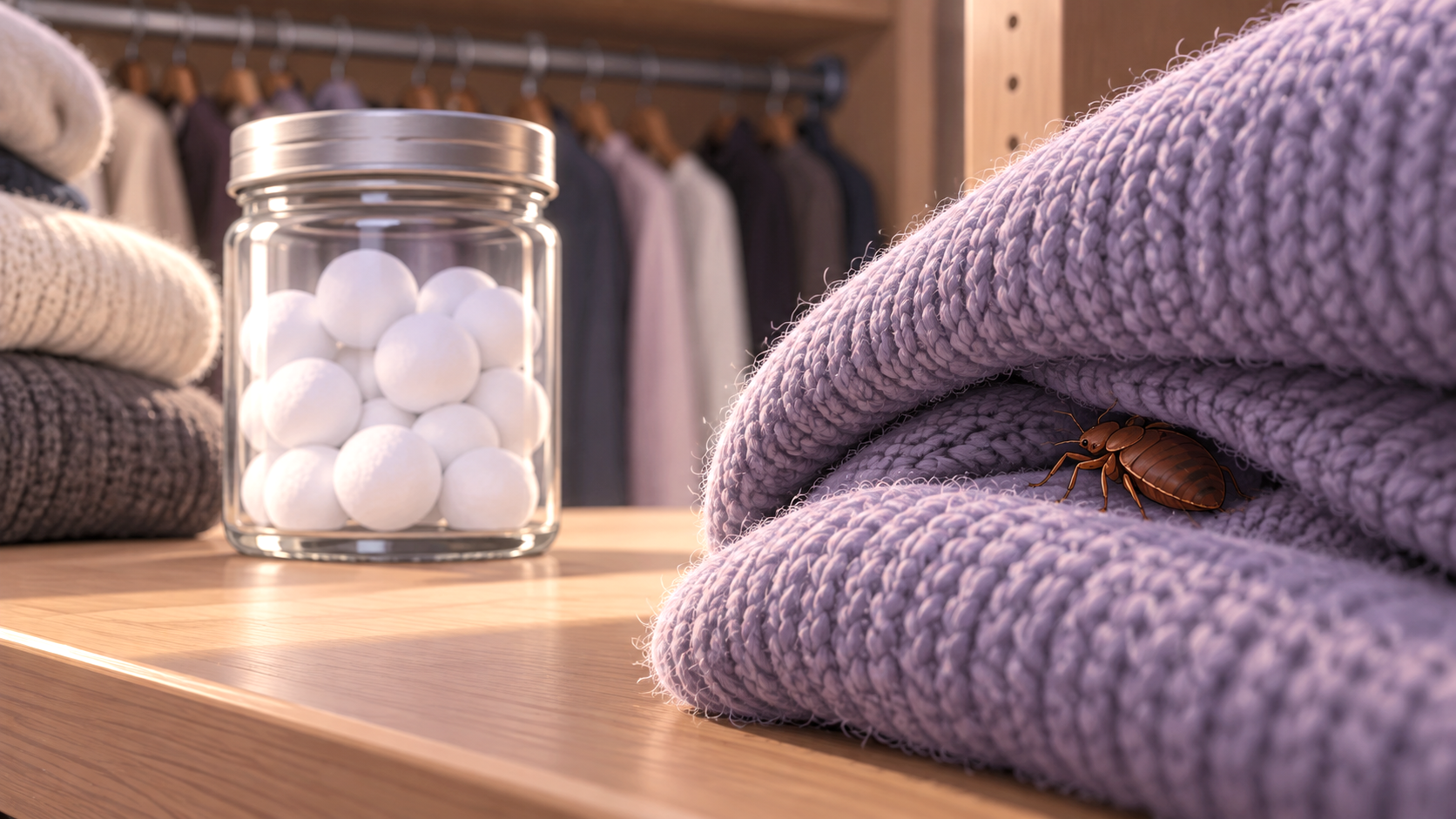
Mothballs are not a dependable bed bug treatment. Although their vapors are insecticidal at sufficient concentrations, bed bug testing found poor control even when mothballs and infested clothing were sealed together. Using mothballs around beds, beneath mattresses, or openly in rooms also creates pesticide exposure without producing reliable eradication.
Sealed-Bag Testing Produced Poor Bed Bug Control
The most useful evidence comes from testing that closely resembles the DIY method people commonly try. Bed bug adults, nymphs, and eggs were placed among clothing inside sealed plastic bags with mothball products containing either 99.8% paradichlorobenzene or 99.5% naphthalene. After one week, fewer than half of the adult bed bugs were dead and the eggs showed no significant treatment effect.
That result is important because the insects were not merely sharing an open bedroom with a few mothballs. They were confined with the vapor inside bags, which should favor accumulation. Surviving adults and unaffected eggs make the method unsuitable when the objective is complete control. The difficulty of eliminating bed bugs concealed through multiple life stages leaves little margin for a product that permits substantial survival.
Mothballs Depend on Vapor Concentration
Modern mothballs generally contain either naphthalene or paradichlorobenzene. Both chemicals slowly change from a solid into vapor. Their labeled clothes-moth use depends on trapping enough insecticidal vapor inside a tightly enclosed storage space.
Scattering mothballs around a bedroom works very differently. The vapor disperses through the room instead of building predictably around hidden insects. A bed bug several inches inside a box spring, wall crack, dresser joint, or sofa frame may receive a completely different exposure from one sitting near a mothball.
The odor cannot tell you whether a lethal bed bug dose has reached those harborages. Smelling the chemical only confirms that vapor is present in the air.
Bed Bug Eggs Make the Method Particularly Weak
A treatment that kills some mobile bed bugs but leaves eggs viable can allow activity to resume as those eggs hatch. Bed bug eggs are tiny and attached within protected crevices, making them difficult to locate manually. Their small pale appearance also means an item can look clear while eggs remain hidden along seams or joints.
Mothball testing is especially unfavorable here because the eggs were not significantly controlled after the week-long exposure. A method that cannot consistently address eggs should not be treated as whole-population elimination.
Reliable control instead requires methods capable of reaching the life stages present or a treatment program that accounts for later hatch. The bed bug life cycle makes incomplete egg control more consequential than simply leaving a few dead insects behind after treatment.
Putting Mothballs Under a Bed Is Not Their Intended Use
Mothballs are pesticides, not general room deodorizers or broad-spectrum household fumigants. Current products are intended for uses specified on their labels, generally involving tightly closed containers for protection of stored fabrics. Using mothballs in an unlisted location or manner can expose people without providing the intended pesticide concentration.
Placing them beneath a mattress, behind a headboard, around bed legs, throughout a bedroom, or inside furniture should not be improvised as a bed bug treatment unless a particular registered product label explicitly authorizes that use. The same principle applies to every chemical used against bed bugs: the treatment site and instructions on the pesticide label control how it can be used.
Adding more mothballs does not convert an unlabeled use into an effective professional fumigation.
The Smell Means You Are Breathing the Pesticide
Naphthalene and paradichlorobenzene are volatile chemicals. When mothball odor is noticeable, pesticide vapor has entered the surrounding air. Mothball exposure can cause headaches, nausea, vomiting, coughing, and eye or nose irritation, while greater or prolonged exposure can produce more serious effects.
Children and pets create an additional concern because mothballs can be mistaken for food or handled directly. EPA also recommends minimizing exposure to paradichlorobenzene moth repellents and following product directions for enclosed storage.
A strong chemical odor around a bed should therefore never be interpreted as evidence that treatment is working. It can instead indicate unnecessary occupant exposure.
Sealing Belongings With Mothballs Is Not a Shortcut Around Starvation
Some people place infested possessions in bags with mothballs hoping the chemical will clear the contents faster than isolation alone. The bed bug test described above shows why that shortcut is unreliable. If the mothballs fail to kill every adult, nymph, and egg, opening the bag can release surviving insects.
Plain sealed isolation operates through a different mechanism. When an item cannot be treated safely another way, denying trapped bugs access to a blood meal for a sufficiently long period can eventually eliminate them. Their long survival without feeding means that interval is measured in months rather than days.
Do not add mothballs, pesticide strips, or other chemicals to a storage bag unless the exact product label authorizes that treatment setup.
Heat and Freezing Are More Predictable for Suitable Belongings
For dryer-safe fabrics, lethal heat provides a far more useful treatment than mothball vapor because it can kill adults, nymphs, and eggs when the entire load reaches an effective temperature. Proper dryer treatment for bed bugs can process clothing rapidly without months of storage.
Small objects that tolerate cold may instead be treated in a household freezer using a controlled temperature and exposure period. Freezing can kill every bed bug life stage when the item reaches a sufficiently low temperature for long enough.
These methods still have material limitations, but their effectiveness can be tied to measurable temperature and exposure rather than the uncertain concentration of mothball vapor around hidden insects.
Mothballs Cannot Treat the Harborages Around the Room
Even successful treatment of one sealed bag would leave bed bugs in a mattress, box spring, frame, baseboard, wall crack, nightstand, couch, or other occupied location untouched. Bed bug populations often occupy multiple protected sites, especially as an infestation progresses.
Effective management therefore combines methods based on where insects are actually hiding. Rutgers lists mothballs among bed bug control methods that waste money while supporting measures such as encasements, heat, freezing, steam, vacuuming, traps, and appropriately used insecticides.
A complete bed bug treatment strategy has to address the infestation rather than create insecticide vapor around individual possessions.
Questions About Mothballs and Bed Bugs
Do naphthalene mothballs kill bed bugs on contact?
Mothballs are designed to work through vapor rather than as a contact insecticide. A bed bug touching a mothball should not be assumed dead or successfully treated.
Are paradichlorobenzene mothballs better than naphthalene mothballs for bed bugs?
Neither has demonstrated sufficiently reliable control to recommend for bed bugs. Testing of products containing both active ingredients left substantial adult survival and failed to significantly control eggs.
Will mothballs repel bed bugs from your bed?
Do not rely on them as a repellent. Even moving bugs away from one treated location would not eliminate them and could complicate efforts to locate harborages.
Can you put mothballs inside a mattress or box spring?
Not unless the specific product label authorizes that treatment site. Filling furniture with mothballs can release pesticide vapor into the sleeping environment without ensuring bed bug control.
Can you put mothballs inside a suitcase with bed bugs?
A sealed suitcase does not make the method reliable. Material-safe heat, freezing, inspection, or an appropriately designed professional treatment provides a more defensible approach.
Do mothballs kill newly hatched bed bug nymphs?
High enough fumigant concentrations may harm insects, but household mothball use does not deliver a validated dose against every nymph. Partial mortality is not sufficient for an infestation treatment.
Can mothballs replace professional bed bug fumigation?
No. Professional fumigation uses a registered fumigant at calculated concentrations under controlled conditions. Research with sulfuryl fluoride has demonstrated complete mortality of bed bug life stages at specific monitored fumigant dosages, which is fundamentally different from placing consumer mothballs around a room.