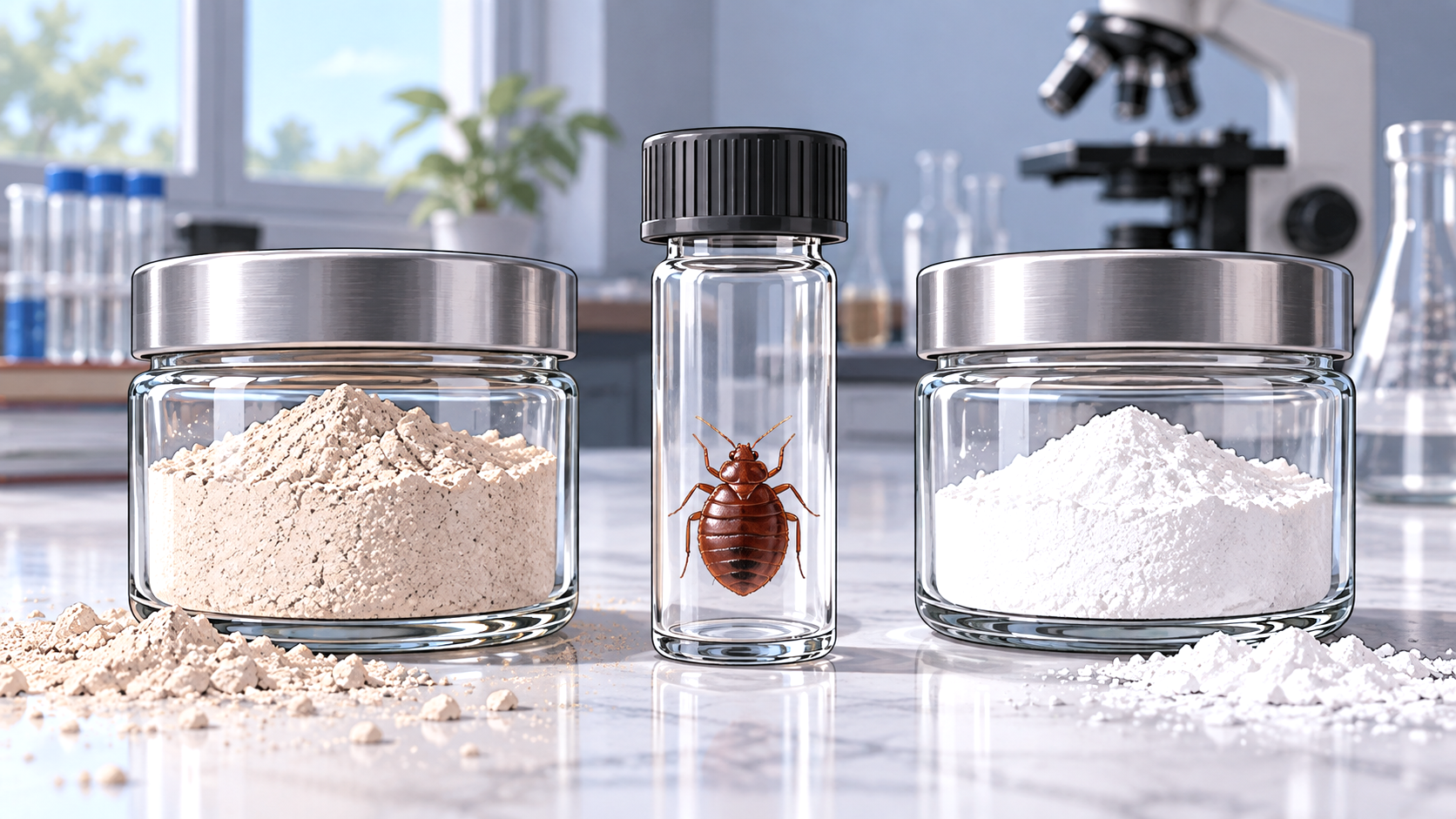
For bed bugs, pesticide-grade diatomaceous earth is the better choice than boric acid. Diatomaceous earth can kill bed bugs after they crawl through an effective deposit and lose protective surface lipids. Boric acid, despite working well against cockroaches and other insects, has performed poorly against bed bugs when applied as a residual dust because bed bugs do not readily ingest it.
Boric Acid Has a Route-of-Exposure Problem With Bed Bugs
Boric acid is highly toxic to bed bugs when it reaches their digestive system. Laboratory experiments found that blood containing at least 2% boric acid produced rapid mortality, while even 0.5% and 1% concentrations eventually killed all tested bugs. The same study found a completely different result when bed bugs merely contacted boric acid powder: high concentrations of residual boric acid dust produced little useful mortality.
Bed bug feeding behavior explains why this creates such a practical disadvantage. They obtain food by piercing a host and sucking blood rather than consuming crumbs or grooming pesticide from their bodies in the way cockroaches can. Researchers also found that reducing boric acid particle size did not solve the poor contact performance. Boric acid could theoretically become useful if incorporated into an effective blood-based bait system, but spreading ordinary boric acid powder around an infested bedroom does not reproduce ingestion exposure.
That makes boric acid a poor match for the way bed bugs naturally encounter household treatments, despite its usefulness against other pests.
Diatomaceous Earth Works When Bugs Walk Through It
Diatomaceous earth does not need to enter a bed bug’s digestive tract. Effective DE deposits damage or disrupt the waxy surface that helps the insect retain water, leading to dehydration after contact. This physical mode of action gives pesticide-grade DE a practical route into the insect simply through normal crawling behavior.
Controlled testing has demonstrated substantial mortality from appropriate formulations. A 2024 study found 100% mortality after two days of laboratory exposure to a professional diatomaceous earth dust. Field results are slower because insects encounter varying amounts of dust and can occupy untreated spaces, but DE has also contributed to meaningful population reductions in real infestations.
The physical action of desiccant dusts differs from many of the chemical insecticides used against bed bugs, which act on specific biochemical or neurological targets.
Not Every Product Sold as Diatomaceous Earth Performs the Same Way
The phrase “diatomaceous earth” covers products manufactured for very different purposes. Particle characteristics, source material, formulation, and intended use can alter both efficacy and exposure risk. In a comparison of several dusts, professional pest-control DE performed well while supermarket DE and a litter-conditioner product produced little useful bed bug mortality. Bed bug mortality varied considerably among different sources of diatomaceous earth.
Use only a pesticide product registered and labeled for bed bug control. Food-grade DE should not be substituted simply because it is easy to purchase, and swimming-pool DE is particularly inappropriate. Household bed bug guidance specifically warns against using food-grade or pool-grade DE as an improvised pesticide because products intended for other purposes can present greater inhalation concerns.
The correct comparison is therefore bed bug-labeled DE versus boric acid, not an arbitrary bag of mineral powder versus another household powder.
DE Is Slow, but Boric Acid Dust May Do Almost Nothing
Diatomaceous earth is not a knockdown insecticide. Mortality develops after enough physical damage and water loss have occurred, so exposed bugs may remain alive for days. In a furnished room, treatment can take considerably longer because some insects encounter only small amounts of dust or remain inside untreated harborages.
Boric acid dust has a different limitation: waiting longer does not necessarily compensate for ineffective contact exposure. Controlled experiments found that bed bugs survived direct contact with concentrations that readily killed German cockroaches. The published boric acid ingestion study concluded that residual dust or spray applications would be ineffective for bed bug interventions.
A slow treatment that eventually kills after contact is fundamentally more useful here than a powder whose strongest lethal route normally requires ingestion.
Diatomaceous Earth Has a Better Role in Integrated Treatment
DE becomes more useful when insects are encouraged to cross treated cracks, crevices, furniture joints, and travel routes while other parts of the infestation are addressed separately. An apartment study combining steam, mattress and box-spring encasements, monitoring, and diatomaceous earth achieved a 97.6% average reduction in bed bug counts after ten weeks, although only half of the treated apartments were completely eradicated during that period.
Those results also show why DE should not be treated as a stand-alone cure. Bed bugs that never encounter the dust can continue surviving elsewhere, particularly when an infestation has spread beyond a few harborages. The difference between a small and extensively distributed bed bug infestation affects how realistic any single treatment method will be.
A complete bed bug elimination plan can combine residual dust with inspection, monitoring, heat or steam where suitable, physical removal, encasements, and other labeled treatments.
Apply DE as a Fine Deposit, Not a Thick Barrier
More powder does not automatically produce better control. Bed bugs need to make useful contact with the dust, while excessive visible piles can increase airborne particles and may be easier for insects to avoid. Desiccant applications are better suited to protected cracks, voids, joints, and travel routes permitted by the product label.
EPA restricts bed bug desiccant use to appropriate labeled sites and notes that desiccants kill by destroying the insect’s protective outer coating. The same physical property that harms bed bugs makes airborne dust undesirable around people.
Vacuuming should also be coordinated with treatment. Vacuuming can physically remove exposed bed bugs, but running a vacuum directly over a residual DE application removes the dust that was intended to remain in place.
Steam and DE Can Complement Each Other if Their Timing Is Managed
Steam offers rapid mortality where lethal temperatures directly reach insects, while DE can remain in dry protected sites and affect bed bugs that move through later. These strengths complement each other, but steam can wet or remove dust if the treatments are applied in the wrong order.
Use steam against suitable bed bug harborages first where appropriate, allow treated areas to dry, then apply a labeled dust to permitted locations that should remain dry. Do not steam through an existing dust deposit and expect its residual performance to remain unchanged.
Boric acid adds little to this pairing because ordinary contact with the dust has not shown comparable efficacy against bed bugs.
Diatomaceous Earth Also Has Limits Against Eggs
Neither powder should be considered an instant egg treatment simply because it is present near an egg. Bed bug eggs remain attached to surfaces and do not crawl through dust. Newly hatched nymphs may contact treated areas later, but that relies on maintaining an effective residual deposit along their movement routes.
Follow-up monitoring therefore remains important even when adults disappear. The continuing appearance of live nymphs or other fresh signs of bed bug activity can indicate newly hatched insects, untreated harborages, or insufficient dust contact.
For immediate egg mortality on suitable materials, methods that directly deliver lethal heat are generally more relevant than relying on either DE or boric acid.
Questions About Diatomaceous Earth and Boric Acid
Can you mix boric acid with diatomaceous earth for bed bugs?
There is no established advantage to doing so. Mixing products can alter how the dust spreads and does not correct boric acid’s poor contact activity against bed bugs. Use a registered product according to its own label.
Why does boric acid work on cockroaches but not bed bugs?
Cockroaches can ingest boric acid while feeding or grooming contaminated material. Bed bugs feed exclusively through piercing-sucking mouthparts and do not interact with dust in the same way.
Can DE kill pyrethroid-resistant bed bugs?
Yes. DE acts physically rather than targeting the same nervous-system pathways as pyrethroids, so pyrethroid resistance does not automatically protect a bed bug from desiccation.
Does DE kill bed bugs immediately?
No. Bed bugs usually remain alive for a period after exposure while dehydration progresses. Immediate knockdown should not be expected.
Can you put DE all over a bedroom carpet?
Only use a pesticide product at locations permitted by its label. Broadcasting fine dust across exposed flooring increases unnecessary inhalation and contact while offering little advantage over strategic treatment of travel routes and harborages.
Can boric acid be dissolved in water and sprayed for bed bugs?
Contact sprays of boric acid have not solved its efficacy problem against bed bugs. Laboratory evidence indicates that ingestion, rather than external contact, is the effective route.
Does getting DE wet make it less effective?
Moisture can interfere with desiccant performance while the dust is wet. Keep residual deposits in dry locations and do not apply them immediately before steam or wet cleaning.
Should DE be the only treatment for an infestation?
No. It is better used as one component of an integrated program, particularly where a dry residual can remain undisturbed and bed bugs are likely to cross it.