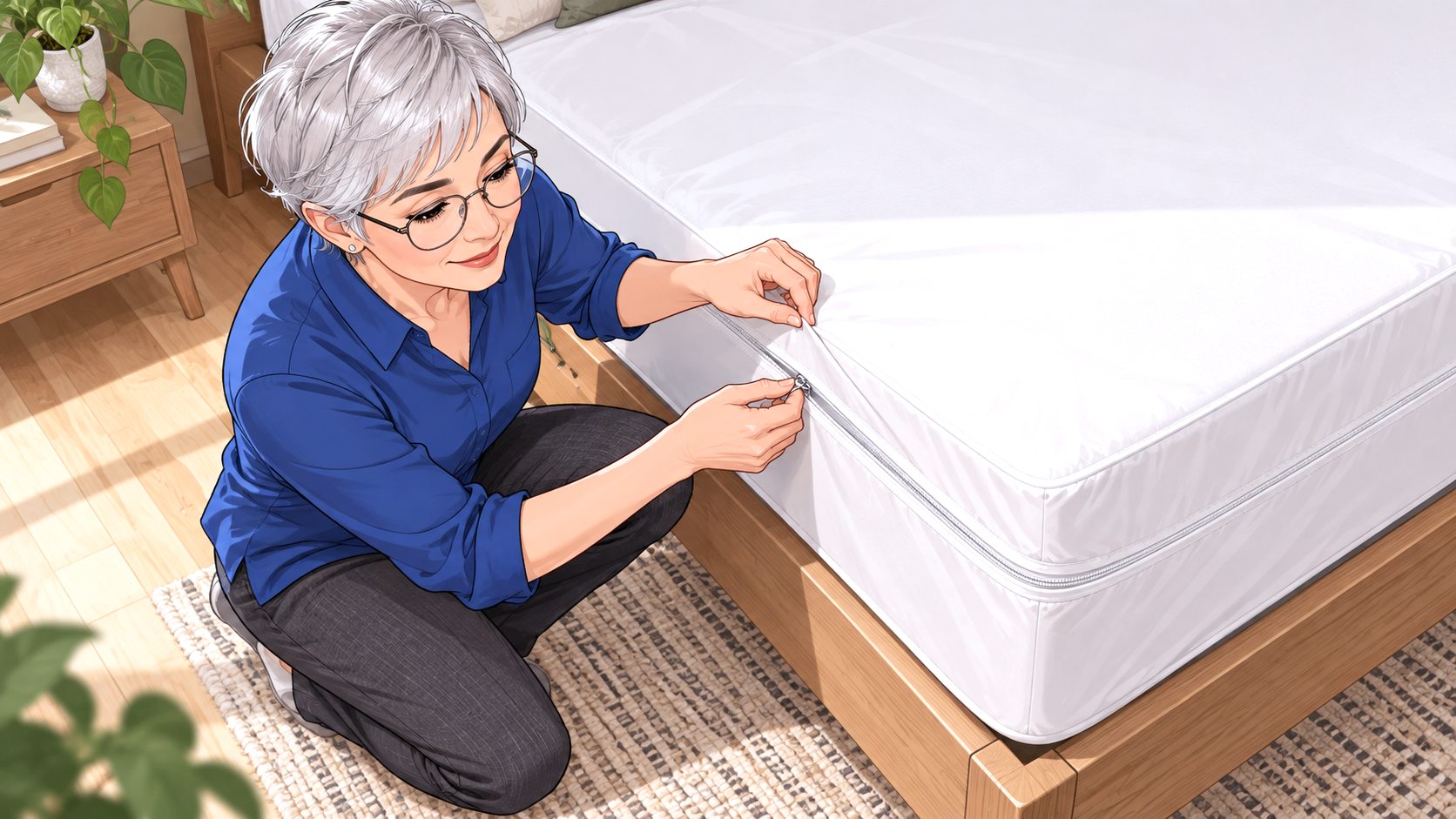
A good bed bug mattress encasement has one job that ordinary mattress protectors cannot perform: completely seal the mattress so bed bugs cannot enter, escape, or feed through the covering. The strongest options use six-sided construction, fine zipper teeth, a protected zipper endpoint, durable fabric, and depth choices that prevent excessive stretching. For most beds, Protect-A-Bed AllerZip is the strongest all-around choice, while Mattress Safe Sofcover Ultimate stands out for documented barrier testing.
Best Bed Bug Mattress Encasements at a Glance
| Encasement | Best For | Notable Features |
|---|---|---|
| Protect-A-Bed AllerZip | Best overall | BugLock zipper, six-sided waterproofing, multiple depth ranges |
| Mattress Safe Sofcover Ultimate | Best documented barrier design | Certified bed bug barrier, tested zipper, tamper-resistant closure |
| SureGuard Mattress Encasement | Best range of mattress depths | Fine zipper, protected closure, depths from 6 to 20 inches |
| SafeRest Zippered Encasement | Best budget-friendly everyday option | Six-sided coverage, several depth ranges, waterproof construction |
| Hospitology Mattress Encasement | Best simple full enclosure | Lab-tested bed bug barrier, 10 to 18-inch mattress fit |
Protect-A-Bed AllerZip Is the Best Overall Choice
Protect-A-Bed AllerZip gets the fundamentals right: all six sides are enclosed, its BugLock closure protects the vulnerable zipper endpoint, and separate depth options cover mattresses from approximately 6 to 18 inches. The entire encasement is waterproof rather than only the sleeping surface, which adds value for a product that may remain installed for a long period. A flexible fit also reduces the strain that develops when an undersized cover is stretched over a thick pillow-top mattress.
The zipper system is the feature that matters most for bed bug use. Bed bugs and small nymphs can exploit surprisingly narrow openings, so a normal household zipper with an exposed endpoint is not equivalent to a purpose-built encasement. EPA recommends bed bug encasements with zippers that close completely and construction sturdy enough to remain intact for at least a year. AllerZip’s protected zipper design and separate depth ranges make it a stronger choice than inexpensive one-size-fits-most covers that become tight at the corners.
An encasement does not prevent bed bugs from living elsewhere on the bed frame or in the room. Its role is to remove the mattress as an accessible hiding structure and contain insects already within it, which makes treating bed bugs associated with a mattress much easier to manage.
Mattress Safe Sofcover Ultimate Has the Strongest Published Barrier Testing
The Mattress Safe Sofcover Ultimate is the strongest choice when documented zipper and fabric testing carries the most weight. It uses a patented zipper closure with a securing hook, is waterproof on all six sides, and comes in several depth ranges, including unusually deep mattresses up to 22 inches.
Mattress Safe publishes bed bug penetration and zipper testing in which insects did not penetrate the laminated fabric, pass through the zipper enclosure, escape through the closure, or successfully feed through the barrier during the evaluated conditions. Manufacturer-funded testing should not be treated as independent comparative evidence that the product outperforms every competitor, but it is still more useful than an unsupported “bed bug proof” claim with no description of how the barrier was evaluated.
Its wide depth selection is valuable because fit affects durability. A cover stretched excessively across corners places more tension on seams and the zipper, while a cover that is far too loose can bunch and snag. Before ordering any encasement, measure the mattress itself rather than assuming its depth from a model name.
SureGuard Is a Strong Choice for Unusual Mattress Depths
SureGuard’s six-sided mattress encasement is available in multiple depth ranges extending from approximately 6 inches to 20 inches, making it useful for unusually thin or thick mattresses. Its Invisi-Zip and SureSeal system is designed to close the zipper endpoint rather than leaving a small accessible gap, and the waterproof membrane extends across all six sides.
Depth selection is more important than many buyers realize. Bed bug protection depends on the enclosure remaining physically intact, and excessive tension can shorten the life of fabric, seams, or zipper components. EPA specifically advises using a high-quality encasement that resists tearing and inspecting it regularly for holes.
A light-colored exterior is another useful feature because insects, cast skins, and dark spotting are easier to notice against a pale surface. Once the complicated folds and seams of the original mattress are covered, subsequent signs of bed bug activity can also be easier to see during routine checks.
SafeRest Is the Better Budget-Oriented Option
SafeRest’s zippered encasement line offers full six-sided enclosure with dedicated mattress-depth ranges rather than relying entirely on one highly elastic size. It is generally less expensive than premium specialist encasements, making it useful when several beds need to be covered at the same time.
SafeRest separates ordinary fitted mattress protectors from its zippered encasements, which is important for bed bug use. A fitted protector covers the top and sides but leaves the underside accessible. Only a complete enclosure can trap insects already inside a mattress or prevent new bugs from reaching its original seams and folds.
Budget should not be reduced to the initial purchase price. A cheap cover that tears during installation or leaves a poorly protected zipper endpoint may need replacing immediately, while an intact encasement can remain part of long-term monitoring after bed bug treatment.
Hospitology Is a Straightforward Choice for Standard Thick Mattresses
The Hospitology mattress encasement provides a simpler option for mattresses approximately 10 to 18 inches thick. The company describes its encasement products as lab-tested for bed bug containment and offers separate box-spring versions, which can be useful when both components of a conventional bed require enclosure.
The relatively broad 10-to-18-inch fit makes purchasing simple, although people with unusually shallow mattresses may be better served by a product offering narrower depth ranges. Loose excess material is not automatically a bed bug failure, but a close fit generally reduces bunching and mechanical wear.
Mattress coverage should also be considered alongside the rest of the sleeping area. A sealed mattress does not address bugs occupying the headboard, frame, bedside furniture, or wall junctions, so room-by-room bed bug inspection remains necessary during an active infestation.
The Zipper Is More Important Than Waterproofing
Waterproofing is useful for protecting an expensive mattress, but it is not what makes an encasement effective against bed bugs. A bed bug-specific cover needs a fabric barrier the insects cannot penetrate, combined with seams and a zipper system that do not leave an escape route.
Pay particular attention to the zipper endpoint. A fine-toothed zipper can still fail if the slider stops beside an exposed opening. Better designs add a flap, locking enclosure, hook system, or other mechanism that covers the closed end. The zipper should also stay completely closed during normal mattress movement.
Full six-sided construction is non-negotiable. Products described only as “mattress protectors,” “waterproof covers,” or fitted protectors may protect the sleeping surface without enclosing the underside. Bed bugs can still reach the original mattress structure from below.
Buy the Correct Depth Before Comparing Comfort Features
Measure from the bottom of the mattress to its highest point, including integrated pillow tops but not removable toppers unless the topper will be enclosed with the mattress. Then choose the manufacturer’s corresponding depth range. Do not deliberately buy a shallower encasement to make it tighter.
A properly sized cover should close without forcing the zipper while remaining reasonably smooth after installation. Pulling aggressively on the zipper to compress a thick mattress can stress the seam where protection is most important.
Softness, cooling claims, antimicrobial treatments, and waterproof membranes can influence comfort, but none compensates for an unreliable closure. For bed bug protection, the buying order should be complete enclosure, secure zipper, tested barrier, correct fit, durable construction, then comfort features.
Encase the Mattress Carefully So You Do Not Damage a New Cover
Installation is one of the easiest times to tear an encasement. Exposed metal edges, sharp bed-frame brackets, staples, damaged foundation corners, and dragging the cover across the floor can puncture thin material before treatment even begins. Two people make installation considerably easier on queen and king mattresses.
Inspect the mattress and frame before sliding on the cover, pad any sharp projection that could rub against it, and close the zipper gently rather than pulling against resistance. After installation, check corners and the zipper periodically for damage. A tear changes the encasement from a sealed barrier into another fabric layer.
Finding bugs outside an intact cover does not mean the encasement failed. Bed bugs can remain in the surrounding structure, and bugs can sometimes be found around a mattress cover without living inside the sealed mattress.
Keep an Encasement Installed Long Enough to Contain Trapped Bugs
An encasement used during an active infestation should not be repeatedly removed for washing. Insects trapped inside cannot feed, but bed bugs can survive extended periods without a blood meal. EPA recommends using an encasement sturdy enough to remain installed for at least a year because trapped insects must eventually die while the barrier stays intact.
Ordinary fitted sheets can be washed normally over the encasement, leaving the enclosure itself undisturbed. If contamination requires washing the cover, follow the manufacturer’s temperature and drying limits because excessive dryer heat can damage waterproof laminates or zipper components.
An encased bed should still be part of the broader process used to eliminate bed bugs throughout a home. Encasements simplify one major hiding structure; they do not kill populations in baseboards, furniture, frames, belongings, or adjacent rooms.
A Mattress Encasement Works Best With Monitoring Around the Bed
Once the mattress surface has been simplified, the bed becomes easier to inspect. Keeping the bed away from walls, preventing bedding from touching the floor, and placing interceptors beneath the legs can make bugs approaching from elsewhere more detectable. EPA specifically combines encasements with interceptors when describing its bed-isolation strategy.
Regular monitoring is especially valuable after treatment because a clean-looking mattress can create false confidence while bugs remain elsewhere. Physical monitoring tools and bed bug detectors used around sleeping areas provide evidence that the encasement itself cannot.
For an existing infestation, an encasement should be treated as a containment and inspection tool, not a stand-alone extermination product. The best encasement is the one that remains completely sealed for the entire period it is needed.