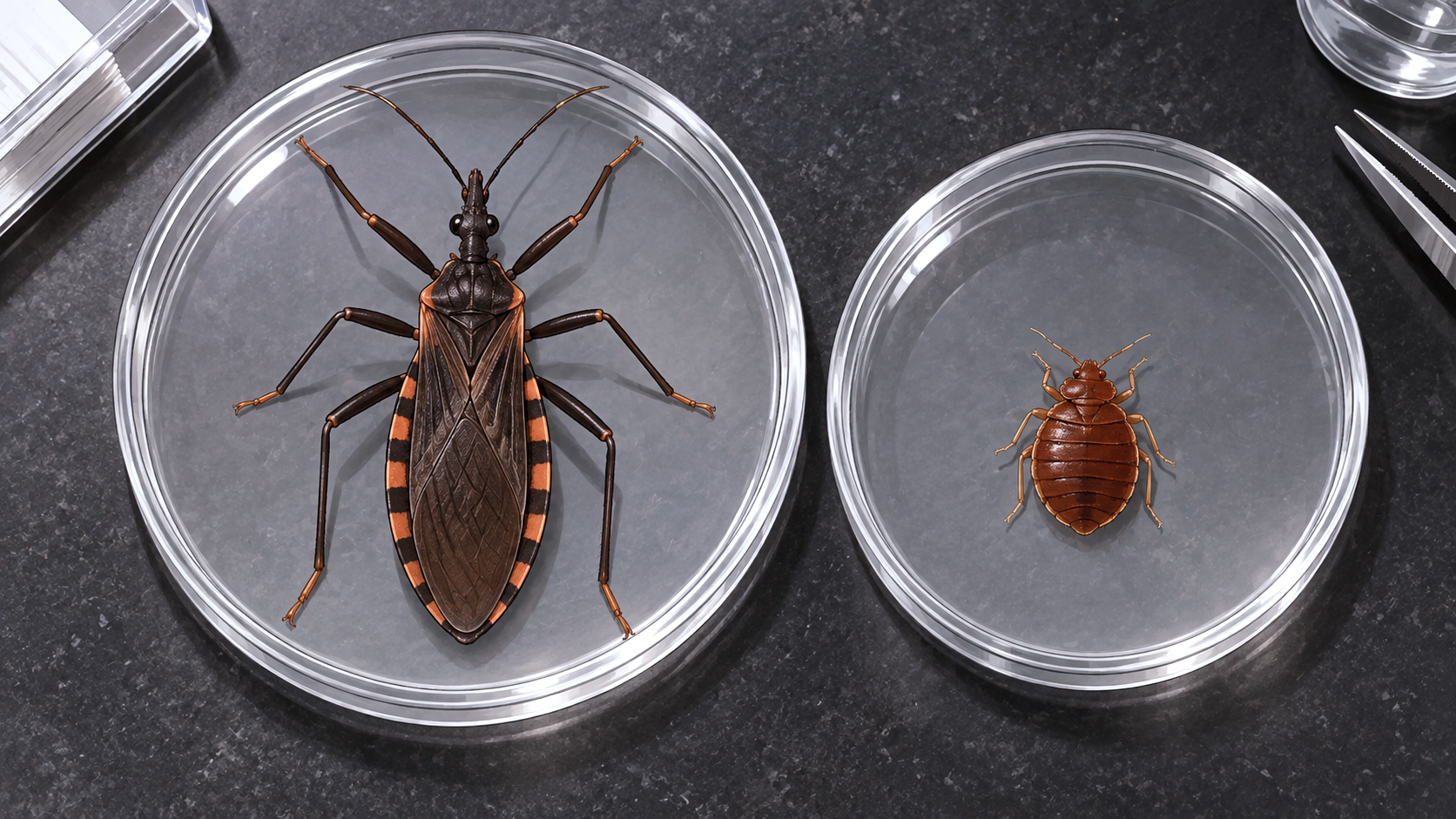
Kissing bugs and bed bugs are both blood-feeding true bugs, but they are difficult to confuse once size and body shape are considered. Adult kissing bugs are generally about 1/2 to more than 1 inch long, with elongated bodies, narrow cone-shaped heads, and functional wings. Adult bed bugs are only about 5–7 mm long, broadly oval, flattened, and wingless. Their medical importance is also different: bed bugs are not known to transmit disease, while some kissing bugs can carry Trypanosoma cruzi, the parasite that causes Chagas disease.
Kissing Bugs Are Much Larger and More Elongated
Size is usually the quickest visual separator. EPA describes an adult bed bug as approximately 5–7 mm long, about the size of an apple seed, with a broad, flattened oval body when unfed. Their reddish-brown shape and proportions are easier to judge once you know what adult bed bugs actually look like. Kissing bugs are several times longer. U.S. species commonly reach roughly 13–33 mm, and the University of Arizona’s peer-reviewed identification guide describes adults as large, dark brown or black insects ranging from about half an inch to more than an inch.
Kissing bugs also have a noticeably narrower front end. Their head projects forward into the characteristic “cone-nose” shape, followed by a narrow neck-like section and a longer abdomen. Many U.S. species have orange, red, or yellow markings along the outside edges of the abdomen. Texas A&M’s kissing bug identification guide emphasizes the cone-shaped head, thin legs, thin antennae, and straight feeding mouthparts as useful identification features. Bed bugs lack that long head and instead appear compact and broadly rounded. Comparing an unknown specimen with the normal size range of bed bugs can eliminate many kissing bug misidentifications immediately.
| Feature | Kissing Bug | Bed Bug |
|---|---|---|
| Adult length | About 13–33 mm, depending on species | About 5–7 mm |
| Overall shape | Long, narrow, somewhat pear-shaped | Broad, flattened, oval |
| Head | Long and cone-shaped | Short and broad |
| Adult wings | Present | No functional wings |
| Common coloring | Dark brown or black, often with orange/red/yellow edge markings | Reddish-brown |
| Typical setting | Outdoors, animal nests, cracks in buildings, occasional indoor intrusion | Beds, furniture, sleeping areas |
| Disease concern | Some can transmit T. cruzi through infected feces | Not known to transmit disease |
Adult Kissing Bugs Have Wings, While Bed Bugs Do Not Fly
Adult kissing bugs possess developed wings and many species can fly into or around buildings, particularly during periods of seasonal dispersal. Nymphs do not yet have functional adult wings. Bed bugs have only reduced wing structures and cannot fly, so an insect clearly flying around a room is not an adult bed bug. Bed bugs instead spread by crawling and by hitchhiking in luggage, furniture, clothing, and other belongings; their lack of flight is central to how bed bugs actually move from place to place.
Location can therefore provide useful supporting evidence. Finding numerous flattened bugs, eggs, cast skins, and dark spotting in mattress seams or a bed frame strongly favors bed bugs. A single large, winged, cone-nosed insect entering a house from outside fits a kissing bug much better. Arizona researchers note that kissing bugs commonly associate with wildlife nests and may enter homes rather than establish the dense bed-and-furniture infestations characteristic of bed bugs.
Their Bites Can Look Similar, So the Skin Reaction Is Not Enough
Both insects usually feed at night and can bite sleeping people without causing immediate pain. Kissing bug bites may produce itching, redness, swelling, or a substantial welt, while bed bug reactions range from no visible mark at all to itchy swollen lesions. The CDC notes that bed bug bite reactions vary widely among people, which makes shape or arrangement on the skin unreliable for identifying the insect. The same limitation applies to kissing bugs: Arizona guidance specifically notes that their bites can resemble bites from bed bugs and other insects.
A line or cluster of itchy marks does not prove bed bugs, and a facial bite does not prove a kissing bug. Physical evidence from the environment carries much more diagnostic value. If bed bugs are suspected, the surrounding signs described in bed bug bite identification and inspection help separate an infestation from an isolated skin reaction.
Severe swelling, breathing difficulty, dizziness, or other signs of anaphylaxis after any suspected insect bite need urgent medical attention. People with unusually severe reactions can use the same general thresholds described for seeking medical care after bed bug bites, while suspected kissing bug exposure also raises the separate question of Chagas disease.
Kissing Bugs Carry a Chagas Disease Risk That Bed Bugs Do Not
The most important medical difference is disease transmission. The CDC states that bed bugs are not known to spread disease to people. Kissing bugs can carry Trypanosoma cruzi, although finding a kissing bug does not mean the insect is infected and being bitten does not automatically cause Chagas disease.
Transmission usually occurs through the bug’s feces rather than directly through its bite. After feeding, an infected kissing bug can deposit parasite-containing feces near the bite site. Infection can occur if those feces are rubbed into the wound, eye, mouth, or another break in the skin. The CDC’s current Chagas transmission guidance identifies contact with infected triatomine feces as the main vector-borne route.
Several kissing bug species occur in the United States, as shown by the CDC’s U.S. triatomine species guide. Chagas disease remains much more strongly associated with Mexico, Central America, and South America, but locally acquired infections have been documented in the United States. A suspected kissing bug should therefore be identified accurately rather than treated as an unusually large bed bug.
Handle a Suspected Kissing Bug Differently From a Bed Bug
Do not crush a suspected kissing bug with bare fingers. If practical, place it in a closed container without direct skin contact so it can be identified. Texas A&M advises recording where and when the insect was found and whether a person or animal may have been bitten; its kissing bug submission guidance also explains options for safely retaining specimens. Local health departments, extension entomologists, or state vector programs may be able to identify specimens depending on the location.
A confirmed bed bug usually points toward inspection of mattresses, box springs, headboards, couches, and nearby crevices because repeated indoor signs suggest an established infestation. Other household insects can resemble bed bugs at a glance, so comparing body structure rather than automatically treating the room prevents unnecessary pesticide use.
Questions About Kissing Bugs and Bed Bugs
Are kissing bugs another type of bed bug?
No. Bed bugs belong to the family Cimicidae, while kissing bugs are triatomine insects in the assassin bug family Reduviidae. Both feed on blood, but they are separate groups with different anatomy, habitats, and medical significance.
Can kissing bugs infest a mattress like bed bugs?
They can enter bedrooms and bite sleeping people, but they do not normally form the dense mattress and bed-frame infestations typical of bed bugs. Repeated evidence concentrated in mattress seams is much more characteristic of bed bugs.
Can a kissing bug bite cause Chagas disease immediately?
The bite itself is not normally the infectious event. Chagas transmission occurs when feces from an infected kissing bug containing T. cruzi enter the body through the bite wound, eyes, mouth, or another opening.
Should you see a doctor after finding a kissing bug?
Simply finding one does not automatically require treatment. Medical advice is more appropriate if you were bitten and have a significant reaction, if parasite-containing material may have contacted an eye or wound, or if a healthcare provider believes your geographic or exposure history warrants Chagas testing.
Can you identify them by color alone?
No. Kissing bug species vary in coloration, and fed bed bugs can become darker or redder after a blood meal. Size, head shape, body proportions, wings, mouthparts, and where the insect was found provide a more dependable identification.