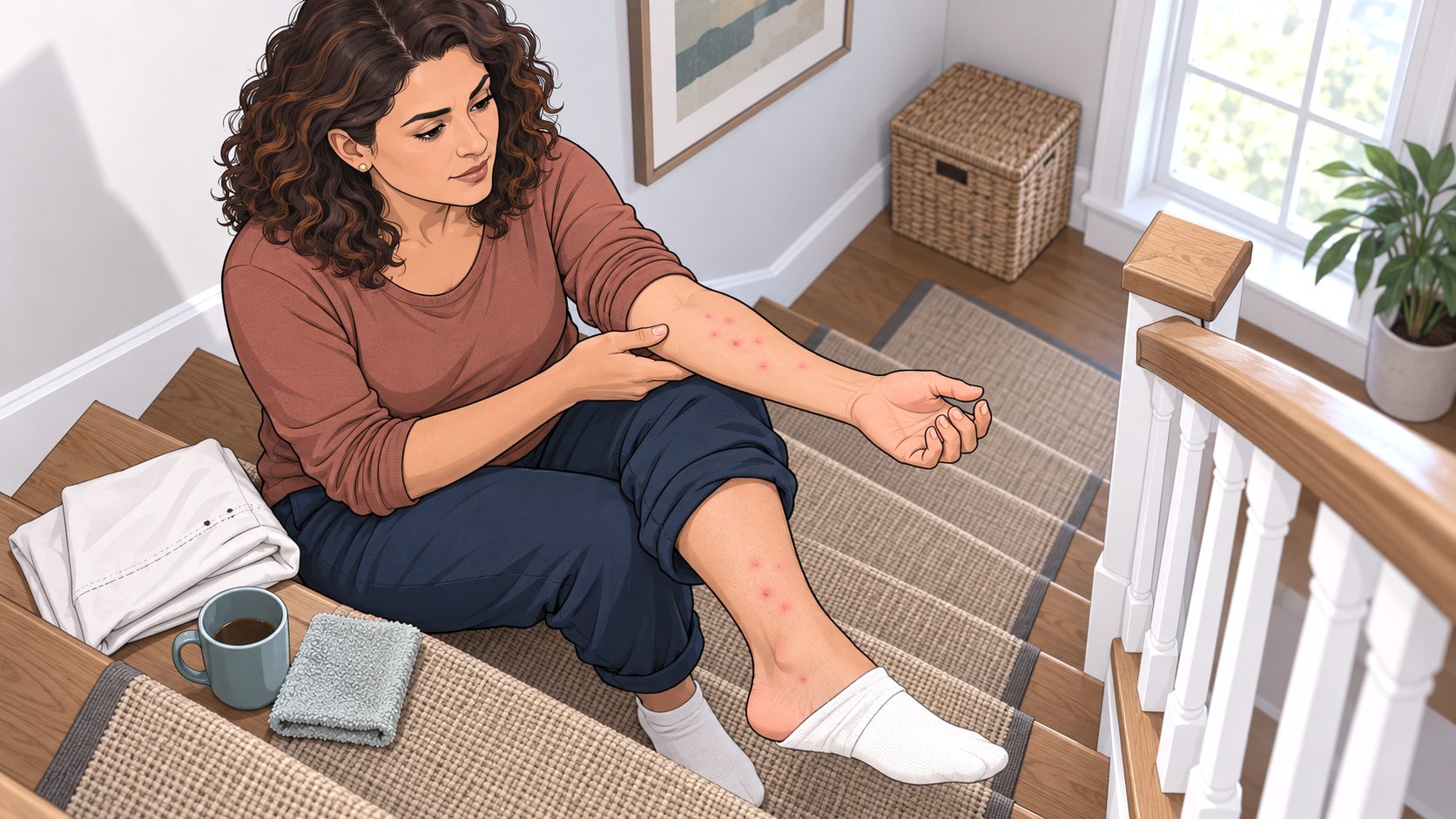
Bed bug bites don’t have one appearance that everyone develops. The familiar image of several small, red, itchy bumps is certainly possible, but reactions range from no visible marks at all to raised wheals, flat discolored spots, blisters, and more pronounced allergic reactions.
Bed bug bites often look like small, slightly swollen, itchy marks on exposed skin. They may appear individually, in clusters, or in a line. Some develop a tiny darker punctum in the center, while others look like red or purplish spots, raised bumps, or larger wheals. Appearance alone cannot confirm that bed bugs caused them.
A Bed Bug Bite Can Have a Tiny Central Punctum
Some bed bug bites develop a small darker point in the center of the lesion. Clinical descriptions call this a central hemorrhagic punctum, marking the site where the skin was pierced.
The Merck Manual describes bed bug lesions as potentially including puncta alone, purpuric macules, blisters, or erythematous macules, papules, and wheals that often have a central hemorrhagic punctum. Published clinical literature likewise describes pruritic wheals with a central punctum as a common presentation.
It can be a useful detail to notice, but we wouldn’t use it to diagnose bed bug bites. A central punctum can occur with other arthropod bites, and plenty of bed bug reactions don’t show one clearly enough to see.
Bed Bug Bites Can Look Very Different From Person to Person
The CDC emphasizes that people respond differently to bed bug bites. At one end of the range, a person may show no physical signs. At the other, bed bug bites can trigger much stronger inflammatory or allergic reactions.
Between those extremes are the reactions most people associate with bed bugs: slightly swollen marks that may be red, pink, or otherwise discolored and can become itchy or irritated.
Merck’s current clinical guidance expands the range further. Bed bug bites may appear as tiny puncta, purplish flat spots, raised bumps, wheals, or blisters. A 2026 systematic review of published bed bug bite case reports likewise found considerable variation in dermatologic presentation, reinforcing why there isn’t a single “correct” bed bug bite appearance.
Skin tone can also affect how inflammation and discoloration appear visually. Redness that is obvious on lighter skin may be subtler or appear differently on darker skin, so comparing a mark against one reference photograph is particularly unreliable.
Bed Bug Bites May Appear in Clusters or Lines
Bed bug bites can occur in groups, lines, or seemingly random arrangements.
Linear patterns are commonly associated with bed bugs, and Merck notes that lesions may form lines or groups. However, the famous “breakfast, lunch, and dinner” description shouldn’t be treated as a diagnostic rule. Not every bed bug feeding produces three marks, and other causes of skin lesions can also produce clustered patterns.
A group of new marks appearing after sleep is therefore more useful as a reason to inspect for bed bugs than as proof that you’ve found them.
The physical evidence around the sleeping area carries much more weight. If you’re trying to establish whether the bites actually came from an infestation, how to tell if you have bed bugs covers the insects, eggs, shed skins, fecal spotting, and other evidence worth looking for.
Bed Bug Bites Don’t Always Appear Immediately
Another reason bite appearance can be confusing is that the reaction may be delayed.
The CDC says bite marks may not appear until one to several days after the bite and notes that some people can take as long as 14 days to develop visible marks. Merck gives a range extending from the morning after exposure to about 10 days.
Previous exposure can also affect the timing and character of a person’s reaction. Clinical literature describes sensitization with repeated exposure, but the progression isn’t identical for everyone. It would therefore be misleading to assume that every person’s bites will become larger, itchier, or faster to appear each time they’re exposed.
This delay also makes it difficult to determine exactly when or where an individual bite occurred.
Some People Have No Visible Reaction at All
No marks doesn’t necessarily mean no bites.
The CDC specifically includes no physical signs within the possible response to bed bug bites. Clinical research has also documented people who show little or no visible reaction despite exposure.
That creates an important limitation when several people share the same room. One person may develop conspicuous itchy lesions while another notices almost nothing, even though both were exposed.
The same variability applies to itching. Bed bug bites don’t always itch, so lack of itching doesn’t rule them out either.
Bed Bug Bites Can Sometimes Look Purple or Bruised
Red bumps aren’t the only documented presentation.
Merck includes purpuric macules among possible bed bug lesions. These are flat areas of purplish discoloration caused by blood leaking into the skin. Depending on the reaction and skin tone, they may look more bruise-like than the raised red bumps usually shown in photographs.
That appearance deserves some caution because many unrelated conditions can produce purple or bruise-like marks. Our closer look at why bed bug bites can turn purple or look bruised covers that presentation without treating discoloration alone as evidence of bed bugs.
Blisters can occur too. Merck lists bullae among possible lesions, while the CDC notes that more pronounced allergic responses can occur in some people. These aren’t the typical reaction, but they fall within the documented clinical range.
Bite Appearance Alone Can’t Confirm Bed Bugs
This is the limitation worth remembering whenever you’re comparing your skin with photographs online.
The Merck Manual specifically cautions that diagnosing bed bug bites from lesion appearance can be difficult because their appearance is usually nonspecific. The CDC similarly recommends looking for additional signs of infestation rather than relying solely on bite marks.
Check the mattress, box spring, bed frame, headboard, and nearby cracks for live bugs, shed exoskeletons, eggs, fecal spots, and rusty blood stains. Those physical signs can connect an otherwise nonspecific skin reaction to an actual infestation.
You can also use the distribution of marks to decide where to examine your skin more closely. Checking your body for bed bug bites and signs covers that process separately.
Questions About What Bed Bug Bites Look Like
Do bed bug bites always have a dot in the middle?
No. A central hemorrhagic punctum is a documented feature of some bed bug lesions, but it isn’t always visible and isn’t unique to bed bugs. Its absence doesn’t rule out a bed bug bite, and its presence doesn’t confirm one.
Are bed bug bites always red?
No. They can appear red or pink on some skin tones, while other reactions may be purplish, darker, or less visibly discolored. Skin tone and the type of inflammatory reaction both affect how a lesion looks.
Can bed bug bites look like bruises?
They can sometimes produce purpuric, bruise-like discoloration. However, unexplained bruising has many possible causes, so a purple mark shouldn’t be attributed to bed bugs without other supporting evidence.
Can one person have obvious bites while another person has none?
Yes. Individual responses vary considerably, and some people show no visible skin reaction after being bitten. Differences in marks between two people sleeping in the same room therefore don’t establish who was or wasn’t bitten.
When should you get medical help for a suspected bed bug bite?
Most bites need only basic symptom management, but the CDC advises medical care when a significant allergic reaction is suspected. Medical evaluation is also appropriate for signs of secondary infection or unusually severe skin reactions.
5 thoughts on “What Do Bed Bug Bites Look Like?”