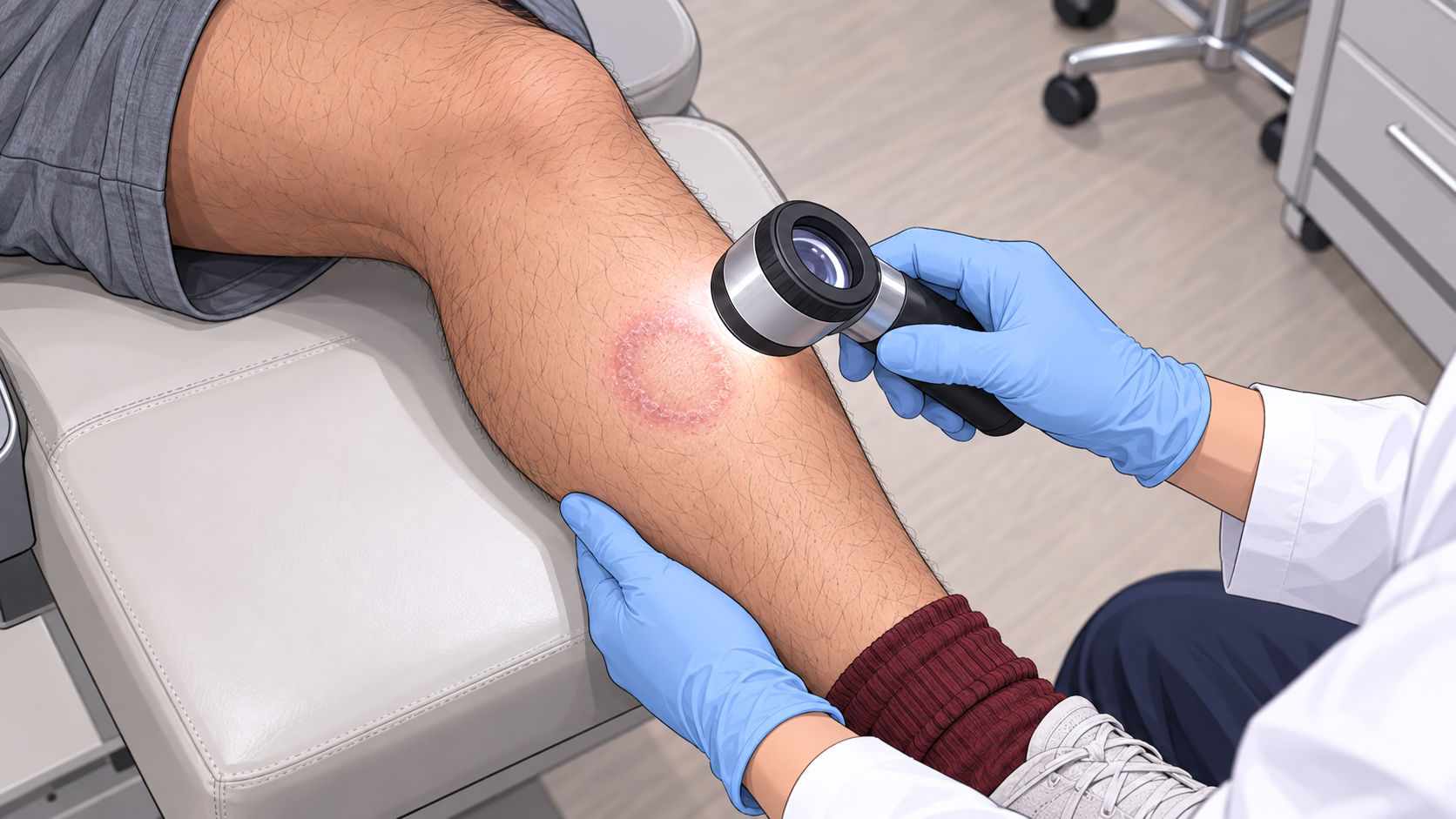
Bed bug bites and ringworm can both itch and appear red, brown, or purple, but their structure usually differs. Ringworm tends to form a slowly enlarging patch with a scaly, raised outer edge and sometimes central clearing. Bed bug bites are usually separate bumps or welts rather than one patch expanding outward from its border. A circular shape alone is not enough to diagnose either condition.
The Outer Edge of the Rash Provides the Strongest Visual Clue
Ringworm of the body, or tinea corporis, is a fungal skin infection rather than an insect reaction. The CDC describes the classic lesion as a raised, scaly ring with central clearing, although the center can also remain scaly or contain scattered bumps. The American Academy of Dermatology notes that affected patches often have a raised, scaly border that gradually enlarges. The active outer margin is particularly useful when comparing ringworm with insect bites because the fungus spreads through the superficial skin, producing an expanding patch rather than a fixed collection of individual feeding reactions.
Bed bug bites do not ordinarily create a progressively widening scaly border. The CDC describes them as small itchy marks that may occur randomly or in a line, although some people develop larger areas of swelling. Their appearance varies enough that bed bug bites may be raised, flat, or swollen, but separate lesions remain more characteristic than a single annular patch whose edge is advancing across the skin.
Central clearing strengthens the case for ringworm without proving it. Mayo Clinic describes body ringworm as an itchy circular rash whose center may become clearer while the ring expands. Bed bug bites occasionally appear around an open area by coincidence, so geometric arrangement should never outweigh scaling and progressive enlargement.
Ringworm Grows; Bites Appear as New Feeding Reactions
Watching the skin over several days can be more useful than judging one photograph. Ringworm often begins as a relatively small patch and gradually expands at its perimeter. The CDC notes that symptoms usually emerge four to fourteen days after contact with the fungi, and untreated lesions can continue enlarging or appear at additional sites.
Bed bug marks follow a different timeline. New lesions can continue appearing when feeding continues, but an existing bite does not normally expand outward as a fungal plaque. Individual reactions may become more or less swollen before fading, and visible marks can be delayed for days after feeding. The broad range of possible bed bug bite appearances makes the behavior of the whole rash more informative than the exact diameter of one spot.
Scaling also deserves attention. Persistent dry or flaky skin concentrated along an advancing margin supports ringworm. Scratching a bite can make it crusty or rough, but that secondary irritation does not create the organized scaly edge typical of tinea corporis.
Ringworm Does Not Always Look Like a Bright Red Circle
The familiar red ring is only one presentation. The CDC notes that ringworm may appear red-purple, brown, gray, or black on brown skin, while the American Academy of Dermatology describes patches on skin of color as often brown or gray rather than bright red. Some lesions are only partly ring-shaped, and overlapping patches can distort the classic outline.
Bed bug reactions also change in appearance across skin tones. On darker skin, redness may be less apparent and lesions can appear brown, purple, or darker than the surrounding skin; bed bug bites on dark or Black skin therefore should not be judged by color alone. Texture and progression remain more useful: ringworm commonly scales and expands, whereas an uncomplicated bite reaction does neither in the same organized pattern.
Steroid creams can further confuse the picture. Ringworm treated with topical corticosteroids without an appropriate antifungal may lose some of its typical border while the infection continues spreading. A rash that becomes less recognizable after steroid use should not automatically be reclassified as insect bites.
The Exposure History Points in Completely Different Directions
Ringworm is contagious. The CDC states that the fungi can spread through direct contact with an infected person or animal, shared items such as towels and clothing, and contaminated surfaces. Contact sports, infected pets, shared towels, locker rooms, and close household exposure can therefore support the diagnosis when the skin appearance also fits.
Bed bug bites require insects in the environment. The skin cannot confirm that by itself. Live bugs, eggs, cast skins, fecal spotting, and rusty stains around mattresses or furniture provide the relevant evidence. Checking mattress seams and other common hiding points is more useful than assuming every itchy cluster found after sleeping came from bed bugs. Repeated early signs around the sleeping area make bite exposure increasingly plausible, while a clean inspection combined with an enlarging scaly patch favors a dermatologic cause.
A systematic search can establish whether bed bugs are actually present before pesticides, laundering routines, or furniture disposal begin. Ringworm instead requires antifungal management and attention to potential transmission sources.
Persistent or Unusual Ring-Shaped Rashes Should Be Diagnosed Before Treatment
Mild body ringworm often responds to topical antifungal medication, but diagnosis becomes important when the rash is extensive, involves the scalp or nails, repeatedly returns, or fails to improve. The American Academy of Dermatology notes that treatment depends on where the infection occurs, with some forms requiring prescription oral medication rather than an over-the-counter skin cream.
Seek medical attention sooner for significant pain, fever, rapidly spreading inflammation, pus, or other evidence of infection. Severe swelling, breathing difficulty, or infected scratching after suspected bed bug exposure also warrants care, and the situations in which bed bug bites need medical evaluation extend beyond ordinary itching.
An enlarging, scaly patch with an active border is much more characteristic of ringworm than bed bug bites. Separate itchy welts become more credible as bed bug reactions when the room supplies independent evidence of an infestation rather than the diagnosis resting on the shape of the rash alone.