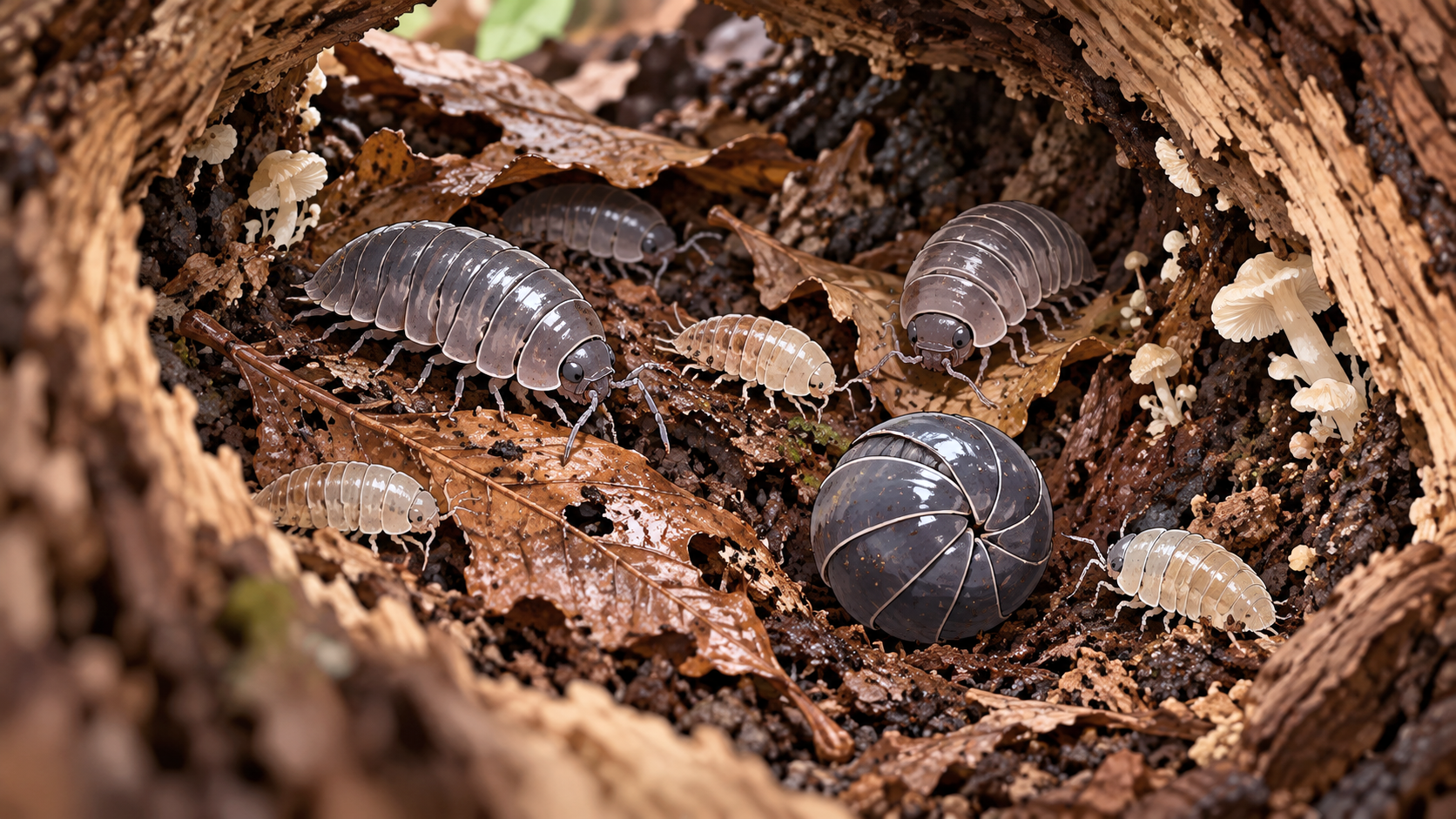
Roly-polies can breathe through specialized structures beneath their bodies, shed their shells in two stages, carry their young in fluid-filled pouches, and even turn bright blue when infected by certain viruses. These small crustaceans have developed some remarkable ways to survive on land, despite descending from aquatic ancestors. The common roly-poly, Armadillidium vulgare, also possesses unusual defenses and feeding habits that make it an important part of the soil ecosystem.
1. Roly-Polies Can Reduce Water Loss by Curling Into a Ball
Rolling into a ball protects roly-polies from more than predators. The posture also reduces evaporation from their exposed respiratory surfaces, helping them retain moisture when conditions become dry.
In a controlled study of Armadillidium vulgare, curled individuals lost water 34.8% more slowly than those whose bodies remained extended. Their carbon dioxide release also decreased by 37.1% under the experimental conditions. The research on conglobation and water conservation demonstrated that curling provides a measurable advantage in dry air, although the difference becomes less pronounced at higher humidity.
The protection comes partly from concealing the underside, where delicate respiratory structures contribute heavily to water loss. A curled pill bug also exposes less body surface to surrounding air. This explains why an individual may remain tightly closed even when no obvious predator is present.
2. They Shed Their Exoskeletons in Two Separate Pieces
Most people familiar with molting insects expect an animal to shed its outer covering in one event. Roly-polies have a different approach. They undergo biphasic molting, replacing the rear portion of their exoskeleton before shedding the front portion.
During this process, the two halves temporarily have different appearances. A partially molted roly-poly may have a pale rear end and a darker front end, making it look as though its body belongs to two different animals. The remaining old covering is eventually shed as the second phase proceeds.
The National Institute of Environmental Health Sciences’ pill bug information describes this unusual sequence. Roly-polies also recover calcium associated with the molting process, supporting the hardening of their replacement exoskeleton. An individual found with mismatched body coloration may therefore be undergoing normal development rather than suffering an injury.
3. Their Blood Contains Copper Instead of Iron-Based Hemoglobin
Roly-polies possess a copper-containing oxygen-transport protein called hemocyanin. Unlike the iron-based hemoglobin responsible for the red color of human blood, oxygenated hemocyanin can give their circulatory fluid a bluish appearance.
Their circulatory system is also different from ours. Instead of keeping blood entirely inside an enclosed network of vessels, roly-polies have an open circulatory system in which hemolymph circulates through body spaces and around internal organs.
Hemocyanin occurs in various crustaceans and other invertebrates, including horseshoe crabs and many mollusks. The common pill bug therefore shares an oxygen-transport system with numerous aquatic animals, despite spending its life on land.
4. Roly-Polies Can Turn Bright Blue Because of a Virus
A vivid blue or violet roly-poly is an unusual sight, and the coloration may indicate infection with an invertebrate iridescent virus. These viruses can produce striking changes in appearance as viral particles accumulate in tissues.
Infected individuals have been documented in multiple terrestrial isopod species. Laboratory examination of unusually blue specimens has revealed dense arrangements of virus particles associated with the coloration. The research on iridovirus infections in terrestrial isopods established this connection through microscopic examination of infected tissues.
The blue coloration is different from the ordinary gray, brown, or patterned appearance of healthy pill bugs. A study of iridescent virus distribution also identified infections across a wider geographical range using observations and molecular evidence. A bright-blue individual should be left undisturbed rather than collected and introduced into a captive isopod colony.
5. They Can Eliminate Nitrogen Waste as Ammonia Gas
Human kidneys remove much of our nitrogen waste through urine. Roly-polies use a very different system, releasing much of their nitrogenous waste as ammonia rather than producing urine in the familiar mammalian sense.
This process allows terrestrial isopods to eliminate waste without the same dependence on producing large volumes of liquid urine. The physiology of nitrogen excretion in terrestrial isopods shows that ammonia release also varies with daily activity and hydration.
It is an unusual adaptation for an animal living on land, where conserving water can determine whether it survives. Their waste-management system reflects the physiological adjustments required as crustacean ancestors adapted to terrestrial environments.
6. Roly-Polies Sometimes Eat Their Own Droppings
Decaying leaves are a familiar food source for pill bugs, but their feeding behavior includes something less obvious. Roly-polies practice coprophagy, meaning they sometimes consume their own feces.
Their droppings contain organic material and microorganisms associated with decomposition. Reingesting this material allows nutrients to pass through the digestive system again, while microorganisms contribute to the biological processes involved in breaking down organic matter.
The nutritional biology of terrestrial isopods describes how coprophagy is associated with microbial activity and nutrient cycling. The same research explains why decomposing leaves are generally more suitable food than fresh foliage. Microbial colonization changes the material before the isopod consumes it.
This feeding behavior helps explain their contribution to soil fertility. By fragmenting organic debris and processing it through their digestive systems, pill bugs participate in the gradual recycling of plant nutrients.
7. They Can Detect Danger Without Seeing a Predator
A roly-poly does not always need direct contact with a predator to change its behavior. Chemical signals in the surrounding environment can influence how long an individual remains curled up after a disturbance.
A study involving common pill woodlice exposed them to chemical cues associated with predators and compared their reactions with those exposed to non-predator cues. Males remained curled for longer when predator-related chemical signals were present, although females did not show the same response under the tested conditions.
The experimental research on predator detection and defensive behavior demonstrates that roly-poly responses involve more than simple touch reflexes. Their defensive behavior can reflect information gathered from the environment before a predator physically attacks.
This also means that repeatedly tapping or disturbing a curled pill bug provides little useful information about its normal behavior. The animal’s response changes with the perceived level of danger.
8. Some Roly-Polies Can Store Sperm for Later Reproduction
Female common pill bugs can retain sperm after mating, allowing them to fertilize later broods without another immediate encounter with a male. This reproductive ability is particularly useful when suitable mates are temporarily unavailable.
Research involving Armadillidium vulgare has documented sperm storage extending across multiple broods. The study of pill bug responses to heat exposure also discusses the reproductive biology of females capable of using stored sperm over an extended period.
A female’s developing young remain inside a specialized brood pouch rather than being deposited directly into the surrounding soil. Calcium uptake during early development is especially pronounced, supporting the formation of the juveniles’ outer skeletons. Measurements of calcium accumulation during embryonic and juvenile development demonstrate how rapidly this mineral requirement increases before the young become independent.
Sperm storage means that finding a single female does not necessarily indicate she is incapable of producing offspring without another mating event.
9. Roly-Polies Can Recognize Suitable Shelter Through Chemical Cues
Groups of roly-polies often gather beneath the same stone, piece of bark, or fallen branch. These gatherings are associated with their need for shelter and moisture, but their behavior also involves chemical signals that influence where individuals settle.
Terrestrial isopods use sensory receptors to locate favorable environments and respond to the presence of other members of their species. Gathering together can reduce the amount of body surface exposed to dry air, improving conditions for individuals within the group.
Their aggregation behavior is especially noticeable beneath objects that retain moisture without becoming submerged. The ecology of the common pill bug describes how humidity, shelter, and chemical communication influence its activity.
Other moisture-dependent arthropods may occupy the same habitat. For example, springtails and terrestrial isopods frequently occur in damp organic material, although their anatomy and behavior differ considerably.
10. Many Familiar Roly-Polies Are Introduced Species
The common pill bug is widespread across North America, but Armadillidium vulgare is not native to the continent. It originated in Europe and surrounding regions before becoming established elsewhere through human activity.
Its success reflects its ability to occupy disturbed environments, gardens, agricultural land, and other habitats containing organic debris and suitable moisture. Introduced terrestrial isopods are now prominent members of many North American soil communities.
The distribution and ecological effects of introduced terrestrial isopods include differences between native and non-native species. Some introduced isopods can become abundant enough to affect local decomposition processes and interactions within soil communities.
Finding roly-polies in an ordinary garden is not automatically a reason to eliminate them. Their feeding contributes to organic matter breakdown, and removing damp debris solely to destroy harmless soil animals can unnecessarily disturb the habitat. Their presence is most useful as evidence of a sheltered environment where decomposition is taking place.