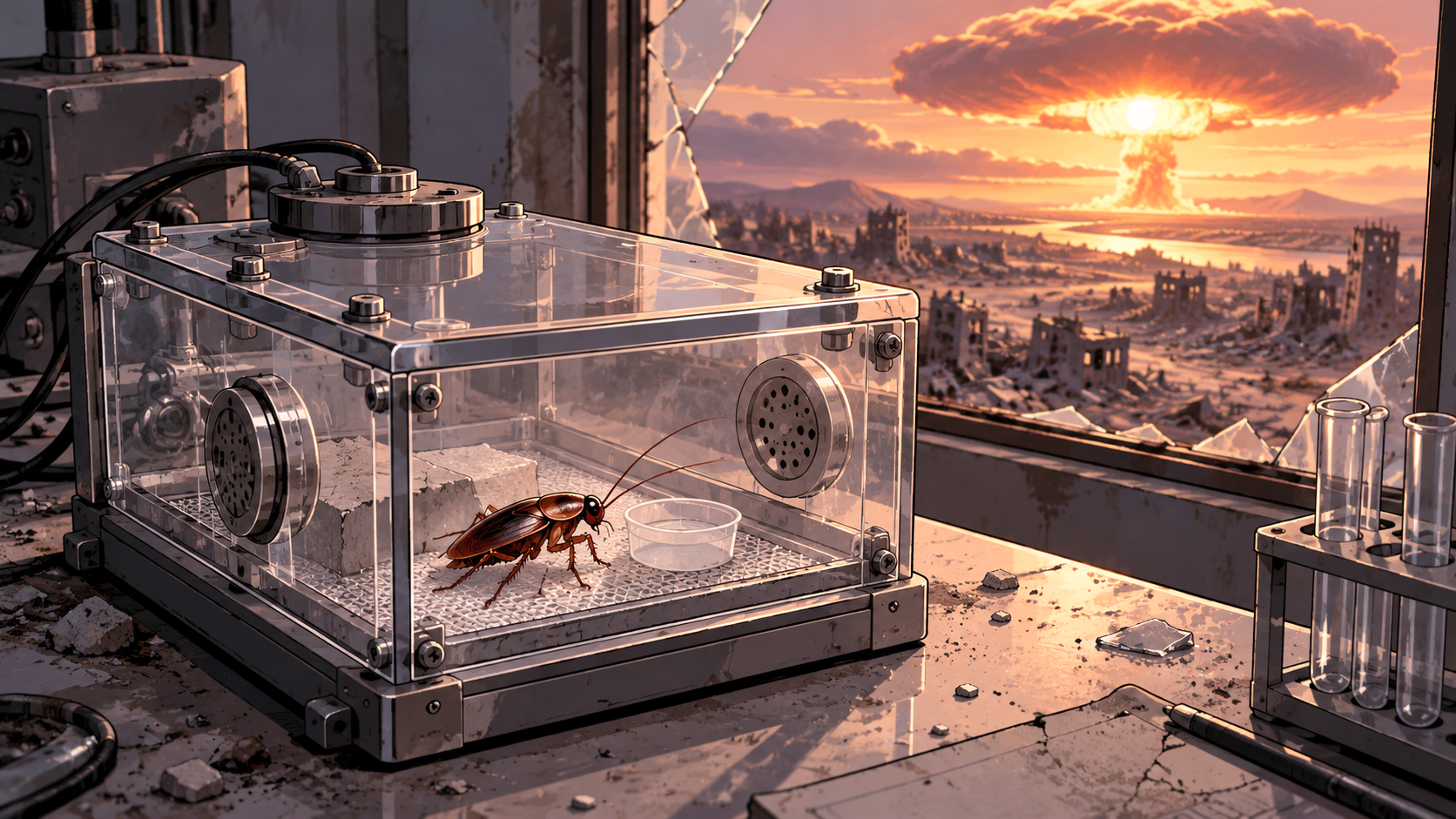
Cockroaches are not capable of simply surviving a nuclear explosion at close range. A detonation produces extreme heat, blast pressure and radiation, any of which can be lethal. Cockroaches do tolerate much higher doses of ionizing radiation than humans, but experiments also show that radiation eventually kills them and can damage reproduction at lower doses. The famous idea contains one genuine biological advantage wrapped inside a much larger myth. Radiation resistance could improve a cockroach’s chances in some contaminated areas away from the worst physical destruction. It would not protect an exposed insect from the fireball or make cockroaches uniquely resistant among insects.
Radiation Resistance Is Only One Part of a Nuclear Detonation
The phrase “survive a nuclear explosion” is misleading if it is treated as a radiation question alone. A nuclear detonation releases a combination of blast energy, intense heat, light and ionizing radiation, followed by radioactive fallout that can contaminate areas farther from the explosion. Everything within the fireball can be vaporized, while surrounding areas can experience severe structural destruction and thermal effects.
No special feature of cockroach anatomy makes the insect immune to being burned, crushed or physically destroyed. The unusual ability of a cockroach to survive temporarily without its head illustrates how differently some insect systems operate from vertebrate systems, but it does not confer protection from catastrophic heat or mechanical damage.
Distance and shelter therefore matter enormously to the original question. A cockroach directly exposed where blast and thermal effects cause severe destruction faces hazards that have nothing to do with whether its cells tolerate radiation better than human cells.
Cockroaches Can Take Much More Radiation Than Humans
The radiation portion of the story has substantial scientific support. Cockroaches can survive doses of ionizing radiation far beyond those capable of causing severe or fatal radiation injury in people.
Human whole-body exposure begins entering the range associated with acute radiation syndrome at comparatively low absorbed doses. According to CDC clinical guidance on acute radiation syndrome, a short whole-body exposure above about 0.7 gray (Gy) can produce the hematopoietic form of acute radiation syndrome, while the estimated human LD50/60 is approximately 2.5 to 5 Gy. One gray is equivalent to 100 rads for absorbed dose.
Cockroach experiments have involved vastly larger exposures. In experiments on German cockroach nymphs, insects exposed to cobalt-60 radiation received doses as high as 9,600 roentgens, with researchers recording mortality at the upper exposure levels and reproductive effects at lower ones. Older experiments involving several pest insects likewise found that cockroaches could tolerate radiation exposures far above doses that would be devastating to humans.
High tolerance does not mean immunity. When twelve arthropod species were exposed to increasing gamma-radiation doses, life expectancy declined significantly at sufficiently high exposures. The American cockroach was actually the most radiation-sensitive species in that particular comparison.
Cockroaches are therefore radiation-resistant relative to humans, but they are not exceptionally indestructible when compared with the wider insect world.
Why Radiation Can Affect Humans More Severely
Ionizing radiation can damage DNA and other cellular structures, with rapidly dividing tissues particularly vulnerable to acute radiation injury. Humans continually depend on highly active cell populations such as those responsible for producing blood cells and maintaining the gastrointestinal lining. At high whole-body doses, destruction of these tissues contributes to bone-marrow and gastrointestinal radiation syndromes.
Adult insects have a different pattern of cell division. Much of a mature cockroach’s body consists of differentiated tissues in which cells are not constantly dividing at the rates found in some vulnerable vertebrate tissues. This helps explain why a cockroach can withstand an acute radiation dose that would be lethal to a person.
The advantage is not constant throughout its biology. Cell division becomes especially important during development and reproduction, which helps explain why irradiation can interfere with fertility even when an adult survives the immediate exposure. The normal cockroach life cycle involves repeated development through nymphal stages before adulthood, while cockroach molting requires extensive tissue growth and reorganization.
Radiation tolerance also varies among cockroach species rather than belonging to “the cockroach” as though every species had the same limit. Experiments comparing multiple insects found substantial differences among species, and larger insects tended to be more radiation-sensitive within the groups examined. The diversity represented by the many types of cockroaches makes a single universal lethal dose inappropriate.
A Cockroach Can Survive Radiation Yet Lose the Ability to Reproduce Normally
Survival immediately after irradiation tells only part of the story. Radiation can damage reproductive tissues and reduce fertility at doses below those required to kill every exposed cockroach.
German cockroach experiments detected male and female sterility at 3,200 roentgens, along with declining numbers of reproductive females, fewer offspring per egg case and abnormalities in reproductive tissues at different exposure levels. The researchers linked these changes to radiation damage affecting reproduction and germ cells.
Other cockroach species show the same broader pattern. Gamma irradiation of Nauphoeta cinerea reduced life expectancy and altered mating behavior, while sufficiently high doses produced sterile males. An adult remaining alive after exposure therefore does not establish that it escaped important biological damage.
This point weakens the popular image of an irradiated cockroach population simply carrying on as normal after a nuclear disaster. A surviving insect would still need to feed, reproduce and complete normal development under whatever environmental conditions remained. The reproductive process behind cockroach eggs and offspring creates additional radiation-sensitive stages beyond the survival of individual adults.
Fallout Creates a Different Scenario From Ground Zero
A cockroach far enough from a nuclear detonation to escape the worst heat and blast could face a different set of conditions. Radioactive material can combine with debris, rise into the atmosphere and later return as fallout. These particles can be transported away from the detonation and expose organisms outside the area of immediate physical destruction.
The amount of exposure would vary with distance, detonation characteristics, shelter, weather and where radioactive material accumulated. Areas downwind can receive dangerous fallout even beyond the zones of severe blast damage. In such a location, greater radiation tolerance could give some cockroaches an advantage over more radiation-sensitive animals.
It still would not guarantee survival. Radiation dose rises with exposure, and cockroach experiments demonstrate declining longevity and eventual mortality as doses increase. Research specifically examining radiation dose and longevity in American cockroaches found that survival depends on factors including dose, age and sex rather than a simple resistant-versus-not-resistant divide.
Shelter could be just as important as intrinsic radiation tolerance. A cockroach protected deep inside a structure might avoid some immediate physical effects, while an exposed individual at the same general distance could experience a very different outcome. The survival story is therefore partly about where the insect happens to be when the detonation occurs.
Cockroaches Would Not Necessarily Be the Last Animals Standing
The most exaggerated version of the myth predicts that cockroaches would survive a nuclear catastrophe while nearly everything else disappeared. Comparative radiation studies provide little support for giving cockroaches that special status.
In one experiment involving eleven insect species and one isopod, the American cockroach proved more sensitive to gamma radiation than every other arthropod tested. Researchers found poor correlation between broad taxonomic group and radiation resistance, meaning there was no simple rule under which cockroaches automatically outperformed other insects.
Their reputation is better understood as a comparison with humans. A dose that poses an enormous acute danger to a person can leave some cockroaches alive, which sounds extraordinary when the two organisms are placed side by side. Expanding that comparison to the entire animal kingdom creates the myth. Some other insects and invertebrates can tolerate substantial radiation as well or better.
Questions About Cockroaches and Nuclear Radiation
Would cockroach eggs survive radiation better than adults?
Not automatically. Developing embryos contain actively dividing cells, making radiation effects on reproduction and development an important limitation. Whether an egg inside a cockroach ootheca survives depends on dose, developmental stage, species and other exposure conditions.
Does a cockroach’s exoskeleton block radiation?
Its exoskeleton provides physical protection and structural support, but it is not an effective shield against highly penetrating gamma radiation of the kind used in many cockroach irradiation experiments. Their relative tolerance is primarily a biological response to radiation damage rather than armor preventing radiation from entering the body.
Can radiation make cockroaches mutate into giant cockroaches?
Ionizing radiation can damage DNA and cause mutations, but radiation does not provide a biological mechanism for instantly transforming ordinary cockroaches into enormous versions of themselves. Severe genetic damage is more likely to reduce viability or reproduction than produce a functional giant animal.
Are cockroaches immune to radioactive fallout?
No. Fallout can expose organisms to ionizing radiation, and cockroaches have finite radiation tolerance. Their greater resistance compared with humans changes the dose they may withstand; it does not make radioactive contamination harmless to them.