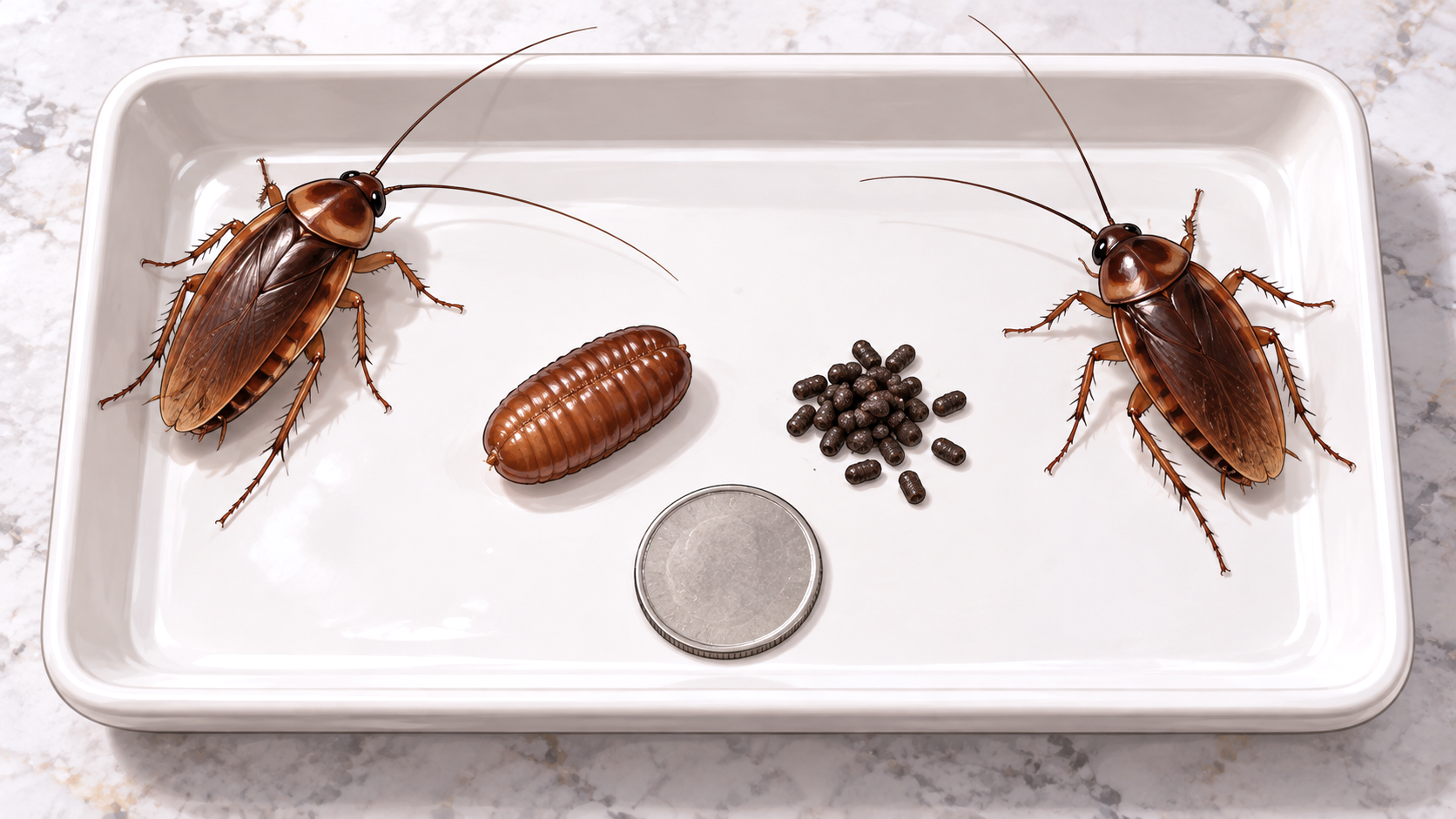
A small brown object behind a refrigerator could be a cockroach egg case or a piece of cockroach feces, but the two have different physical structures. Cockroach eggs are enclosed in a protective capsule called an ootheca, which resembles a tiny purse, bean, or rectangular pod. Cockroach poop appears as dark specks, stains, or small cylindrical pellets. Egg cases usually have a defined outline and a seam along one edge, while droppings lack that organized capsule structure.
The most reliable identification comes from examining the object’s shape, surface pattern, size, and arrangement. Color alone is insufficient because both materials can be dark brown or nearly black.
Cockroach Egg Cases vs Droppings: Side-by-Side Differences
| Feature | Cockroach egg case (ootheca) | Cockroach poop |
|---|---|---|
| Appearance | Purse-shaped, beanlike, or rectangular capsule | Tiny specks, irregular grains, stains, or pellets |
| Typical size | Approximately 5–10 mm in many common household species | Fine specks below 1 mm to pellets a few millimeters long |
| Surface | Firm casing, sometimes with transverse divisions | Granular, irregular, or relatively smooth |
| Distinctive marking | Raised seam or keel along one long edge | No organized opening seam |
| Color | Tan, reddish brown, dark brown, or black | Usually dark brown to black |
| Arrangement | Individual capsules, sometimes attached to surfaces | Scattered particles, clusters, or accumulated staining |
| Function | Protects developing eggs | Waste produced by feeding cockroaches |
The University of California’s cockroach identification information identifies egg cases and fecal spots as separate signs of cockroach activity. A deposited capsule can remain recognizable long after the young emerge, while fecal material may accumulate into stains that no longer resemble individual droppings.
The Raised Seam Is the Strongest Egg-Case Clue
Examine a suspected egg case along its narrow upper edge. Many cockroach oothecae have a raised ridge called a keel, which can resemble a tiny zipper or crimped seam. This is the region along which the capsule opens when the young emerge.
An ootheca is not simply a solid brown pellet. It is a structured casing containing eggs arranged in compartments. Some species have visible transverse divisions associated with those compartments, while others have smoother outer surfaces. The University of California, Riverside’s account of cockroach reproduction describes the two-row egg arrangement and the capsule’s opening along its upper edge.
Droppings have no comparable opening structure. A large cockroach’s fecal pellet may possess lengthwise grooves, but those grooves are not an egg-case seam. Their direction can be useful: grooves on a fecal cylinder typically run along its length, whereas an egg capsule may show regularly spaced divisions across its surface together with a distinct keel.
Not every seam is obvious in a photograph. An egg case resting with its ridged edge against the floor may appear almost smooth from above. Rotating the viewing angle or using a close-up photograph can reveal features hidden in the original view without breaking the object.
Does an Egg Case Have to Be Larger Than Cockroach Poop?
Usually, but there is some overlap among species and individual deposits. A German cockroach ootheca is approximately 8 millimeters long and 3 millimeters high. Its regular, elongated shape is much more conspicuous than the fine fecal specks commonly associated with that species. The University of Florida’s measurements of German cockroach egg cases provide a useful reference when examining a suspected capsule alongside a ruler.
American cockroach egg cases are similarly around 8 millimeters long but broader and more robust. The University of Florida’s American cockroach description records capsules approximately 8 millimeters long and 5 millimeters high, initially brown before darkening.
Smaller egg cases can occur in other cockroach species. Conversely, larger cockroaches produce formed fecal pellets rather than exclusively pepper-like specks. An object measuring several millimeters is therefore not automatically an egg case.
A more dependable approach is to examine whether it has a continuous, symmetrical shell. A regular capsule with a defined keel supports an ootheca identification; an irregular rod with no specialized seam is more consistent with feces.
Why Egg Cases and Droppings Are Found in Different Patterns
Deposits scattered across a cabinet corner usually represent repeated fecal deposition rather than a collection of individual egg cases. Cockroaches leave waste while moving, feeding, and occupying hiding spaces, so numerous small spots may develop around a frequently used crevice.
Egg-case placement depends more strongly on the reproductive behavior of the species. American cockroaches deposit capsules in sheltered locations, sometimes fastening them to a surface. Brown-banded cockroaches may attach egg cases to furniture, walls, ceilings, or concealed elevated surfaces. Penn State Extension’s description of brown-banded cockroaches documents this characteristic attachment behavior.
German cockroaches behave differently. Females generally carry the ootheca protruding from the rear of the abdomen until shortly before hatching. As a result, an exposed German cockroach egg case may remain attached to a female rather than lying among nearby fecal deposits. A University of California photograph of a female carrying an ootheca illustrates the arrangement.
A capsule discovered near droppings should not automatically be assumed to belong to the same species, particularly in buildings where multiple cockroach species may occur. The object’s features and surrounding evidence must support the identification.
Can an Empty Egg Case Look Like a Dropping?
An empty ootheca can be mistaken for feces if it has been flattened, broken, or partially hidden beneath debris. However, a sufficiently intact case should retain some of its original capsule structure.
After hatching, the seam may appear split or lifted. One side can look opened while the remainder of the casing stays intact. This is different from an ordinary fecal pellet, which has no organized exit opening.
An intact-looking capsule does not prove that it still contains viable eggs, and a split capsule does not establish when hatching occurred. The University of California’s cockroach guidance notes that egg cases may remain in protected locations after being deposited, with their appearance reflecting the species and stage of development.
Damaged cases are particularly difficult to identify. A detached fragment may resemble a seed husk, dried organic material, or an unusually shaped dropping. If no seam, compartment divisions, or recognizable capsule outline remains, a confident identification from appearance alone may not be possible.
Finding an intact case does provide a different clue from finding ordinary fecal material: it indicates egg production, although it does not necessarily prove that the capsule was deposited at that exact location or that the eggs remain viable. The places where cockroaches lay their eggs vary according to whether the female carries, deposits, or attaches the ootheca.
How to Identify the Material Without Crushing It
Breaking an unidentified object is unnecessary and may destroy the features needed to recognize it. Instead, examine it where it lies with a flashlight and photograph it beside a ruler or another reliable scale.
A useful identification sequence is to look for an uninterrupted capsule outline, inspect the long edge for a keel, and examine whether the surface divisions follow a regular pattern. If those features are absent, consider whether the material is an irregular pellet or accumulated fecal staining.
The University of California’s photograph showing an ootheca alongside fecal matter provides a direct reference for comparing the two materials in the same setting.
Several additional clues can improve confidence without requiring destructive examination. A female cockroach carrying a capsule establishes the nature of that attached object. Tiny black spots concentrated around a joint are more consistent with fecal deposits, while a rigid, purse-shaped capsule attached beneath furniture is more suggestive of an ootheca. The broader appearance of cockroach droppings varies enough that a single small pellet cannot always be classified reliably.
An unidentified brown object also need not be either eggs or feces. Seeds, shed insect parts, food particles, and fragments of other household materials can resemble both. Additional evidence, such as nearby cockroach specimens or recognizable shed skins, provides stronger confirmation than appearance alone.
What if You Find Both Egg Cases and Droppings?
Discovering both materials in the same protected area provides stronger evidence of cockroach activity than either finding independently. Droppings suggest that cockroaches have occupied or traveled through the location, while a genuine ootheca indicates that a female produced an egg case.
Their presence together does not establish how many cockroaches are currently living there. Fecal stains can persist after insects have disappeared, and empty egg cases may remain long after hatching. A single deposited case also does not prove that a complete breeding population is established inside the room.
The most informative accompanying evidence is the presence of cockroaches at different developmental stages. Small nymphs near an egg case strengthen the possibility of local reproduction, while adults and fecal deposits without nymphs leave more uncertainty. The appearance of cockroach hiding and aggregation sites can provide additional context because cockroaches may concentrate in sheltered crevices rather than constructing a conventional nest.
For an object that remains ambiguous, preserve its original appearance in clear photographs and compare the seam, dimensions, and surface structure before deciding what it represents. Those physical characteristics are more dependable than color, location, or the assumption that every dark household particle is cockroach waste.
3 thoughts on “Cockroach Eggs vs Cockroach Poop”