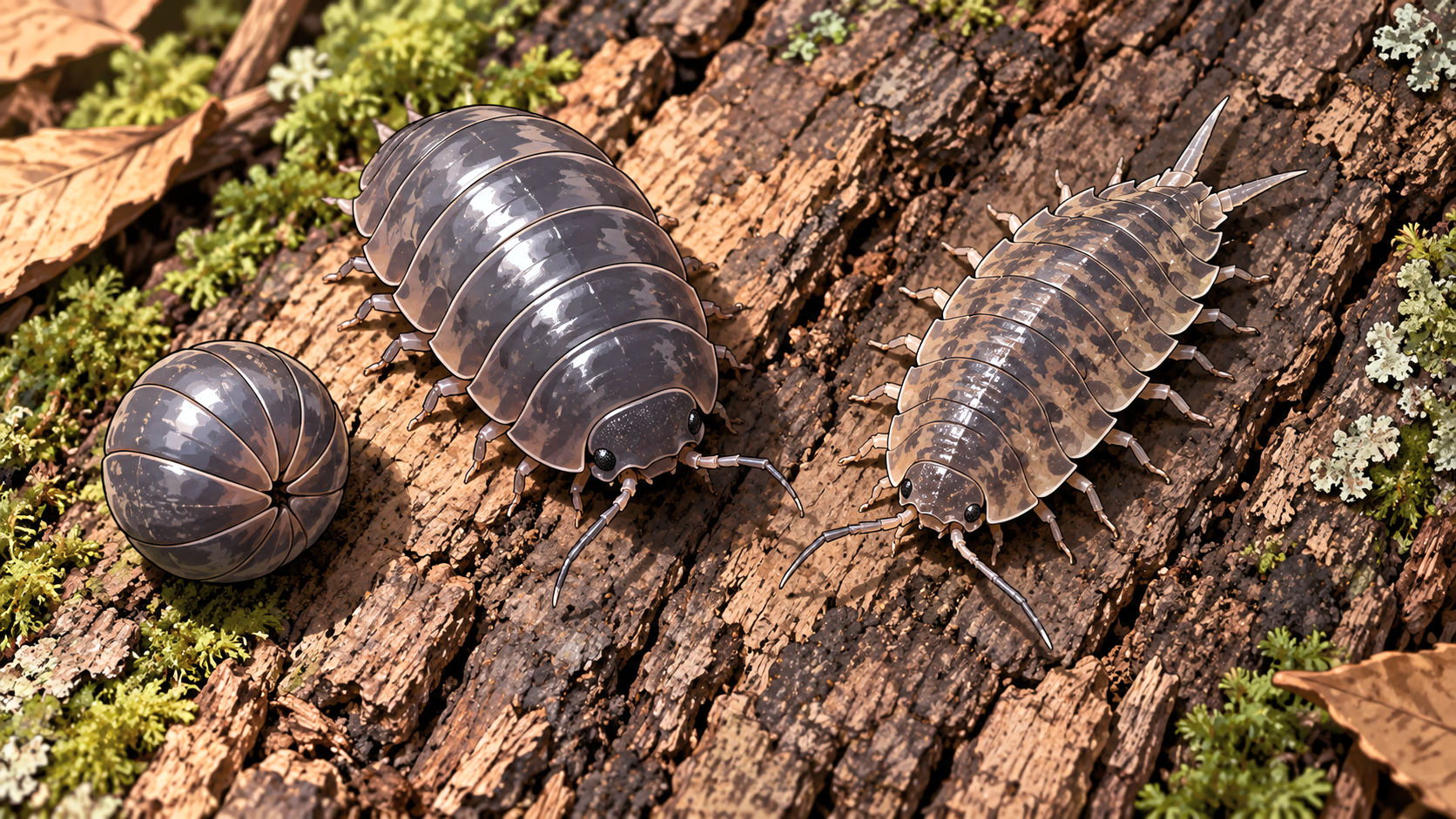
A roly-poly can roll into a tight, enclosed ball, while a typical sowbug cannot. Roly-polies also tend to have a more strongly rounded, dome-shaped body with short rear appendages. Sowbugs are usually flatter, and their paired uropods project visibly from the rear. Both are terrestrial isopod crustaceans, not insects. Those differences are easiest to see on a live animal. Color alone is unreliable because both groups can occur in overlapping shades of gray, brown and other muted colors.
The Fastest Test Is Whether the Animal Can Form a Complete Ball
Gently disturbing the animal usually reveals the most practical difference. True pillbugs such as Armadillidium vulgare perform conglobation, pulling the body into a compact sphere while enclosing the legs, underside and antennae. Anatomical identification keys describe Armadillidium as capable of rolling into a ball with its antennae hidden. A typical sowbug such as Porcellio scaber may contract its body, become motionless or tuck its legs closer underneath, but it cannot close itself into the same sealed sphere.
Rolling is more than an identification trick. It protects vulnerable structures from predators and can reduce evaporative water loss. Measurements in A. vulgare found that conglobation reduced water loss under dry experimental conditions. Those defensive benefits help explain why roly-polies curl into a ball so readily after pressure or strong vibration.
Not every isopod that bends its body qualifies as the familiar pillbug form. Some terrestrial isopods can enroll imperfectly while leaving appendages exposed. For a practical roly-poly-versus-sowbug identification, look for a compact sphere with the vulnerable underside tucked away rather than merely a curved or contracted animal.
Look at the Rear End if the Animal Will Not Roll
The uropods provide a useful identification feature when behavior is difficult to observe. These paired appendages occur at the posterior end of the body. In Armadillidium, the uropods are broad, relatively short and largely contained within the rounded outline of the animal when viewed from above. In common non-rolling woodlice, the uropods extend noticeably beyond the rear margin.
A detailed North American identification key describes the difference precisely: Armadillidium has uropods that do not extend beyond the body’s elliptical outline, whereas genera including Porcellio have prominent uropods projecting beyond it. Identification references similarly note that pillbugs in Armadillidiidae have short rear appendages compared with most other woodlice. On a sowbug, these projections can resemble a pair of tiny tails. They are not stingers and do not make the animal dangerous. Their position simply provides a convenient visual feature for separating the two body forms.
A Sowbug Usually Looks Flatter
Seen from the side, a roly-poly generally has a more convex profile. Its dorsal plates form the rounded contour needed to close into a ball. Sowbugs usually have a flatter body, which is better suited to pressing against surfaces and sheltering beneath bark, stones and other tight cover.
The difference is useful even before the animal reacts to you. A strongly arched, oval isopod with no conspicuous projections at the rear is more consistent with a pillbug. A flatter animal with visible rear uropods points toward a sowbug. Shape is more dependable than trying to identify either one from normal roly-poly color variation, because pigmentation can vary within species.
Surface texture can add information but is less useful as a first test. Porcellio scaber, the rough woodlouse or rough sowbug, has a distinctly granulated dorsal surface; taxonomic keys use that texture to distinguish it from smoother relatives. (pmc.ncbi.nlm.nih.gov) A magnified view can therefore narrow identification further once body shape and uropods have already established that the animal is not a typical pillbug.
Their Similarities Explain Why the Names Get Mixed Up
Roly-polies and sowbugs are close relatives within the terrestrial isopod suborder Oniscidea. Both have a segmented exoskeleton, two main antennae, seven pairs of walking legs as adults and abdominal appendages involved in respiration. Their shared isopod anatomy reflects a common crustacean body plan rather than the six-legged structure of insects. They also occupy many of the same microhabitats. Both commonly shelter beneath logs, stones, leaf litter, mulch, plant pots and other objects that maintain humidity. Their respiratory surfaces make moisture particularly important, so damp protected places suit terrestrial isopods far better than exposed dry ground.
Their diets overlap as well. Both primarily function as detritivores, consuming decaying plant material and other organic matter. The similarities in habitat, feeding and overall segmented appearance explain why a quick glance often produces the same common name even when the animals belong to different families or genera.
“Woodlouse” Does Not Identify a Third Lookalike
Woodlouse is a broad common name for terrestrial isopods. Pillbugs and sowbugs are therefore both woodlice rather than three separate groups that need to be distinguished from one another. Taxonomic databases place these land-dwelling crustaceans within the terrestrial isopod group Oniscidea.
“Roly-poly” and “pillbug” are commonly applied to forms capable of rolling into a ball, particularly Armadillidium in North America. “Sowbug” commonly refers to non-conglobating forms such as Porcellio. Common names vary regionally, so the physical features of the animal provide more reliable identification than a name supplied by a neighbor, garden center or social-media post. This naming overlap also explains why asking whether a roly-poly is an isopod or crustacean produces a different kind of answer from comparing it with a sowbug. Isopod and crustacean describe classification; pillbug and sowbug distinguish familiar terrestrial forms within that broader group.
Identification Matters More Than the Difference for Most Household Sightings
Either animal found repeatedly indoors usually points back to suitable conditions outdoors and an entry route rather than a reproducing household infestation. Their dependence on moisture means many individuals that wander into dry rooms eventually desiccate. The environmental reasons roly-polies enter houses apply broadly to sowbugs as well because both favor damp shelter.
You normally do not need species-level identification to remove occasional indoor visitors. Accurate identification becomes more useful when recording biodiversity, investigating garden feeding, keeping isopods in captivity or determining the geographic status of a particular species.
Identification Questions That Can Resolve Difficult Cases
What if the animal rolls partly, but its antennae remain visible?
Partial enrollment is not the same as the tight conglobation characteristic of Armadillidium. Some terrestrial isopods can curve or incompletely roll their bodies. Scientific descriptions distinguish perfect and imperfect conglobation partly by how completely the appendages are protected.
Are roly-polies smaller than sowbugs?
Size is not a dependable separator. Species, age and individual growth create substantial overlap. Body profile, rear uropods and rolling ability provide stronger evidence than length alone.
Do baby sowbugs look like baby roly-polies?
Young terrestrial isopods can be especially difficult to separate because they are small and often pale. As juvenile roly-polies develop toward the adult body form, the structural features needed for confident identification become easier to examine.
Can both roly-polies and sowbugs appear in the same yard?
Yes. Their moisture and shelter requirements overlap enough for multiple terrestrial-isopod species to occupy the same property. Finding one type does not rule out the other.