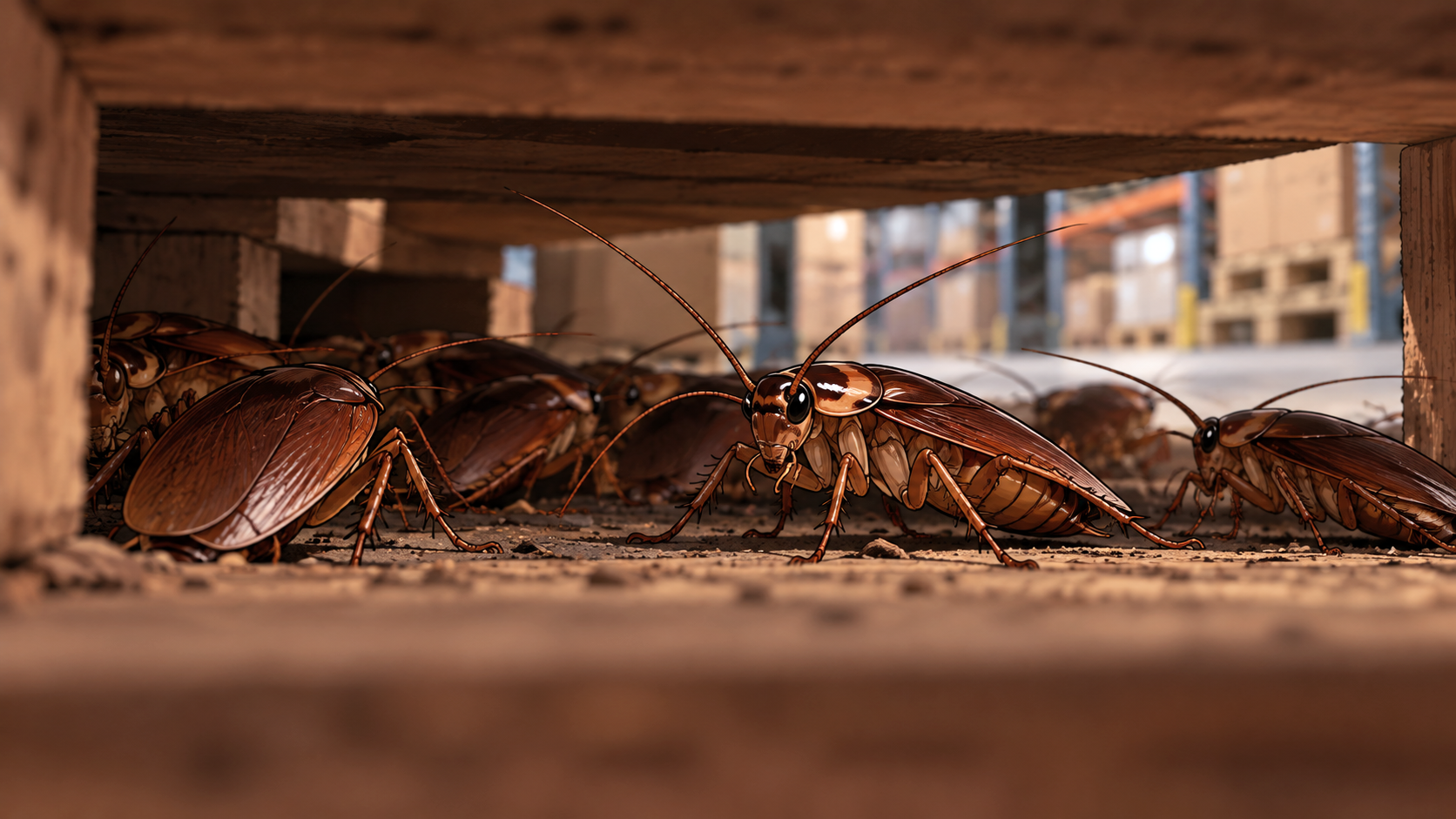
Cockroaches are not necessarily solitary insects. Many species live in groups, sharing shelters and responding to chemical signals left by other cockroaches. German cockroaches are particularly social, often resting together in groups containing adults and nymphs. However, these gatherings are not organized colonies like those of ants or termites, with specialized worker and soldier castes.
Biologists describe this behavior as aggregation or gregariousness. Cockroaches can influence one another’s decisions about where to settle, remain sheltered, or find food without relying on a permanent colony hierarchy. Other species are less strongly social, so finding a cockroach alone does not necessarily mean more are nearby.
What Makes a Cockroach Group Different From a Colony?
The word colony is sometimes used loosely for a population of cockroaches occupying the same building or laboratory enclosure. In behavioral biology, however, an aggregation is different from a eusocial colony.
| Characteristic | Cockroach aggregation | Eusocial insect colony |
|---|---|---|
| Shared resting space | Common | Common |
| Chemical communication | Present in many species | Common |
| Specialized worker caste | Generally absent | Characteristic of many species |
| Soldier caste | Absent in ordinary cockroaches | Present in termites and some ants |
| Division of reproductive labor | No permanent caste-based division | Central feature |
| Group decisions | Can emerge from individual interactions | Can involve specialized roles and coordinated activity |
German cockroach populations can contain numerous reproductive adults and immature individuals living together. They are not divided into permanent jobs, and no individual needs to direct the others.
Researchers studying collective shelter selection in German cockroaches demonstrated that group decisions can emerge through simple interactions among individuals without a leader. The insects followed local behavioral rules that collectively favored particular shelters.
This form of organization is simpler than a termite society but more complex than unrelated insects accidentally occupying the same space. The absence of a specialized queen among ordinary cockroaches reflects one important difference between their groups and eusocial colonies.
German Cockroaches Prefer the Company of Other Cockroaches
German cockroaches (Blattella germanica) provide some of the strongest evidence of social grouping among household pest species. Individuals frequently share resting shelters, and their attraction to one another can influence where an entire group settles.
In experiments involving identical shelters, German cockroach nymphs tended to gather in one location rather than distribute themselves evenly. The 2004 study of aggregation and group odors found that this occurred even when the available shelters were equally suitable.
The result cannot be explained solely by the physical qualities of the chosen location. Social attraction made an already occupied shelter more likely to attract additional cockroaches.
Groups can contain different developmental stages. Young nymphs and adults may share the same general resting area, although their preferences are not necessarily identical. Researchers investigating shelter choices among cockroaches of different ages found that the presence of adults could change which shelter nymphs preferred.
The final distribution therefore depends on both environmental conditions and the identities of the insects already present. A shelter suitable for one cockroach may become particularly attractive when others occupy it, provided crowding does not outweigh the benefits.
Chemical Signals Help Cockroaches Stay Together
Much of German cockroach aggregation depends on chemical information rather than direct visual contact.
Their feces contain substances that attract other cockroaches and encourage them to remain near previously occupied locations. These aggregation signals include volatile carboxylic acids associated with bacteria living in the insects’ digestive systems.
In a 2015 study published in Proceedings of the National Academy of Sciences, researchers compared feces from ordinary German cockroaches with feces from insects raised without the usual gut microorganisms. The bacteria-free material was substantially less attractive.
The research on bacterial contributions to cockroach aggregation signals identified numerous volatile compounds and showed that introducing bacteria could restore the attractiveness of previously bacteria-free fecal material.
These findings help explain why cockroaches can continue favoring an established resting area even when the insects occupying it change. Chemical information associated with previous occupants can remain available.
Cockroaches also detect chemicals on one another’s body surfaces. Such contact signals provide information about nearby individuals and can influence whether they remain together.
This communication is not equivalent to issuing commands. A chemical signal changes the probability that another cockroach will approach or stay; it does not force every insect to respond identically.
Can Cockroaches Recognize Members of Their Own Family?
German cockroaches can distinguish siblings from unrelated individuals using chemical characteristics of their body surfaces.
A study published in Behavioral Ecology found that both nymphs and adults discriminated between siblings and nonsiblings, even without previous social experience with those particular individuals.
The research on kin recognition through cuticular hydrocarbons identified chemical differences that cockroaches detected through antennal contact. Individuals tended to prefer siblings as social companions, whereas unrelated individuals were preferred in mating contexts.
These responses indicate that cockroach social behavior can be influenced by genetic relatedness, not just physical proximity.
Nevertheless, an aggregation should not be assumed to contain one family. German cockroach groups can include individuals from different families, and chemical recognition does not establish a permanent family structure in which parents consistently supervise their offspring.
The different reproductive outputs of female cockroaches also mean that a group containing many young insects need not originate from a single female.
Cockroaches Make Better Shelter Choices in Groups
Grouping can improve the quality of decisions made by individual cockroaches.
In experiments published in PLOS ONE, researchers offered German cockroaches shelters of different quality. Groups were better at selecting favorable shelters than isolated individuals. The study of public information in cockroach shelter selection found that insects benefited from information provided by the behavior of others.
An individual does not need to inspect every possible shelter personally. When other cockroaches remain in a particular location, their presence can influence whether a newcomer settles there.
However, social attraction has limits. Competition for space can become important when shelters are crowded. Experiments examining cockroach groups in fragmented habitats found that distributing available shelter among smaller spaces could prevent individuals from gathering into one cohesive group.
Consequently, an infestation may form several separate aggregations rather than one large gathering. The number and distribution of groups can change as available space and population density change.
Do Cockroaches Feed Together?
German cockroaches can influence one another’s feeding behavior, although they do not organize collective food collection in the manner of some ants.
Researchers tested whether cockroaches responded to odors associated with other individuals that were feeding. In a controlled experiment, the insects preferred odors from feeding cockroaches over a combination of food odor and nonfeeding cockroach odor.
The 2011 study of feeding aggregations demonstrated that cockroaches can use information about nearby individuals when selecting food sources.
This behavior is known as local enhancement. The presence or activity of other individuals increases the likelihood that a cockroach will investigate or remain at a particular resource.
It does not establish that one cockroach deliberately guides another to food. Individuals can respond to incidental cues produced by nearby feeding activity without communicating a specific destination.
Such interactions can influence the distribution of cockroaches during feeding, but they do not imply that every individual always feeds with companions.
Do All Cockroach Species Prefer Living in Groups?
Social grouping varies across the cockroach order. German cockroaches are well studied because their aggregation behavior is pronounced, but their social structure should not be treated as representative of every species.
Some cockroaches live in family groups with prolonged parental contact. Wood-feeding cockroaches in the genus Cryptocercus, for example, remain in family associations within decaying wood. Their offspring depend on their parents for nutritional assistance involving specialized gut microorganisms.
Research on parental care and family living in Cryptocercus describes the unusually close associations between parents and developing offspring. These insects demonstrate that cockroach social relationships can extend beyond temporary aggregation.
Other cockroaches are encountered individually for substantial periods, particularly while exploring, feeding, or occupying separate shelters. Solitary observations do not necessarily indicate that the species lacks social behavior altogether.
A single American cockroach entering a building, for instance, cannot establish whether other members of its species are present. Nor does it demonstrate that the individual normally lives alone.
Differences in habitat, developmental stage, and species biology all influence whether cockroaches gather or remain separated.
Does Finding One Cockroach Mean There Are More?
One cockroach does not prove that a group is present. The interpretation depends on whether the species commonly establishes indoor populations and whether additional evidence of repeated activity exists.
German cockroaches frequently form indoor aggregations, so repeated encounters with them may reflect a population occupying nearby shelter. Larger outdoor species can enter buildings individually without establishing a resident group.
Even when several cockroaches are present, they may occupy separate locations rather than gather in one accessible space. Their movement between rooms and connected structures means the distribution of visible insects may change over time.
Finding multiple cockroaches together provides evidence of aggregation, particularly when they remain close rather than merely crossing the same area. However, determining whether the group is actively occupying a location requires additional observations. The physical evidence associated with an established cockroach harborage can help distinguish sustained occupation from a temporary gathering.
The University of California’s cockroach management guidance also emphasizes species identification and monitoring because the presence of one insect cannot reliably establish the size or distribution of a population.